5 Min Read
Webb Watches Carbon-Rich Dust Shells Form, Expand in Star System
NASA, ESA, CSA, STScI; Science: Emma Lieb (University of Denver), Ryan Lau (NSF NOIRLab), Jennifer Hoffman (University of Denver)
Astronomers have long tried to track down how elements like carbon, which is essential for life, become widely distributed across the universe. Now, NASA’s James Webb Space Telescope has examined one ongoing source of carbon-rich dust in our own Milky Way galaxy in greater detail: Wolf-Rayet 140, a system of two massive stars that follow a tight, elongated orbit.
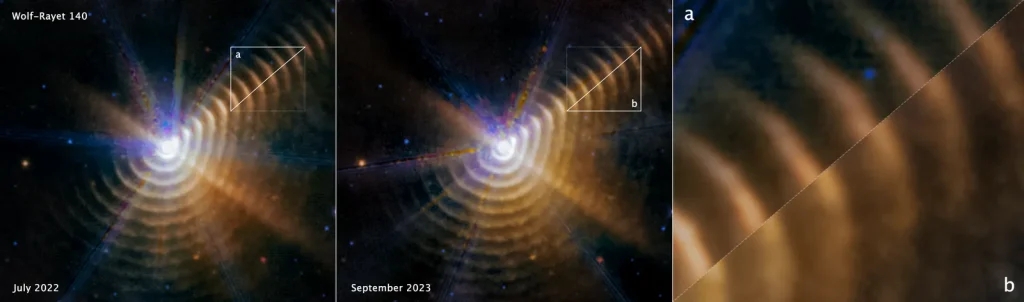
As they swing past one another (within the central white dot in the Webb images), the stellar winds from each star slam together, the material compresses, and carbon-rich dust forms. Webb’s latest observations show 17 dust shells shining in mid-infrared light that are expanding at regular intervals into the surrounding space.
Image: Compare Observations of Wolf-Rayet 140 (MIRI Images)
“The telescope not only confirmed that these dust shells are real, its data also showed that the dust shells are moving outward at consistent velocities, revealing visible changes over incredibly short periods of time,” said Emma Lieb, the lead author of the new paper and a doctoral student at the University of Denver in Colorado.
Every shell is racing away from the stars at more than 1,600 miles per second (2,600 kilometers per second), almost 1% the speed of light. “We are used to thinking about events in space taking place slowly, over millions or billions of years,” added Jennifer Hoffman, a co-author and a professor at the University of Denver. “In this system, the observatory is showing that the dust shells are expanding from one year to the next.”
Like clockwork, the stars’ winds generate dust for several months every eight years, as the pair make their closest approach during a wide, elongated orbit. Webb also shows how dust formation varies — look for the darker region at top left in both images.
Video: Fade Between 2022 and 2023 Observations of Wolf-Rayet 140
Video: Stars’ Orbits in Wolf-Rayet 140 (Visualization)
The telescope’s mid-infrared images detected shells that have persisted for more than 130 years. (Older shells have dissipated enough that they are now too dim to detect.) The researchers speculate that the stars will ultimately generate tens of thousands of dust shells over hundreds of thousands of years.
“Mid-infrared observations are absolutely crucial for this analysis, since the dust in this system is fairly cool. Near-infrared and visible light would only show the shells that are closest to the star,” explained Ryan Lau, a co-author and astronomer at NSF NOIRLab in Tuscon, Arizona, who led the initial research about this system. “With these incredible new details, the telescope is also allowing us to study exactly when the stars are forming dust — almost to the day.”
The dust’s distribution isn’t uniform. Though this isn’t obvious at first glance, zooming in on the shells in Webb’s images reveals that some of the dust has “piled up,” forming amorphous, delicate clouds that are as large as our entire solar system. Many other individual dust particles float freely. Every speck is as small as one-hundredth the width of a human hair. Clumpy or not, all of the dust moves at the same speed and is carbon rich.
The Future of This System
What will happen to these stars over millions or billions of years, after they are finished “spraying” their surroundings with dust? The Wolf-Rayet star in this system is 10 times more massive than the Sun and nearing the end of its life. In its final “act,” this star will either explode as a supernova — possibly blasting away some or all of the dust shells — or collapse into a black hole, which would leave the dust shells intact.
Though no one can predict with any certainty what will happen, researchers are rooting for the black hole scenario. “A major question in astronomy is, where does all the dust in the universe come from?” Lau said. “If carbon-rich dust like this survives, it could help us begin to answer that question.”
“We know carbon is necessary for the formation of rocky planets and solar systems like ours,” Hoffman added. “It’s exciting to get a glimpse into how binary star systems not only create carbon-rich dust, but also propel it into our galactic neighborhood.”
These results have been published in The Astrophysical Journal Letters and were presented in a press conference at the 245th meeting of the American Astronomical Society in National Harbor, Maryland.
The James Webb Space Telescope is the world’s premier space science observatory. Webb will solve mysteries in our solar system, look beyond to distant worlds around other stars, and probe the mysterious structures and origins of our universe and our place in it. Webb is an international program led by NASA with its partners, ESA (European Space Agency) and the Canadian Space Agency.
Downloads & Related Information
The following sections contain links to download this article’s images and videos in all available resolutions followed by related information links, media contacts, and if available, research paper and Spanish translation links.
Related Images & Videos
Compare Observations of Wolf-Rayet 140 (MIRI Images)
Watch dust move in space! Compare the two mid-infrared images taken by the James Webb Space Telescope of Wolf-Rayet 140, a system of dust shells ejected by two massive stars that are in an elongated orbit. Look to the top right of the first two images. Two triangles are matched…
Wolf-Rayet 140 (MIRI Compass Image)
This 2023 image of Wolf-Rayet 140, a system of dust shells ejected by two massive stars at the center, was captured by the James Webb Space Telescope’s MIRI (Mid-Infrared Instrument). The image shows a scale bar, compass arrows, and color key for reference. The scale bar is…
Fade Between 2022 and 2023 Observations of Wolf-Rayet 140
This video alternates between two James Webb Space Telescope observations of Wolf-Rayet 140, a two-star system that has sent out more than 17 shells of dust over 130 years. Mid-infrared light observations highlight them with excellent clarity. By comparing this pair of…
Stars’ Orbits in Wolf-Rayet 140 (Visualization)
When the two massive stars in Wolf-Rayet 140 swing past one another, their winds collide, material compresses, and carbon-rich dust forms. The stronger winds of the hotter Wolf-Rayet star blow behind its slightly cooler (but still hot) companion. The stars create dust for…
Related Links
Webb Blog: Learn more about WR 140
Infographic: Choose your path: Destiny of Dust
SVS Graphic: Periodic Table of the Elements: Origins of the Elements
Share
Details
Last Updated
Sep 21, 2026
LocationNASA Goddard Space Flight Center
Contact
Media
Laura Betz
NASA’s Goddard Space Flight Center
Greenbelt, Maryland
laura.e.betz@nasa.gov
Claire Blome
Space Telescope Science Institute
Baltimore, Maryland
Christine Pulliam
Space Telescope Science Institute
Baltimore, Maryland
Science
Emma Lieb (University of Denver)
Related Terms
- James Webb Space Telescope (JWST)
- Astrophysics
- Binary Stars
- Goddard Space Flight Center
- Nebulae
- Science & Research
- Stars
- The Milky Way
- The Universe
Related Links and Documents
- Dynamic Imprints of Colliding-wind Dust Formation from WR 140
- 3D Print Files of Wolf-Rayet 140
- Noticias en español: Webb observa cómo se forman y expanden capas de polvo rico en carbono en un sistema estelar, PDF (374.06 KB)
Keep Exploring
Related Topics
James Webb Space Telescope
Webb is the premier observatory of the next decade, serving thousands of astronomers worldwide. It studies every phase in the…
Stars
Stars Stories
Universe
Source: NASA Science