2 min read
Hubble Spots a Supernova
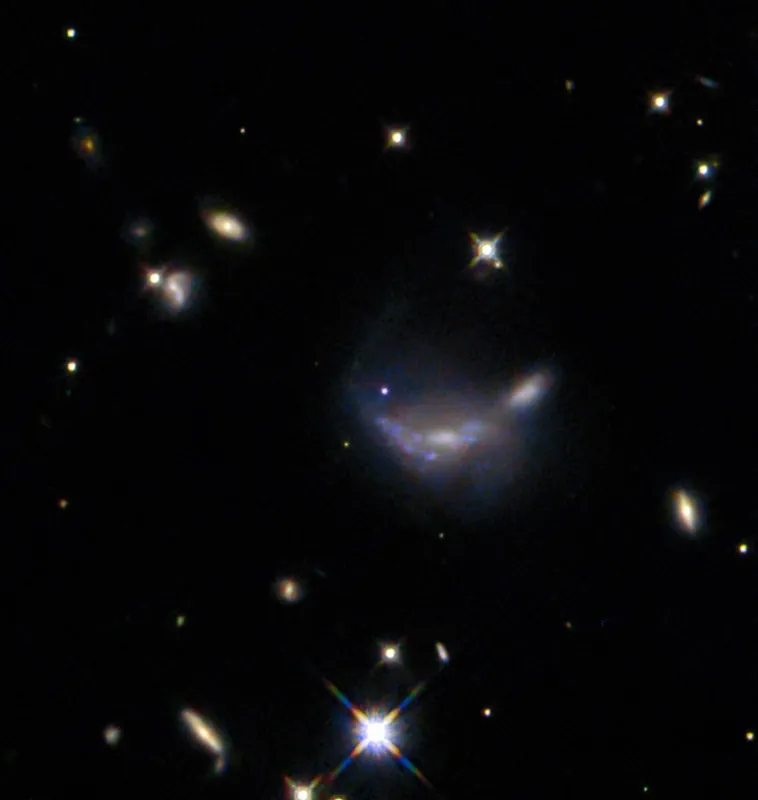
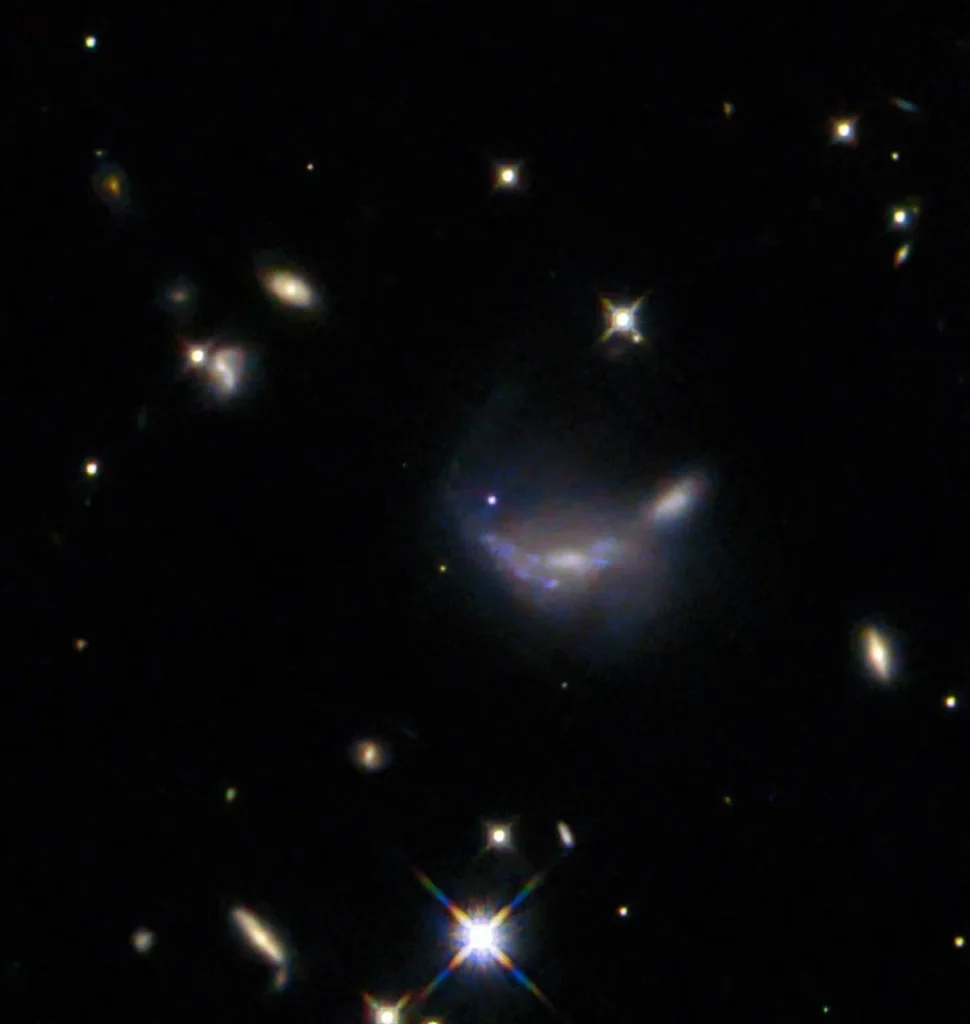
The subject of this NASA/ESA Hubble Space Telescope image is a supernova-hosting galaxy located about 600 million light-years away in the constellation Gemini. Hubble captured this image roughly two months after a supernova named SN 2022aajn was discovered. The supernova is visible as a blue dot at the center of the image, brightening the hazy body of the galaxy.
Other than the announcement of its discovery in November 2022, SN 2022aajn has never been the subject of published research. Why then would Hubble observe this supernova? SN 2022aajn is what’s known as a Type Ia supernova, which results from the explosion of the core of a dead star. Supernovae of this type help astronomers measure the distance to faraway galaxies. This is possible because Type Ia supernovae have the same intrinsic luminosity — no matter how bright they seem from Earth, they put out the same amount of light as other Type Ia supernovae. By comparing the observed brightness to the known intrinsic brightness, researchers can calculate the distance to the supernova and its host galaxy.
This seemingly simple way of measuring distances is complicated by cosmic dust. The farther away a supernova is, the fainter and redder it will appear — but intergalactic dust can make a supernova appear fainter and redder as well. To understand this complication, researchers will use Hubble to survey a total of 100 Type Ia supernovae in seven wavelength bands from ultraviolet to near-infrared. This image combines data taken at four infrared wavelengths. Infrared light passes through dust more easily than visible or ultraviolet light. By comparing the brightness of the sampled supernovae across different wavelengths, researchers can disentangle the effects of dust and distance, helping to improve measurements of galaxies billions of light-years away.
@NASAHubble
@NASAHubble
@NASAHubble
Explore More
The Death Throes of Stars
Homing in on Cosmic Explosions
Media Contact:
Claire Andreoli (claire.andreoli@nasa.gov)NASA’s Goddard Space Flight Center, Greenbelt, MD
Share
Details
Last Updated
Mar 28, 2025
EditorAndrea GianopoulosLocationNASA Goddard Space Flight Center
Related Terms
- Hubble Space Telescope
- Astrophysics
- Astrophysics Division
- Galaxies
- Goddard Space Flight Center
- Stars
- Supernovae
Keep Exploring
Discover More Topics From Hubble
Hubble Space Telescope
Since its 1990 launch, the Hubble Space Telescope has changed our fundamental understanding of the universe.
Hubble’s Night Sky Challenge
Reshaping Our Cosmic View: Hubble Science Highlights
Hubble’s 35th Anniversary
Source: NASA Science