5 Min Read
Webb Reveals Rapid-Fire Light Show From Milky Way’s Central Black Hole
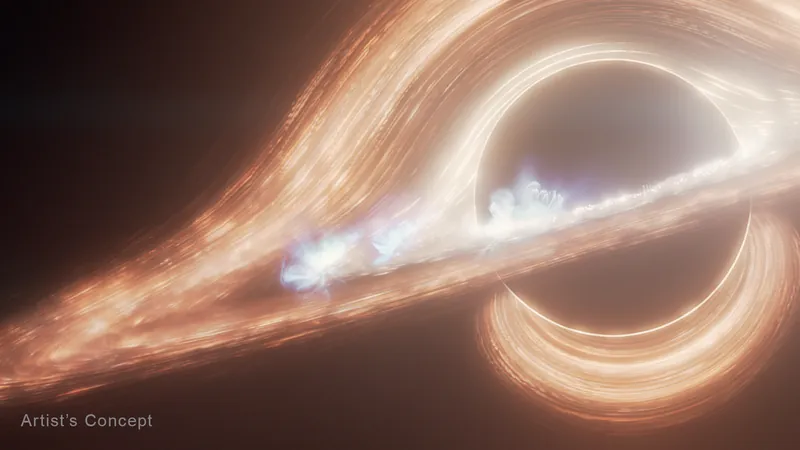
Illustration: NASA, ESA, CSA, Ralf Crawford (STScI)
The supermassive black hole at the center of the Milky Way appears to be having a party, complete with a disco ball-style light show. Using NASA’s James Webb Space Telescope, a team of astrophysicists has gained the longest, most detailed glimpse yet of the “void” that lurks in the middle of our galaxy.
They found that the swirling disk of gas and dust (or accretion disk) orbiting the central supermassive black hole, called Sagittarius A*, is emitting a constant stream of flares with no periods of rest. The level of activity occurs over a wide range of time — from short interludes to long stretches. While some flares are faint flickers, lasting mere seconds, other flares are blindingly bright eruptions, which spew daily. There also are even fainter changes that surge over months.
The new findings could help physicists better understand the fundamental nature of black holes, how they get fed from their surrounding environments, and the dynamics and evolution of our own galaxy.
The study published in the Feb. 18 issue of The Astrophysical Journal Letters.
“In our data, we saw constantly changing, bubbling brightness,” said Farhad Yusef-Zadeh of Northwestern University in Illinois, who led the study. “And then boom! A big burst of brightness suddenly popped up. Then, it calmed down again. We couldn’t find a pattern in this activity. It appears to be random. The activity profile of this black hole was new and exciting every time that we looked at it.”
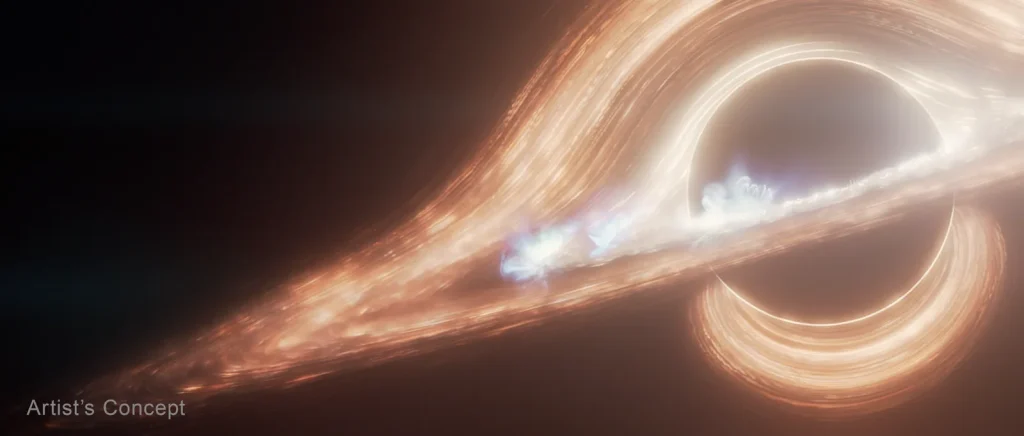
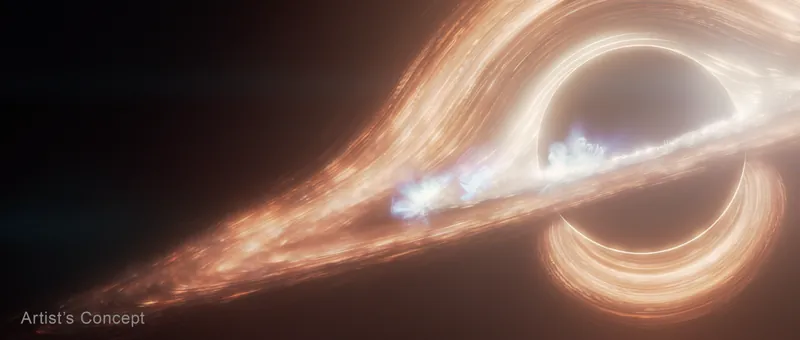
Image: Flaring Disk Around Milky Way’s Black Hole (Artist’s Concept)
Random Fireworks
To conduct the study, Yusef-Zadeh and his team used Webb’s NIRCam (Near-Infrared Camera) to observe Sagittarius A* for a total of 48 hours in 8- to 10-hour increments across one year. This enabled them to track how the black hole changed over time.
While the team expected to see flares, Sagittarius A* was more active than they anticipated. The observations revealed ongoing fireworks of various brightnesses and durations. The accretion disk surrounding the black hole generated five to six big flares per day and several small sub-flares or bursts in between.
Two Separate Processes at Play
Although astrophysicists do not yet fully understand the processes at play, Yusef-Zadeh suspects two separate processes are responsible for the short bursts and longer flares. He posits that minor disturbances within the accretion disk likely generate the faint flickers. Specifically, turbulent fluctuations within the disk can compress plasma (a hot, electrically charged gas) to cause a temporary burst of radiation. Yusef-Zadeh likens these events to solar flares.
“It’s similar to how the Sun’s magnetic field gathers, compresses, and then erupts a solar flare,” he explained. “Of course, the processes are more dramatic because the environment around a black hole is much more energetic and much more extreme. But the Sun’s surface also bubbles with activity.”
Yusef-Zadeh attributes the big, bright flares to occasional magnetic reconnection events — a process where two magnetic fields collide, releasing energy in the form of accelerated particles. Traveling at velocities near the speed of light, these particles emit bright bursts of radiation.
“A magnetic reconnection event is like a spark of static electricity, which, in a sense, also is an ‘electric reconnection,’ ” Yusef-Zadeh said.
Dual ‘Vision’
Because Webb’s NIRCam can observe two separate wavelengths at the same time (2.1 and 4.8 microns in the case of these observations), Yusef-Zadeh and his collaborators were able to compare how the flares’ brightness changed with each wavelength. Yet again, the researchers were met with a surprise. They discovered events observed at the shorter wavelength changed brightness slightly before the longer-wavelength events.
“This is the first time we have seen a time delay in measurements at these wavelengths,” Yusef-Zadeh said. “We observed these wavelengths simultaneously with NIRCam and noticed the longer wavelength lags behind the shorter one by a very small amount — maybe a few seconds to 40 seconds.”
This time delay provided more clues about the physical processes occurring around the black hole. One explanation is that the particles lose energy over the course of the flare — losing energy quicker at shorter wavelengths than at longer wavelengths. Such changes are expected for particles spiraling around magnetic field lines.
Aiming for an Uninterrupted Look
To further explore these questions, Yusef-Zadeh and his team hope to use Webb to observe Sagittarius A* for a longer period of time, such as 24 uninterrupted hours, to help reduce noise and enable the researchers to see even finer details.
“When you are looking at such weak flaring events, you have to compete with noise,” Yusef-Zadeh said. “If we can observe for 24 hours, then we can reduce the noise to see features that we were unable to see before. That would be amazing. We also can see if these flares repeat themselves or if they are truly random.”
The James Webb Space Telescope is the world’s premier space science observatory. Webb is solving mysteries in our solar system, looking beyond to distant worlds around other stars, and probing the mysterious structures and origins of our universe and our place in it. Webb is an international program led by NASA with its partners, ESA (European Space Agency) and CSA (Canadian Space Agency).
Downloads & Related Information
The following sections contain links to download this article’s images and videos in all available resolutions followed by related information links, media contacts, and if available, research paper and Spanish translation links.
Related Images & Videos
Flaring Disk Around Milky Way’s Black Hole (Artist’s Concept)
This artist’s concept portrays the supermassive black hole at the center of the Milky Way galaxy, known as Sagittarius A* (A-star). It’s surrounded by a swirling accretion disk of hot gas. The black hole’s gravity bends light from the far side of the disk, making it appear to…
Infrared Flickers and Flares from Sagittarius A*
This timelapse video compresses about 9 hours of infrared observations by NASA’s James Webb Space Telescope into 30 seconds. Webb observed the black hole at the center of the Milky Way, known as Sagittarius A* (A-star). Webb detected both faint flickers and brighter flares (one…
Observations and Light Curve of Sagittarius A*
This timelapse video shows observations of the Milky Way’s central black hole, known as Sagittarius A* (A-star), by NASA’s James Webb Space Telescope. At left, NIRCam (Near-Infrared Camera) images, created by combining data at wavelengths of 2.1 and 4.8 microns, show a point of…
Related Links
Article: Learn more about telescope images of the Milky Way’s black hole
Video: Sizing up different black hole masses
Interactive: Learn about the stars that orbit around Sagittarius A*
Black Hole Resources from NASA’s Universe of Learning
Share
Details
Last Updated
Sep 21, 2026
LocationNASA Goddard Space Flight Center
Contact
Media
Laura Betz
NASA’s Goddard Space Flight Center
Greenbelt, Maryland
laura.e.betz@nasa.gov
Amanda Morris
Northwestern University
Evanston, Illinois
Christine Pulliam
Space Telescope Science Institute
Baltimore, Maryland
Science
Farhad Yusef-Zadeh (Northwestern)
Related Terms
- James Webb Space Telescope (JWST)
- Astrophysics
- Black Holes
- Galaxies, Stars, & Black Holes
- Goddard Space Flight Center
- Science & Research
- Supermassive Black Holes
- The Milky Way
- The Universe
Related Links and Documents
- Northwestern University Press Release
- Noticias en español: El telescopio Webb revela un espectáculo de luces de gran velocidad procedente del agujero negro central de la Vía Láctea, PDF (372.49 KB)
Keep Exploring
Related Topics
James Webb Space Telescope
Webb is the premier observatory of the next decade, serving thousands of astronomers worldwide. It studies every phase in the…
Universe
Black Holes
Galaxies
Source: NASA Science