4 Min Read
NASA’s Webb Reveals New Details, Mysteries in Jupiter’s Aurora
NASA, ESA, CSA, Jonathan Nichols (University of Leicester), Mahdi Zamani (ESA/Webb)
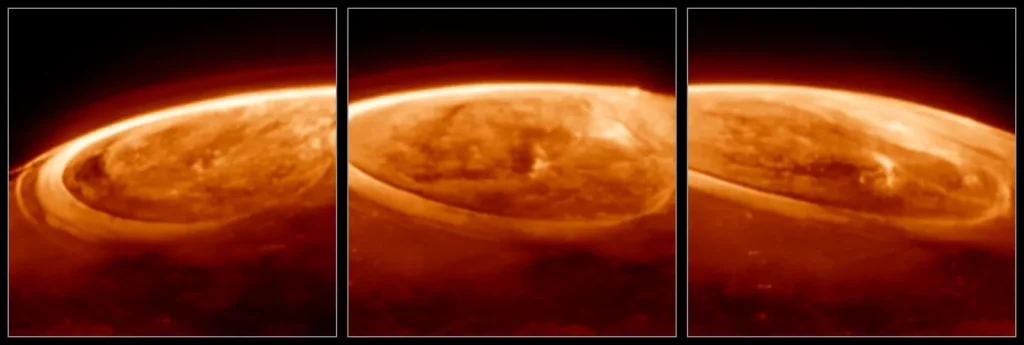
NASA’s James Webb Space Telescope has captured new details of the auroras on our solar system’s largest planet. The dancing lights observed on Jupiter are hundreds of times brighter than those seen on Earth. With Webb’s advanced sensitivity, astronomers have studied the phenomena to better understand Jupiter’s magnetosphere.
Auroras are created when high-energy particles enter a planet’s atmosphere near its magnetic poles and collide with atoms or molecules of gas. On Earth these are known as the Northern and Southern Lights. Not only are the auroras on Jupiter huge in size, they are also hundreds of times more energetic than those in Earth’s atmosphere. Earth’s auroras are caused by solar storms — when charged particles from the Sun rain down on the upper atmosphere, energize gases, and cause them to glow in shades of red, green and purple.
Image A: Close-up Observations of Auroras on Jupiter
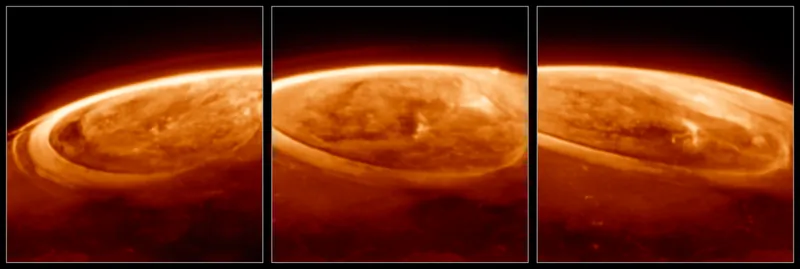
Now, Webb’s unique capabilities are providing new insights into the auroras on Jupiter. The telescope’s sensitivity allows astronomers to capture fast-varying auroral features. New data was captured with Webb’s NIRCam (Near-Infrared Camera) Dec. 25, 2023, by a team of scientists led by Jonathan Nichols from the University of Leicester in the United Kingdom.
“What a Christmas present it was – it just blew me away!” shared Nichols. “We wanted to see how quickly the auroras change, expecting them to fade in and out ponderously, perhaps over a quarter of an hour or so. Instead, we observed the whole auroral region fizzing and popping with light, sometimes varying by the second.”
In particular, the team studied emission from the trihydrogen cation (H3+), which can be created in auroras. They found that this emission is far more variable than previously believed. The observations will help develop scientists’ understanding of how Jupiter’s upper atmosphere is heated and cooled.
The team also uncovered some unexplained observations in their data.
“What made these observations even more special is that we also took pictures simultaneously in the ultraviolet with NASA’s Hubble Space Telescope,” added Nichols. “Bizarrely, the brightest light observed by Webb had no real counterpart in Hubble’s pictures. This has left us scratching our heads. In order to cause the combination of brightness seen by both Webb and Hubble, we need to have a combination of high quantities of very low-energy particles hitting the atmosphere, which was previously thought to be impossible. We still don’t understand how this happens.”
Video: Webb Captures Jupiter’s Aurora
The team now plans to study this discrepancy between the Hubble and Webb data and to explore the wider implications for Jupiter’s atmosphere and space environment. They also intend to follow up this research with more Webb observations, which they can compare with data from NASA’s Juno spacecraft to better explore the cause of the enigmatic bright emission.
These results were published today in the journal Nature Communications.
The James Webb Space Telescope is the world’s premier space science observatory. Webb is solving mysteries in our solar system, looking beyond to distant worlds around other stars, and probing the mysterious structures and origins of our universe and our place in it. Webb is an international program led by NASA with its partners, ESA (European Space Agency) and CSA (Canadian Space Agency).
Downloads & Related Information
The following sections contain links to download this article’s images and videos in all available resolutions followed by related information links, media contacts, and if available, research paper and Spanish translation links.
Related Images & Videos
Close-up Observations of Auroras on Jupiter
These observations of Jupiter’s auroras, taken at a wavelength of 3.36 microns (F335M) were captured with Webb’s NIRCam (Near-Infrared Camera). Scientists found that the emission from trihydrogen cation, known as H3+, is far more variable than previously believed.
Pullout of Aurora Observations on Jupiter (NIRCam Image)
At left: Observations of Jupiter’s auroras at 3.36 microns, showing emission from trihydrogen cation. At right: A image of the planet Jupiter, released in 2023, to indicate the location of the observed auroras.
Pullout of Aurora Observations on Jupiter
NASA’s James Webb Space Telescope has captured new details of the auroras on our solar system’s largest planet. The dancing lights observed on Jupiter are hundreds of times brighter than those seen on Earth. These observations of Jupiter’s auroras (shown on the left of the above…
Closeup Observations of Auroras on Jupiter
NASA’s James Webb Space Telescope has captured new details of the auroras on our solar system’s largest planet. The dancing lights observed on Jupiter are hundreds of times brighter than those seen on Earth. These observations of Jupiter’s auroras at a wavelength of 3.36 microns…
Related Links
Read more: NASA’s Webb Captures Neptune’s Auroras for the First Time
Share
Details
Last Updated
Sep 21, 2026
LocationNASA Goddard Space Flight Center
Contact
Media
Laura Betz
NASA’s Goddard Space Flight Center
Greenbelt, Maryland
laura.e.betz@nasa.gov
Bethany Downer
ESA/Webb
Baltimore, Maryland
Christine Pulliam
Space Telescope Science Institute
Baltimore, Maryland
Related Terms
- James Webb Space Telescope (JWST)
- Astrophysics
- Goddard Space Flight Center
- Jupiter
- Planets
- Science & Research
- The Solar System
Related Links and Documents
- The science paper by J. Nichols et al.
- The European Space Agency Press Release
- NASA’s Webb Captures Neptune’s Auroras For First Time
- Noticias en español: Webb revela nuevos detalles y misterios en las auroras de Júpiter, PDF (400.0 KB)
Keep Exploring
Related Topics
James Webb Space Telescope
Webb is the premier observatory of the next decade, serving thousands of astronomers worldwide. It studies every phase in the…
Jupiter
What Is the Solar Wind?
Juno
NASA’s Juno spacecraft has explored Jupiter, its moons, and rings since 2016, gathering breakthrough science and breathtaking imagery.
Source: NASA Science