1 min read
Hubble Spies Faint Irregular Galaxy
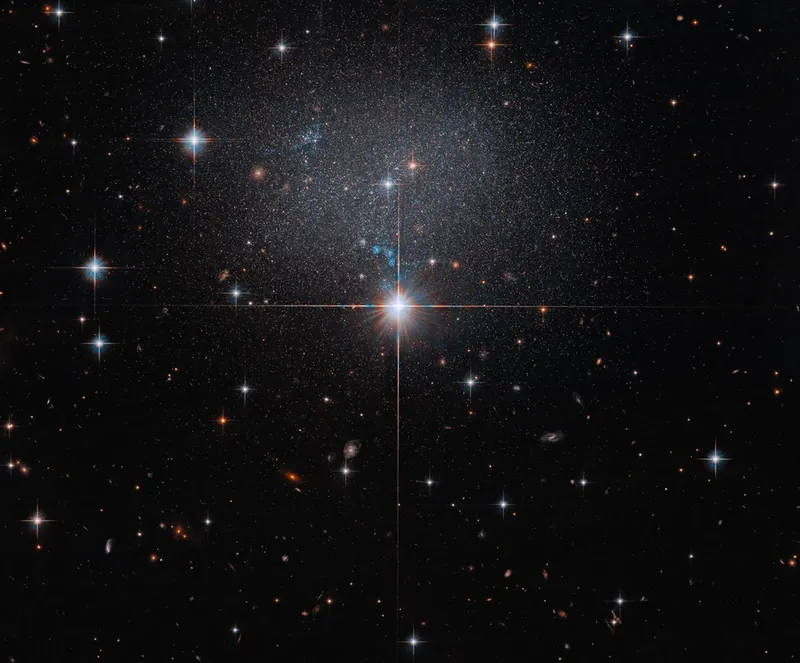
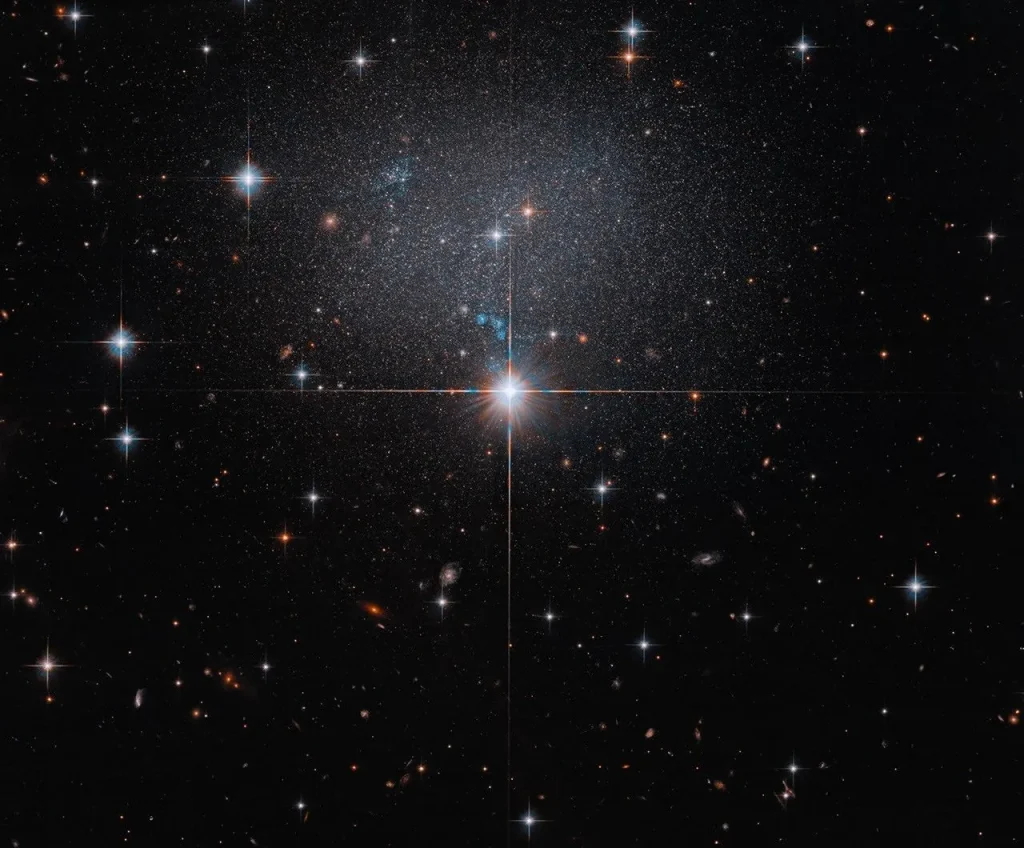
This NASA Hubble Space Telescope image features the dwarf irregular galaxy ESO 490-017, roughly 12,000 light-years in diameter and some 23 million light-years away in the constellation Canis Major. The galaxy’s low surface brightness makes it appear as a faint, starry swarm behind brighter foreground stars that are easily recognized by their diffraction spikes. Numerous red, orange, and beige dots are distant galaxies peppering the black background, many exhibiting distinct spiral structure.
The data in this image of ESO 490-017 was part of a Hubble observing program that looked at the movement of galaxies and galaxy clusters through space. Matter in the universe is distributed unevenly, and the gravitational influence of that matter drives the “cosmic flow” or movement of large-scale structures in the universe.
Hubble is uniquely capable of providing distances to nearby galaxies like ESO 490-017 by measuring the luminosities of low-mass red giant stars as “standard candles”. The observing program also provided a legacy archive of the types of stars in local galaxies.
@NASAHubble
@NASAHubble
@NASAHubble
Media Contact:
Claire AndreoliNASA’s Goddard Space Flight Center, Greenbelt, MDclaire.andreoli@nasa.gov
Share
Details
Last Updated
May 27, 2026
EditorAndrea GianopoulosLocationNASA Goddard Space Flight Center
Related Terms
Keep Exploring
Discover More Topics From Hubble
Hubble Space Telescope
Since its 1990 launch, the Hubble Space Telescope has changed our fundamental understanding of the universe.

Hubble’s Galaxies
Explore an assortment of galaxies with Hubble.
Hubble Science Highlights
Hubble’s most notable scientific discoveries reflect the broad range of research and the breakthroughs it has achieved.
Hubble Images
Explore Hubble’s iconic images of the universe, and view photos of mission operations and astronauts servicing Hubble in space.
Source: NASA Science