4 min read
What You Need to Know About the November 2022 Lunar Eclipse
To view this video please enable JavaScript, and consider upgrading to a web browser that
supports HTML5 video
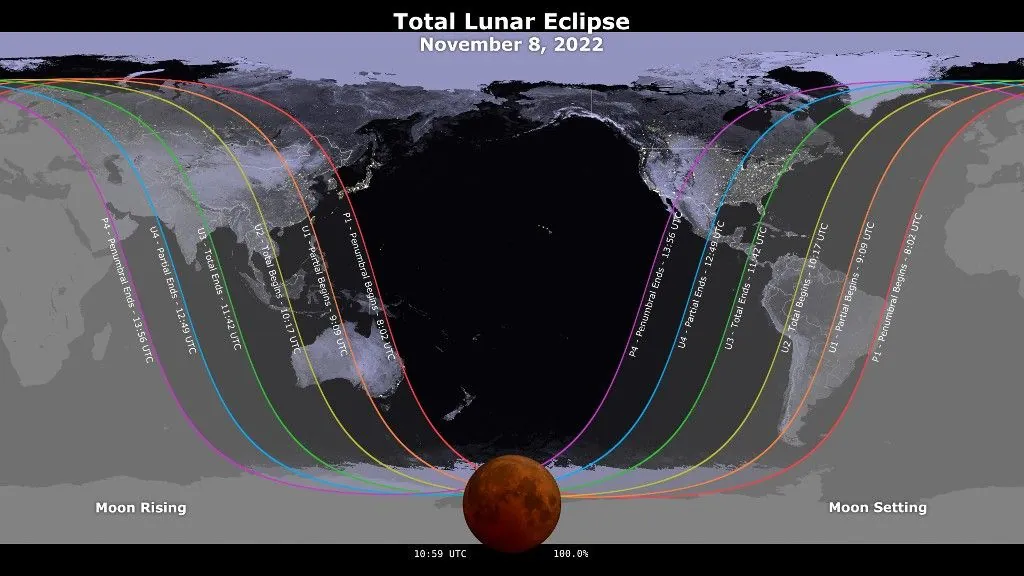
The Moon moves right to left, passing through the penumbra and umbra, leaving in its wake an eclipse diagram with the times at various stages of the eclipse. Times are shown in Coordinated Universal Time (UTC).
What’s special about the November 2022 lunar eclipse?
The last total lunar eclipse for three years occurs on November 8, 2022, with the next occurring on March 14, 2025 — though we will continue to see partial and penumbral lunar eclipses during that time.
A lunar eclipse occurs when the Sun, Earth, and Moon align so that the Moon passes into Earth’s shadow. In a total lunar eclipse, the entire Moon falls within the darkest part of Earth’s shadow, called the umbra. When the Moon is within the umbra, it will turn a reddish hue. Lunar eclipses are sometimes called “Blood Moons” because of this phenomenon.
How can I observe the eclipse?
You don’t need any special equipment to observe a lunar eclipse, although binoculars or a telescope will enhance the view and the red color. A dark environment away from bright lights makes for the best viewing conditions.
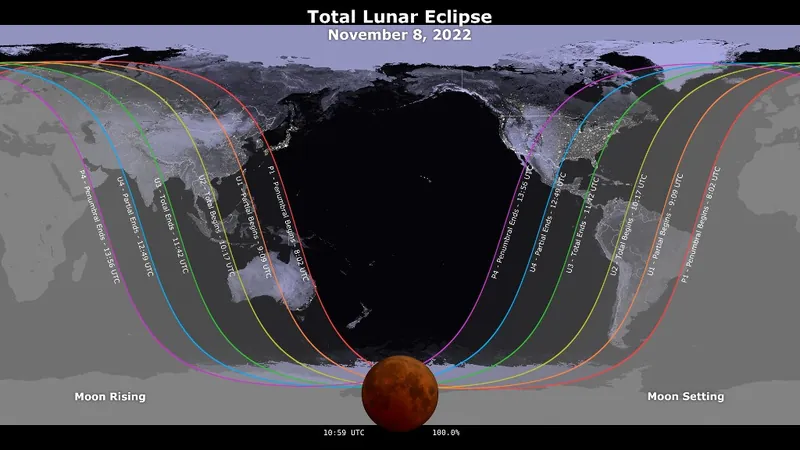
Totality ― the stage of the eclipse where the Moon is entirely in Earth’s shadow ― will be visible across North and Central America and in Ecuador, Colombia, and western portions of Venezuela and Peru. In Puerto Rico, the Moon sets just after totality begins. The eclipse is also visible in Asia, Australia, and New Zealand. Viewers in Alaska and Hawaii will have the opportunity to see every stage of the eclipse.
What if it’s cloudy or I’m not in the viewing region?
Join in online: Live Stream the November 8 Lunar Eclipse
You can also visit NASA’s Dial-a-Moon for a visualization of the eclipse.
What can I expect to observe?
What else can I see tonight?
The Moon will be in the constellation Aries. NASA provides a monthly skywatching tips series that will highlight additional targets to focus on in between monitoring the eclipse.
Why does the Moon turn red during a lunar eclipse?
The same phenomenon that makes our sky blue and our sunsets red causes the Moon to turn red during a lunar eclipse. It’s called Rayleigh scattering. Light travels in waves, and different colors of light have different physical properties. Blue light has a shorter wavelength and is scattered more easily by particles in Earth’s atmosphere than red light, which has a longer wavelength.
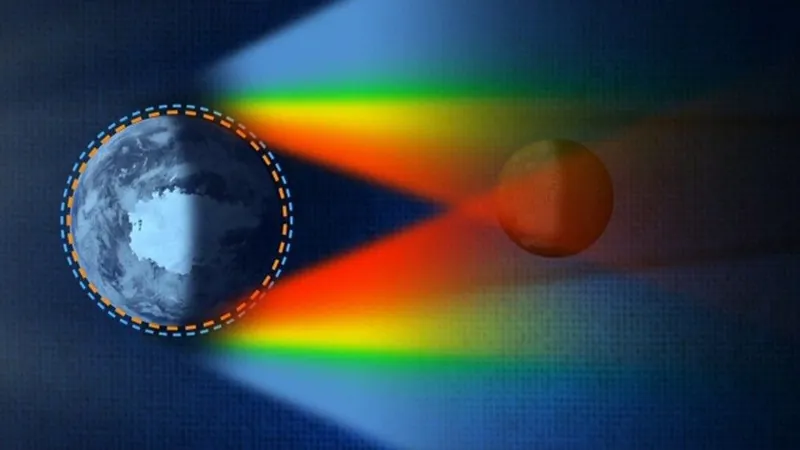
Red light, on the other hand, travels more directly through the atmosphere. When the Sun is overhead, we see blue light throughout the sky. But when the Sun is setting, sunlight must pass through more atmosphere and travel farther before reaching our eyes. The blue light from the Sun scatters away, and longer-wavelength red, orange, and yellow light pass through.
During a lunar eclipse, the Moon turns red because the only sunlight reaching the Moon passes through Earth’s atmosphere. The more dust or clouds in Earth’s atmosphere during the eclipse, the redder the Moon will appear. It’s as if all the world’s sunrises and sunsets are projected onto the Moon.
Share
Details
Last Updated
Oct 30, 2024
Related Terms
- Earth’s Moon
- Eclipses
- Lunar Eclipses
Explore More
3 min read
What’s Up: October 2026 Skywatching Tips from NASA
Article
21 hours ago
6 min read
NASA’s Moon Orbiter Spots New, ‘Once-in-Century’ Moon Crater
Article
2 weeks ago
3 min read
Celebrate International Observe the Moon Night with NASA
In April, the world watched as four humans circled the Moon for the first time…
Article
2 weeks ago
Keep Exploring
Discover More Topics From NASA
Earth
Your home. Our Mission. And the one planet that NASA studies more than any other.
Eclipses
Lunar Discovery and Exploration
Skywatching
Source: NASA Science