1 min read
Eclipse Resources for Learners and Educators: Connecting the Eclipse to Astrophysics
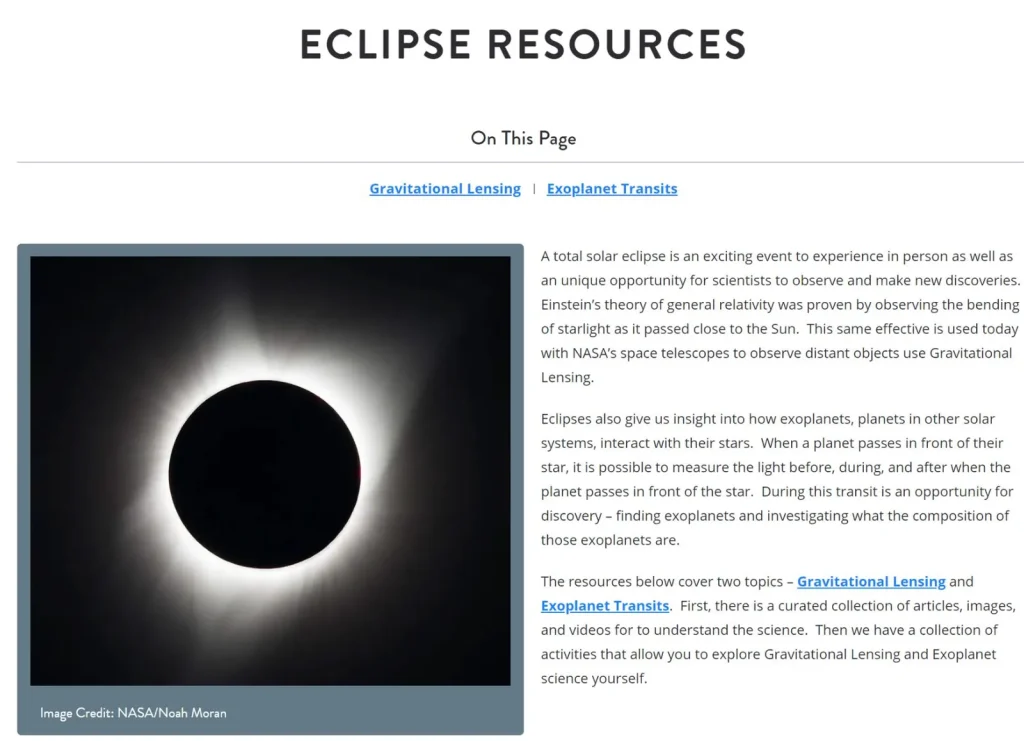
In anticipation of the upcoming total solar eclipse on April 8, 2024, NASA’s Universe of Learning has created a webpage of astrophysics-related eclipse resources for learners and educators. The webpage shares information about two topics that align with eclipse science: gravitational lensing and exoplanet transits. The collection of resources includes articles, images, and videos to understand and explain the science. Additional activities allow learners to explore gravitational lensing and exoplanet transit science for themselves.
NASA’s Universe of Learning is supported by NASA under cooperative agreement award number NNX16AC65A and is part of NASA’s Science Activation Portfolio. To learn more, visit: https://science.nasa.gov/sciact-team/universe-of-learning/
Share
Details
Last Updated
Jun 21, 2024
EditorNASA Science Editorial Team
Related Terms
Explore More
6 min read
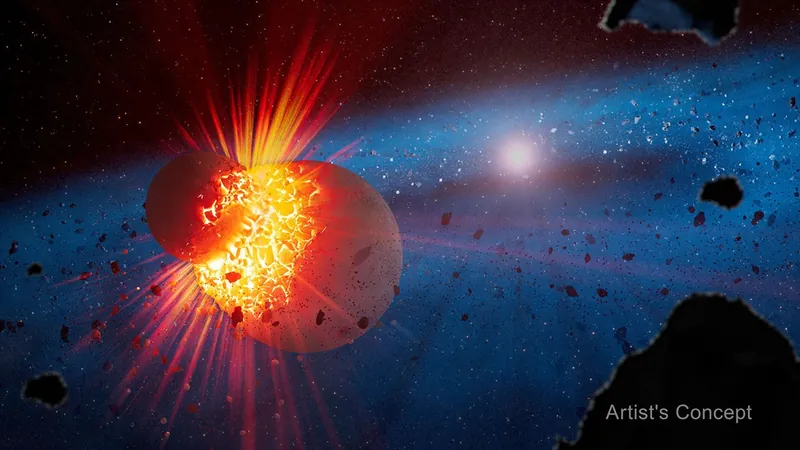
NASA’s Webb Provides Crash Course on Planet-Shattering Collisions
Article
1 day ago
2 min read
NASA Opens Applications for Second Season of ORBIT Student Challenge
Following a successful inaugural year of ingenuity and career building, NASA ORBIT (Opportunities in Research,…
Article
3 days ago
6 min read
NASA Highlights Lessons Learned From Swift Boost Mission
A commercial mission to boost NASA’s Swift observatory concluded without raising the spacecraft’s orbit, but…
Article
4 days ago
Keep Exploring
Discover More Topics From NASA
James Webb Space Telescope
Webb is the premier observatory of the next decade, serving thousands of astronomers worldwide. It studies every phase in the…
Perseverance Rover
This rover and its aerial sidekick were assigned to study the geology of Mars and seek signs of ancient microbial…
Parker Solar Probe
On a mission to “touch the Sun,” NASA’s Parker Solar Probe became the first spacecraft to fly through the corona…
Juno
NASA’s Juno spacecraft entered orbit around Jupiter in 2016, the first explorer to peer below the planet’s dense clouds to…
Source: NASA Science