Category: Universe
-
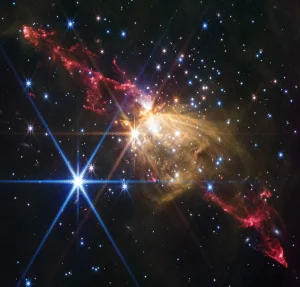
NASA’s Webb Observes Immense Stellar Jet on Outskirts of Our Milky Way
A blowtorch of seething gasses erupting from a volcanically growing monster star has been captured by NASA’s James Webb Space Telescope. Stretching across 8 light-years, the length of the stellar eruption is approximately twice the distance between our Sun and…
-
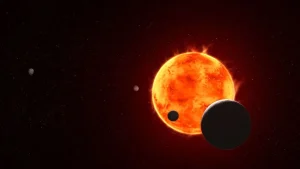
NASA Webb Looks at Earth-Sized, Habitable-Zone Exoplanet TRAPPIST-1 e
Scientists are in the midst of observing the exoplanet TRAPPIST-1 e with NASA’s James Webb Space Telescope. Careful analysis of the results so far presents several potential scenarios for what the planet’s atmosphere and surface may be like, as NASA…
-
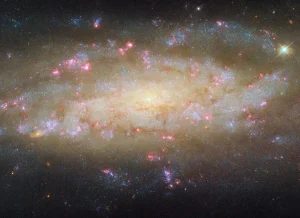
Hubble Spies Galaxy with Lots to See
While it may appear as just another spiral galaxy among billions in the universe, this image from the NASA/ESA Hubble Space Telescope reveals a galaxy with plenty to study. The galaxy, NGC 7456, is located over 51 million light-years away…
-
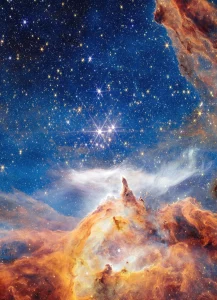
Glittering Glimpse of Star Birth From NASA’s Webb Telescope
This is a sparkling scene of star birth captured by NASA’s James Webb Space Telescope. What appears to be a craggy, starlit mountaintop kissed by wispy clouds is actually a cosmic dust-scape being eaten away by the blistering winds and…
-
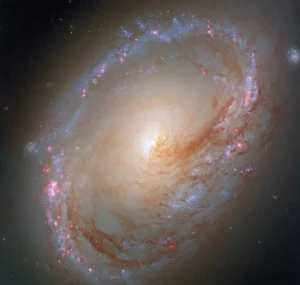
Hubble Homes in on Galaxy’s Star Formation
This NASA/ESA Hubble Space Telescope image features a galaxy whose asymmetric appearance may be the result of a galactic tug of war. Located 35 million light-years away in the constellation Leo, the spiral galaxy Messier 96 is the brightest of…
-

Astronomers Map Stellar ‘Polka Dots’ Using NASA’s TESS, Kepler
Scientists have devised a new method for mapping the spottiness of distant stars by using observations from NASA missions of orbiting planets crossing their stars’ faces. The model builds on a technique researchers have used for decades to study star…
-
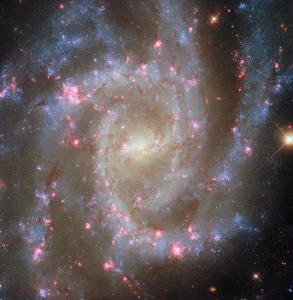
Hubble Observes Noteworthy Nearby Spiral Galaxy
This NASA/ESA Hubble Space Telescope image offers a new view of the nearby spiral galaxy NGC 2835, which lies 35 million light-years away in the constellation Hydra (the Water Snake). The galaxy’s spiral arms are dotted with young blue stars…
-
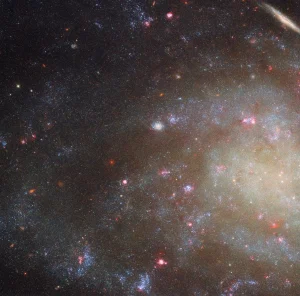
Hubble Examines Low Brightness, High Interest Galaxy
This NASA/ESA Hubble Space Telescope image zooms in on the feathery spiral arms of the galaxy NGC 45, which lies just 22 million light-years away in the constellation Cetus (the Whale). The portrait uses data drawn from two complementary observing…
-
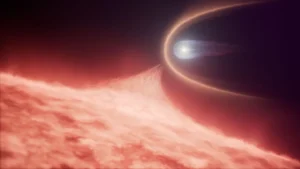
NASA’s Hubble Uncovers Rare White Dwarf Merger Remnant
An international team of astronomers has discovered a cosmic rarity: an ultra-massive white dwarf star resulting from a white dwarf merging with another star, rather than through the evolution of a single star. This discovery, made by NASA’s Hubble Space…
-
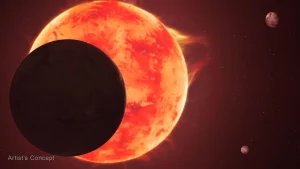
Webb Narrows Atmospheric Possibilities for Earth-sized Exoplanet TRAPPIST-1 d
The exoplanet TRAPPIST-1 d intrigues astronomers looking for possibly habitable worlds beyond our solar system because it is similar in size to Earth, rocky, and resides in an area around its star where liquid water on its surface is theoretically…