To view this video please enable JavaScript, and consider upgrading to a web browser that
supports HTML5 video
March 1–9, 2026
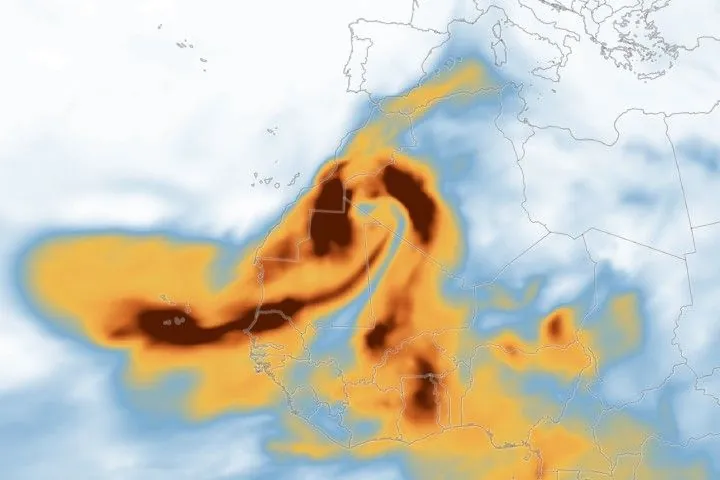
Winter winds lofted clouds of dust from the Sahara Desert, carrying it north toward the Mediterranean and dispersing it widely across Europe in March 2026. When the dust combined with moisture-laden weather systems, a dirty rain fell in parts of Spain, France, and the United Kingdom.
This animation highlights the concentration and movement of dust throughout the region from March 1 to March 9. It depicts dust column mass density—a measure of the amount of dust contained in a column of air—produced with a version of the GEOS (Goddard Earth Observing System) model. The model integrates satellite data with mathematical equations that represent physical processes in the atmosphere.
The animation shows dust plumes originating in northwestern Africa being blown both to the west across the Atlantic Ocean and north toward the Mediterranean. As plumes spread throughout Western Europe over several days, people observed hazy skies from southern England, where sunrises and sunsets took on an eerie glow, to the Alps in Switzerland and Italy, where a dust layer encroached on the Matterhorn.
Not all of the dust remained aloft. Storms encountered some of the dust, causing particles to fall to the ground with rain and coat surfaces with a brownish residue. A low-pressure system, named Storm Regina by Portugal’s weather service, moved across the Iberian Peninsula and brought so-called blood rain to southern and eastern Spain, along with parts of France and the southern UK in early March, according to news reports.
Over the Mediterranean, areas of “dusty cirrus” clouds developed higher in the atmosphere, where dust particles can act as condensation nuclei for ice crystals, according to MeteoSwiss, Switzerland’s Federal Office for Meteorology and Climatology. Scientists are studying these clouds to better understand their formation and how they affect weather, climate, and even solar power generation.
In a new analysis, researchers used NASA’s MERRA-2 (Modern-Era Retrospective Analysis for Research and Applications, Version 2), observations from MODIS (Moderate Resolution Imaging Spectroradiometer), and other satellite products to parse the effect of airborne Saharan dust on solar power in Hungary. They found that photovoltaic performance dropped to 46 percent on high-dust days, compared with 75 percent or more on low-dust days. They determined the greatest losses occurred because dust enhanced the presence and reflectance of cirrus clouds and reduced the amount of radiation that reached solar panels.
Some research suggests more frequent and intense wintertime dust events have affected Europe in recent years. Researchers have proposed several factors contributing to these outbreaks, including drier-than-normal conditions in northwestern Africa and weather patterns more often driving winds north from the Sahara.
NASA Earth Observatory animation by Lauren Dauphin, using GEOS-FP data from the Global Modeling and Assimilation Office at NASA GSFC. Story by Lindsey Doermann.
References & Resources
- Barcelona Dust Regional Center (2026, March) Daily Dust Products. Accessed March 11, 2026.
- FOX Weather (2026, March 9) Blood rain, a rare weather phenomenon, falls across southern Europe. Accessed March 11, 2026.
- IQAir (2026, March 6) Southwest Europe Air Quality Alert: Southwest Europe Dust. Accessed March 11, 2026.
- Met Office (2026, March 4) What is ‘blood rain’ and will we see it this week? Accessed March 11, 2026.
- MeteoSwiss (2026, March 4) He’s here again, the visitor from North Africa. Accessed March 11, 2026.
- NASA Earth Observatory (2022, March 31) Dusty Storm Clouds Over Europe. Accessed March 11, 2026.
- NASA Earthdata (2026) Dust/Ash/Smoke. Accessed March 11, 2026.
- Seifert, A., et al. (2023) Aerosol–cloud–radiation interaction during Saharan dust episodes: the dusty cirrus puzzle. Atmospheric Chemistry and Physics, 23, 6409–6430.
- Varga, G., et al. (2026) Saharan dust and cirrus clouds: Dominating indirect impact of dust events on photovoltaic energy generation in Hungary (2019–2024). Solar Energy, 307.
You may also be interested in:
Stay up-to-date with the latest content from NASA as we explore the universe and discover more about our home planet.
Dust Storm Sweeps Over Mali
2 min read
At a time of year when dust storm activity winds down, a plume of dust blanketed parts of the West…
Article
Cloudy Cloak Over the Northwest
2 min read
A low-lying cloud layer brought autumn ambience to western Washington and Oregon, while mountainous areas near the coast remained above…
Article
A Moonlit Earth as Seen From Artemis II
4 min read
An astronaut’s photo, taken en route to the Moon, reveals our planet and its place in space in a novel…
Article
1
2
3
4
Next
Keep Exploring
Discover More from NASA Earth Science
Subscribe to Earth Observatory Newsletters
Subscribe to the Earth Observatory and get the Earth in your inbox.
Earth Observatory Image of the Day
NASA’s Earth Observatory brings you the Earth, every day, with in-depth stories and stunning imagery.
Explore Earth Science
Earth Science Data
Open access to NASA’s archive of Earth science data
Source: NASA Science