2 min read
Hubble Captures a Cosmic Cloudscape
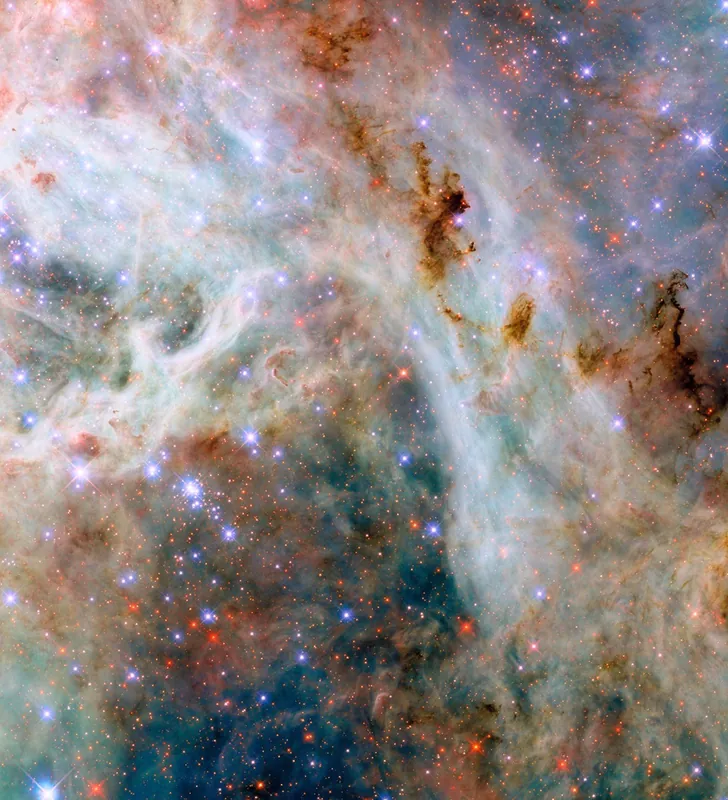
Download this image
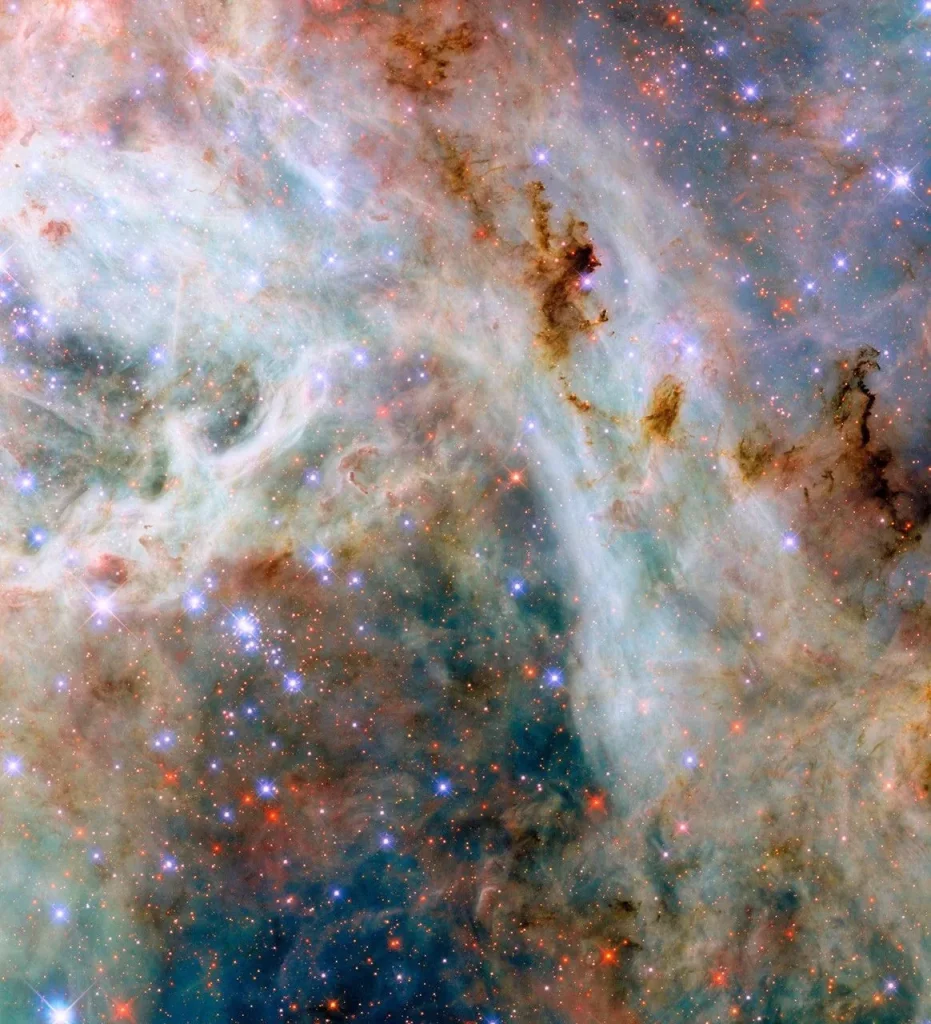
The universe is a dusty place, as this NASA/ESA Hubble Space Telescope image featuring swirling clouds of gas and dust near the Tarantula Nebula reveals. Located in the Large Magellanic Cloud about 160,000 light-years away in the constellations Dorado and Mensa, the Tarantula Nebula is the most productive star-forming region in the nearby universe, home to the most massive stars known.
The nebula’s colorful gas clouds hold wispy tendrils and dark clumps of dust. This dust is different from ordinary household dust, which may include bits of soil, skin cells, hair, and even plastic. Cosmic dust is often comprised of carbon or of molecules called silicates, which contain silicon and oxygen. The data in this image was part of an observing program that aims to characterize the properties of cosmic dust in the Large Magellanic Cloud and other nearby galaxies.
Dust plays several important roles in the universe. Even though individual dust grains are incredibly tiny, far smaller than the width of a single human hair, dust grains in disks around young stars clump together to form larger grains and eventually planets. Dust also helps cool clouds of gas so that they can condense into new stars. Dust even plays a role in making new molecules in interstellar space, providing a venue for individual atoms to find each other and bond together in the vastness of space.
@NASAHubble
@NASAHubble
@NASAHubble
Explore More
Caldwell 103 / Tarantula Nebula / 30 Doradus
Hubble Studies the Tarantula Nebula’s Outskirts
Hubble’s New View of the Tarantula Nebula
Hubble’s Bubbles in the Tarantula Nebula
Hubble Probes Interior of Tarantula Nebula
Media Contact:
Claire Andreoli (claire.andreoli@nasa.gov)NASA’s Goddard Space Flight Center, Greenbelt, MD
Share
Details
Last Updated
Mar 28, 2025
EditorAndrea GianopoulosLocationNASA Goddard Space Flight Center
Related Terms
- Hubble Space Telescope
- Absorption or Dark Nebulae
- Astrophysics
- Astrophysics Division
- Emission Nebulae
- Goddard Space Flight Center
- Nebulae
- Star-forming Nebulae
- The Universe
Keep Exploring
Discover More Topics From Hubble
Hubble Space Telescope
Since its 1990 launch, the Hubble Space Telescope has changed our fundamental understanding of the universe.
Exploring the Birth of Stars
Seeing ultraviolet, visible, and near-infrared light helps Hubble uncover the mysteries of star formation.
Hubble’s Night Sky Challenge
Hubble Focus: The Lives of Stars
This e-book highlights the mission’s recent discoveries and observations related to the birth, evolution, and death of stars.
Source: NASA Science