2 min read
Hubble Comes Face-to-Face with Spiral’s Arms
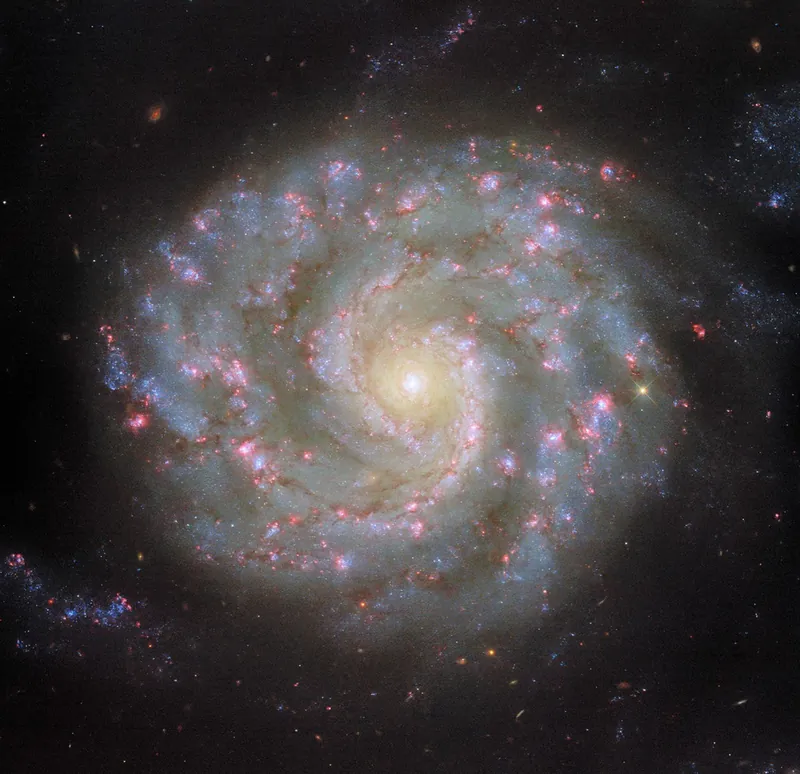
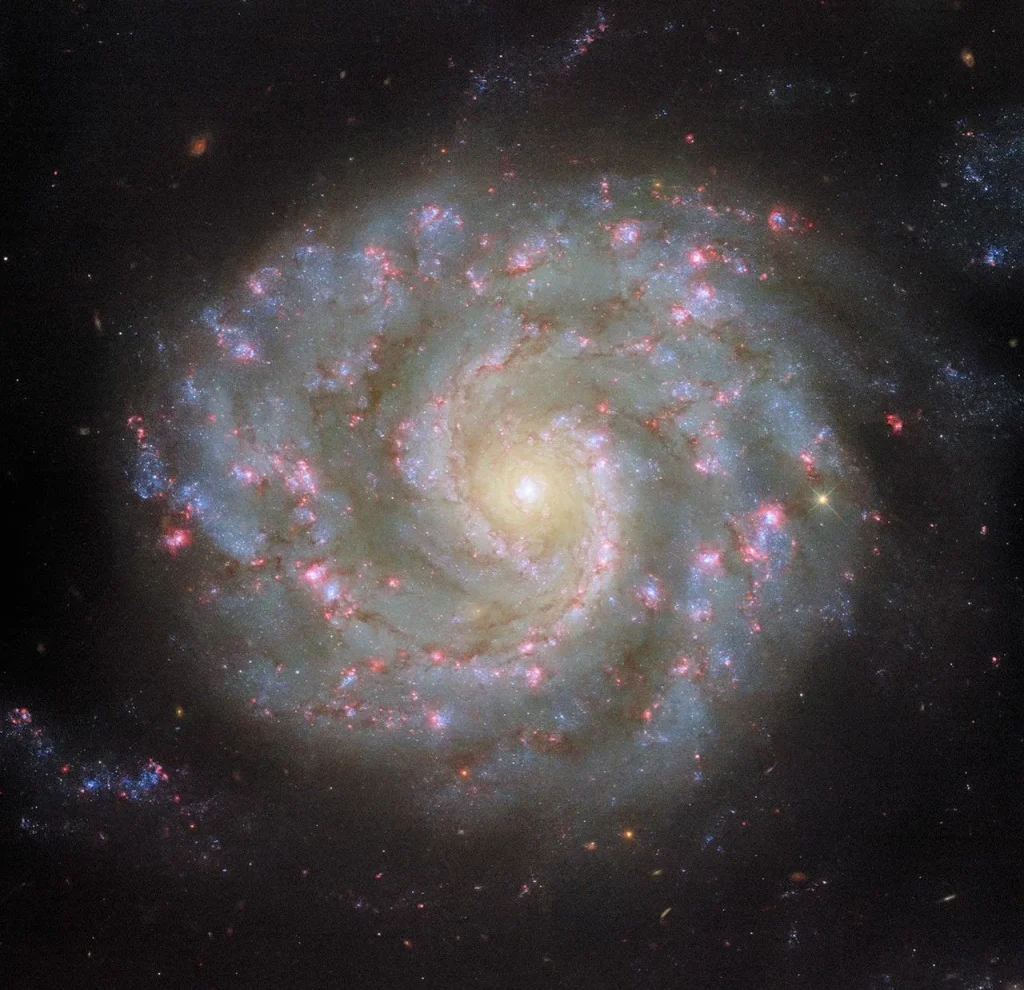
The spiral galaxy NGC 3596 is on display in this NASA/ESA Hubble Space Telescope image that incorporates six different wavelengths of light. NGC 3596 is situated 90 million light-years from Earth in the constellation Leo, the Lion. British astronomer Sir William Herschel first documented the galaxy in 1784.
NGC 3596 appears almost perfectly face-on when viewed from Earth, showcasing the galaxy’s neatly wound spiral arms. These bright arms hold concentrations of stars, gas, and dust that mark the area where star formation is most active, illustrated by the brilliant pink star-forming regions and young blue stars tracing NGC 3596’s arms.
What causes these spiral arms to form? It’s a surprisingly difficult question to answer, partly because spiral galaxies are so diverse. Some have clear spiral arms, while others have patchy, feathery arms. Some have prominent bars across their centers, while others have compact, circular nuclei. Some have close neighbors, while others are isolated.
Early ideas of how spiral arms formed stumped astronomers with the ‘winding problem’. If a galaxy’s spiral arms are coherent structures, its arms would wind tighter and tighter as the galaxy spins, until the arms are no longer visible. Now, researchers believe that spiral arms represent a pattern of high-density and low-density areas rather than a physical structure. As stars, gas, and dust orbit within a galaxy’s disk, they pass in and out of the spiral arms. Much like cars moving through a traffic jam, these materials slow down and bunch up as they enter a spiral arm, before emerging and continuing their journey through the galaxy.
@NASAHubble
@NASAHubble
@NASAHubble
Media Contact:
Claire Andreoli (claire.andreoli@nasa.gov)NASA’s Goddard Space Flight Center, Greenbelt, MD
Share
Details
Last Updated
May 09, 2025
EditorAndrea GianopoulosLocationNASA Goddard Space Flight Center
Related Terms
- Hubble Space Telescope
- Astrophysics
- Astrophysics Division
- Galaxies
- Goddard Space Flight Center
- Spiral Galaxies
- The Universe
Keep Exploring
Discover More Topics From Hubble
Hubble Space Telescope
Since its 1990 launch, the Hubble Space Telescope has changed our fundamental understanding of the universe.
Hubble Science Highlights
Hubble’s most notable scientific discoveries reflect the broad range of research and the breakthroughs it has achieved.
Hubble’s 35th Anniversary
Hubble’s Night Sky Challenge
Source: NASA Science