2 min read
Hubble Filters a Barred Spiral
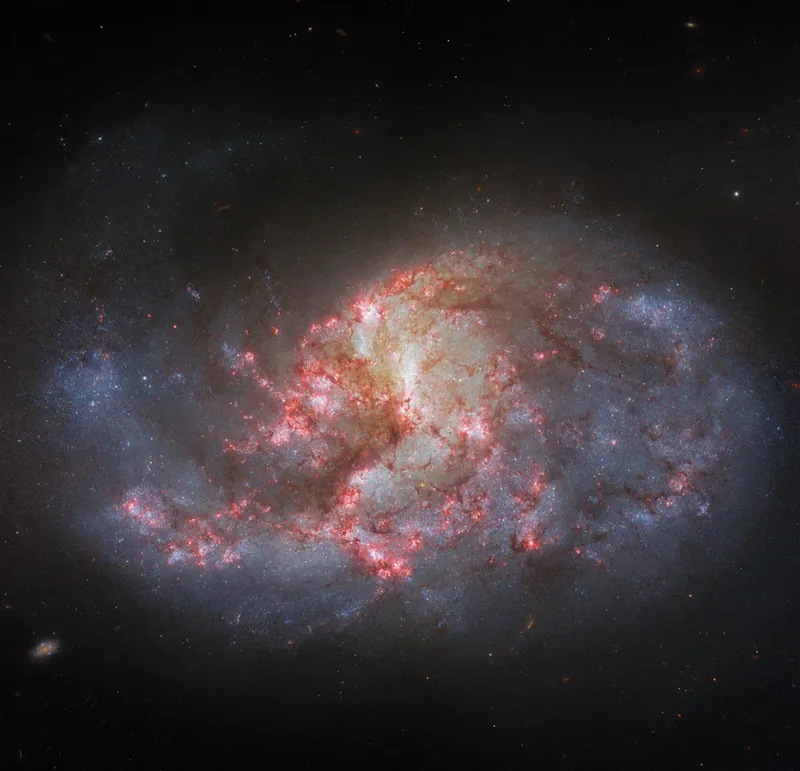
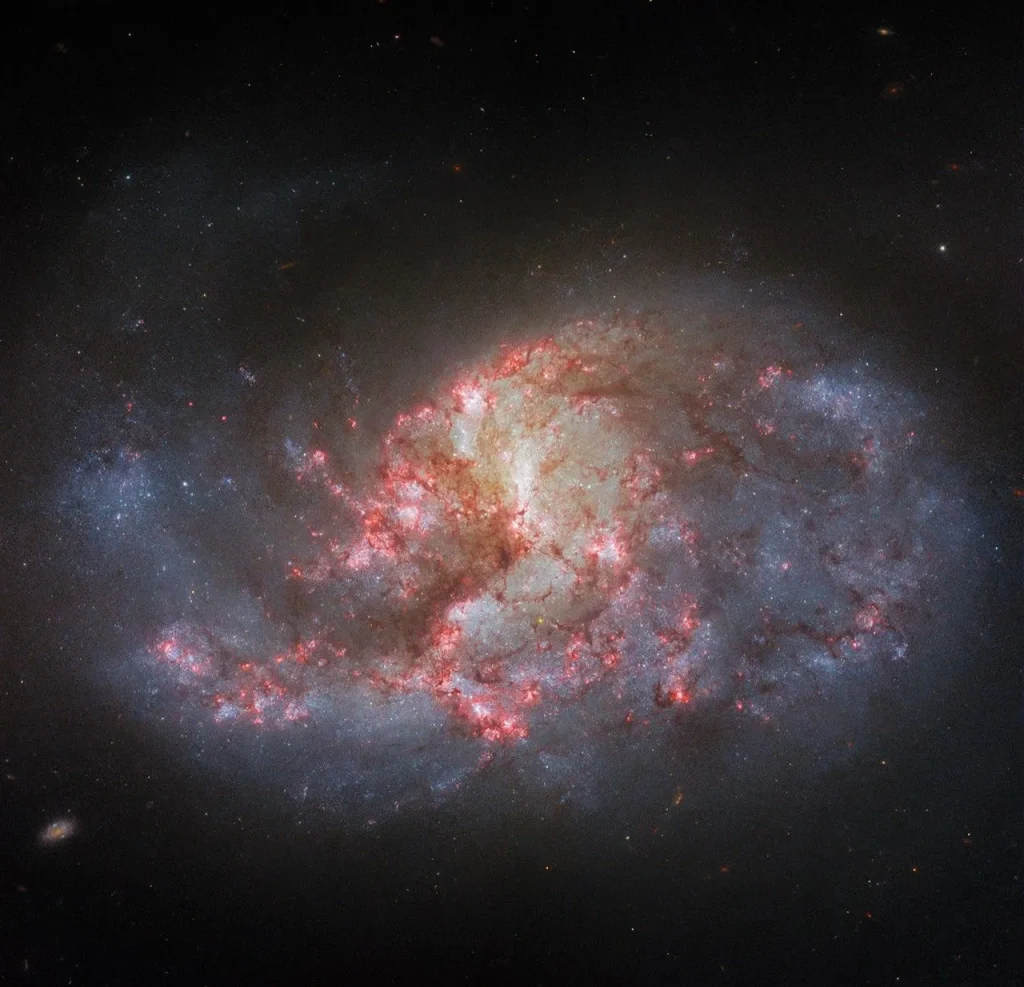
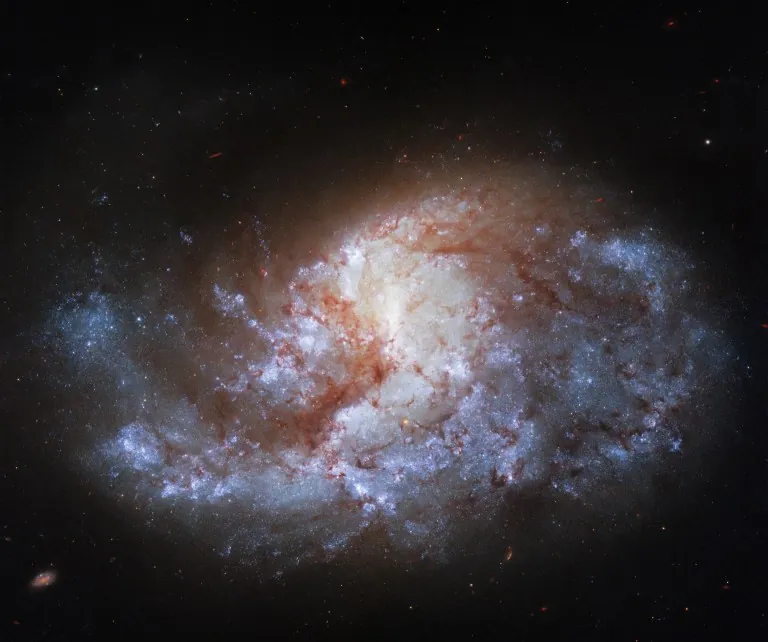
This NASA/ESA Hubble Space Telescope image features a luminous tangle of stars and dust called the barred spiral galaxy NGC 1385, located about 30 million light-years away. Hubble released an earlier image of NGC 1385, but the two images are notably different. This more recent image has far more pinkish-red and umber shades, whereas cool blues dominate the earlier image. This chromatic variation is not just a creative choice, but also a technical one, that represents the different number and types of filters used to collect the data that comprises the respective images.
NGC 1385, released in 2021
NGC 1385, released in 2023
NGC 1385, released in 2023
Before and After
Two views of NGC 1385
These two views of NGC 1385 illustrate how Hubble’s filters allow astronomers to see specific features in this barred spiral galaxy. The earlier (left) image shows areas where hot, young, blue stars dominate. The more recent (right) image features pinkish-red, dusty areas where stars are forming.
Like all telescopes used in scientific research, Hubble holds a range of filters. These highly specialized filters are pieces of physical hardware that allow a range of wavelengths (broadband filters) or very specific wavelengths (narrowband filters) of light to enter the telescope. This allows astronomers to look for specific features in the object. The data can tell us what elements are present, the temperature, and pressure of the object. The ability to probe extremely specific parts of the electromagnetic spectrum is very useful to astronomers. It helps them better understand the physical processes and environments of the objects they study.
Text Credit: ESA/Hubble
Watch on YouTube: How Hubble Images are Made
@NASAHubble
@NASAHubble
@NASAHubble
Media Contact:
Claire Andreoli (claire.andreoli@nasa.gov)NASA’s Goddard Space Flight Center, Greenbelt, MD
Share
Details
Last Updated
Jun 03, 2025
EditorAndrea GianopoulosLocationNASA Goddard Space Flight Center
Related Terms
- Hubble Space Telescope
- Astrophysics
- Astrophysics Division
- Galaxies
- Goddard Space Flight Center
- Spiral Galaxies
- Stars
- The Universe
Keep Exploring
Discover More Topics From Hubble
Hubble Space Telescope
Since its 1990 launch, the Hubble Space Telescope has changed our fundamental understanding of the universe.
Exploring the Birth of Stars
Seeing ultraviolet, visible, and near-infrared light helps Hubble uncover the mysteries of star formation.
Hubble’s Galaxies
Explore an assortment of galaxies with Hubble.
Hubble’s Night Sky Challenge
Source: NASA Science