3 min read
Hubble Jams With A Cosmic Guitar
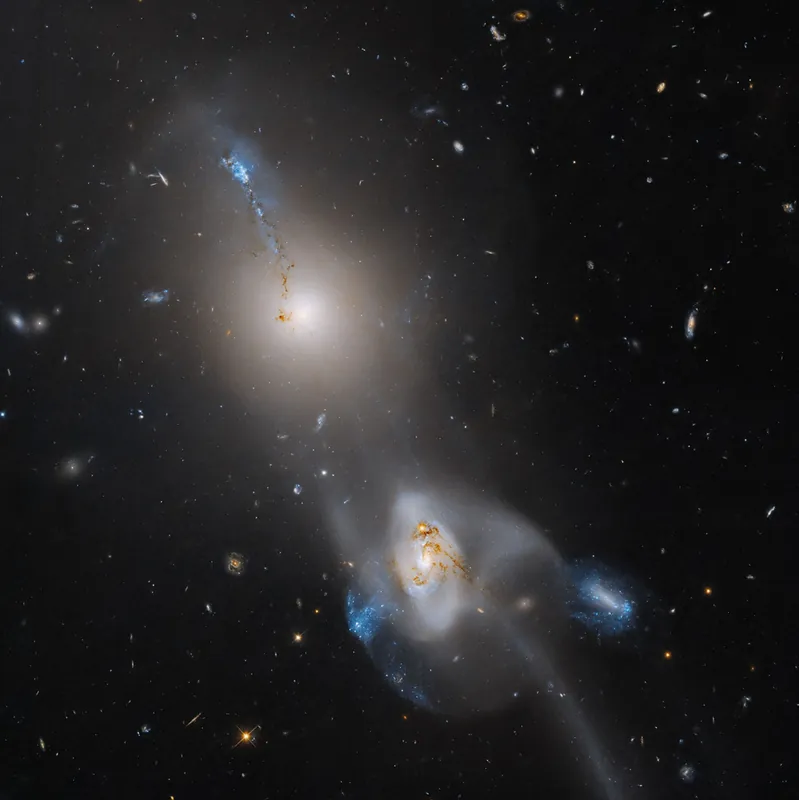
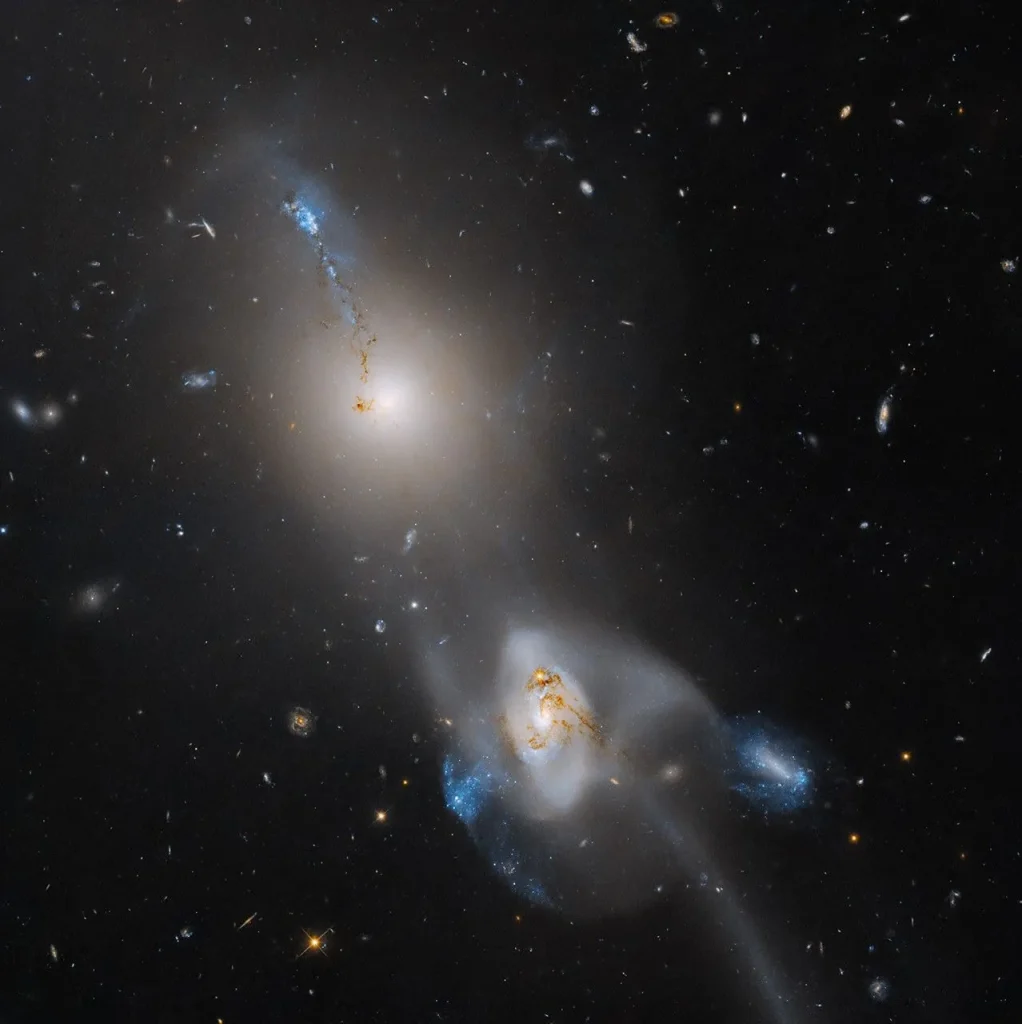
Arp 105 is a dazzling ongoing merger between an elliptical galaxy and a spiral galaxy drawn together by gravity, characterized by a long, drawn out tidal tail of stars and gas more than 362,000 light-years long. The immense tail, which extends beyond this image from NASA’s Hubble Space Telescope, was pulled from the two galaxies by their gravitational interactions and is embedded with star clusters and dwarf galaxies. The distinctively shaped arrangement of galaxies and tail gives the grouping its nickname: The Guitar.
The gravitational dance between elliptical galaxy NGC 3561B and spiral galaxy NGC 3561A creates a wealth of fascinating colliding galaxy features. A long lane of dark dust emerging from the elliptical galaxy ends in, and may be feeding, a bright blue area of star formation on the base of the guitar known as Ambartsumian’s Knot. Ambartsumian’s Knot is a tidal dwarf galaxy, a type of star-forming system that develops from the debris in tidal arms of interacting galaxies.
Two more bright blue areas of star formation are obvious in the Hubble image at the edges of the distorted spiral galaxy. The region to the left in the spiral galaxy is likely very similar to Ambartsumian’s Knot, a knot of intense star formation triggered by the merger. The region to the right is still under investigation ― it could be part of the collision, but its velocity and spectral data (indicating distance) are different from the rest of the system, so it may be a foreground galaxy.
Thin, faint tendrils of gas and dust are just barely visible stretching between and connecting the two galaxies. These tendrils are particularly interesting to astronomers since they may help define the timescale of the evolution of this collision.
A multitude of more-distant background galaxies are visible around and even through this merging duo. The bright blue blob of stars to the left of Ambartsumian’s Knot may be a particularly bright background galaxy.
Arp 105 is one of the brightest objects in the crowded galaxy cluster Abell 1185 in the constellation Ursa Major. Abell 1185, located around 400 million light-years away, is a chaotic cluster of at least 82 galaxies, many of which are interacting, as well as a number of wandering globular clusters that are not gravitationally attached to any particular galaxy. This Hubble image was taken as part of a study of the ongoing creation of galactic and intergalactic stellar populations in Abell 1185.
Explore More
Hubble’s Galaxies
Galaxy Details and Mergers
Hubble Focus E-Book: Galaxies through Space and Time
@NASAHubble
@NASAHubble
@NASAHubble
Media Contact:
Claire Andreoli (claire.andreoli@nasa.gov)NASA’s Goddard Space Flight Center, Greenbelt, MD
Share
Details
Last Updated
Mar 28, 2025
EditorNASA Hubble Mission TeamLocationNASA Goddard Space Flight Center
Related Terms
- Goddard Space Flight Center
- Astrophysics
- Astrophysics Division
- Elliptical Galaxies
- Hubble Space Telescope
- Interacting Galaxies
- Spiral Galaxies
- The Universe
Keep Exploring
Discover More Topics From Hubble
Hubble Space Telescope
Since its 1990 launch, the Hubble Space Telescope has changed our fundamental understanding of the universe.
Hubble’s Partners in Science
Hubble’s Night Sky Challenge
Hubble’s Galaxies
Explore an assortment of galaxies with Hubble.
Source: NASA Science