2 min read
Hubble Snaps Galaxy Cluster’s Portrait
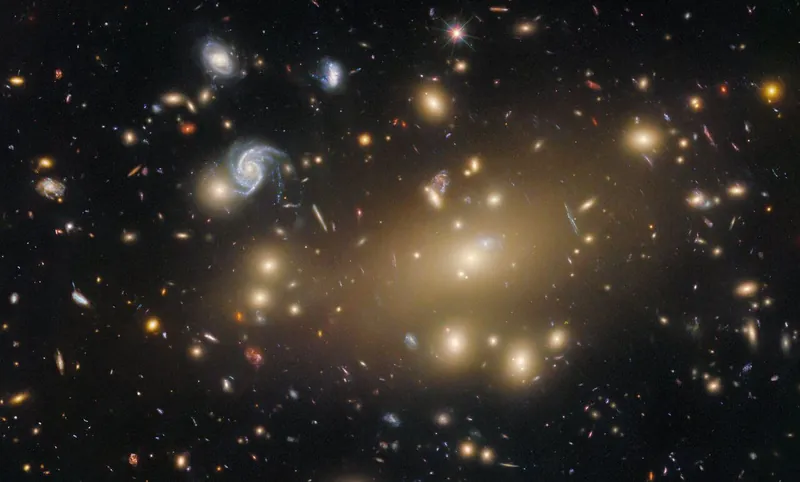
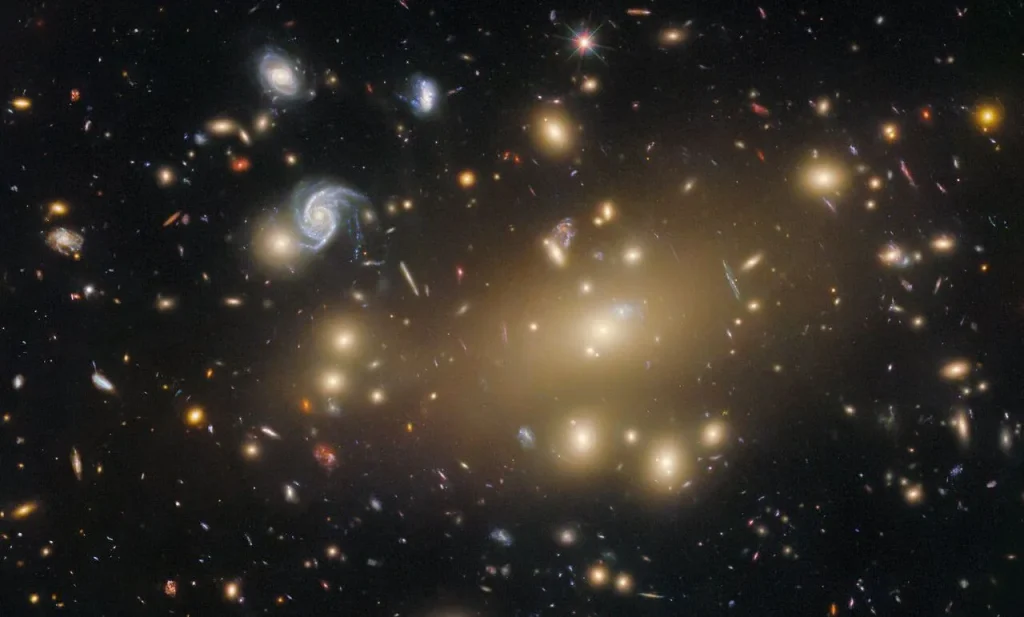
A massive, spacetime-warping cluster of galaxies is the setting of today’s NASA/ESA Hubble Space Telescope image. The galaxy cluster in question is Abell 209, located 2.8 billion light-years away in the constellation Cetus (the Whale).
This Hubble image of Abell 209 shows more than a hundred galaxies, but there’s more to this cluster than even Hubble’s discerning eye can see. Abell 209’s galaxies are separated by millions of light-years, and the seemingly empty space between the galaxies is filled with hot, diffuse gas that is visible only at X-ray wavelengths. An even more elusive occupant of this galaxy cluster is dark matter: a form of matter that does not interact with light. Dark matter does not absorb, reflect, or emit light, effectively making it invisible to us. Astronomers detect dark matter by its gravitational influence on normal matter. Astronomers surmise that the universe is comprised of 5% normal matter, 25% dark matter, and 70% dark energy.
Hubble observations, like the ones used to create this image, can help astronomers answer fundamental questions about our universe, including mysteries surrounding dark matter and dark energy. These investigations leverage the immense mass of a galaxy cluster, which can bend the fabric of spacetime itself and create warped and magnified images of background galaxies and stars in a process called gravitational lensing.
While this image lacks the dramatic rings that gravitational lensing can sometimes create, Abell 209 still shows subtle signs of lensing at work, in the form of streaky, slightly curved galaxies within the cluster’s golden glow. By measuring the distortion of these galaxies, astronomers can map the distribution of mass within the cluster, illuminating the underlying cloud of dark matter. This information, which Hubble’s fine resolution and sensitive instruments help to provide, is critical for testing theories of how our universe evolved.
Text Credit: ESA/Hubble
@NASAHubble
@NASAHubble
@NASAHubble
Media Contact:
Claire Andreoli (claire.andreoli@nasa.gov)NASA’s Goddard Space Flight Center, Greenbelt, MD
Do NASA Science with Dark Energy Explorers!
-
Help astronomers study dark energy.
NASA invites people of all ages and backgrounds to participate in authentic NASA research via “citizen science” or “participatory science” projects, where volunteers and amateurs have helped make thousands of important scientific discoveries. As a part of the Dark Energy Explorers project, you’ll help astronomers understand the mysterious force that pulls galaxies apart.
Share
Details
Last Updated
Feb 06, 2026
EditorAndrea GianopoulosLocationNASA Goddard Space Flight Center
Related Terms
- Hubble Space Telescope
- Astrophysics
- Astrophysics Division
- Galaxies
- Galaxy clusters
- Goddard Space Flight Center
- Gravitational Lensing
Keep Exploring
Discover More Topics From Hubble
Hubble Space Telescope
Since its 1990 launch, the Hubble Space Telescope has changed our fundamental understanding of the universe.
Hubble Gravitational Lenses
Focusing in on Gravitational Lenses
Shining a Light on Dark Matter
Source: NASA Science