2 min read
Hubble Spies a Spectacular Starburst Galaxy
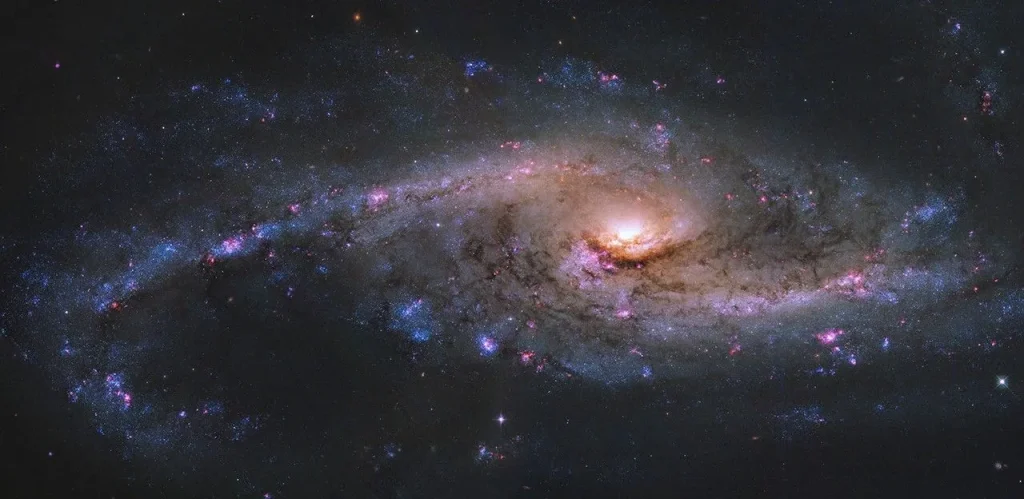
Sweeping spiral arms extend from NGC 4536, littered with bright blue clusters of star formation and red clumps of hydrogen gas shining among dark lanes of dust. The galaxy’s shape may seem a little unusual, and that’s because it’s what’s known as an “intermediate galaxy”: not quite a barred spiral, but not exactly an unbarred spiral, either ― a hybrid of the two.
NGC 4536 is also a starburst galaxy, in which star formation is happening at a tremendous rate that uses up the gas in the galaxy relatively quickly, by galactic standards. Starburst galaxies can happen due to gravitational interactions with other galaxies or ― as seems to be the case for NGC 4536 ― when gas is packed into a small region. The bar-like structure of NGC 4536 may be driving gas inwards toward the nucleus, giving rise to a crescendo of star formation in a ring around the nucleus. Starburst galaxies birth lots of hot blue stars that burn fast and die quickly in explosions that unleash intense ultraviolet light (visible in blue), turning their surroundings into glowing clouds of ionized hydrogen, called HII regions (visible in red).
NGC 4536 is approximately 50 million light-years away in the constellation Virgo. It was discovered in 1784 by astronomer William Herschel. Hubble took this image of NGC 4536 as part of a project to study galactic environments to understand connections between young stars and cold gas, particularly star clusters and molecular clouds, throughout the local universe.
Download the image
Explore More
Hubble’s Galaxies
Galaxy Details and Mergers
Hubble Focus E-Book: Galaxies through Space and Time
@NASAHubble
@NASAHubble
@NASAHubble
Media Contact:
Claire AndreoliNASA’s Goddard Space Flight Center, Greenbelt, MDclaire.andreoli@nasa.gov
Share
Details
Last Updated
Mar 28, 2025
LocationNASA Goddard Space Flight Center
Related Terms
- Hubble Space Telescope
- Astrophysics
- Astrophysics Division
- Galaxies
- Goddard Space Flight Center
- Spiral Galaxies
- The Universe
Keep Exploring
Discover More Topics From Hubble
Hubble Space Telescope
Since its 1990 launch, the Hubble Space Telescope has changed our fundamental understanding of the universe.
Hubble’s Cosmic Adventure
Hubble’s Night Sky Challenge
Hubble’s 35th Anniversary
Source: NASA Science