3 Min Read
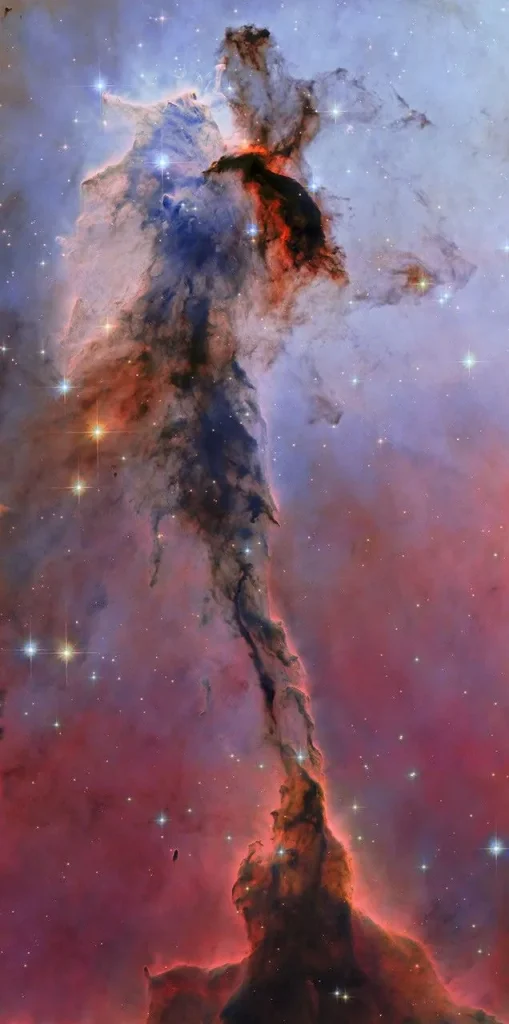
Hubble Spies Cosmic Pillar in Eagle Nebula
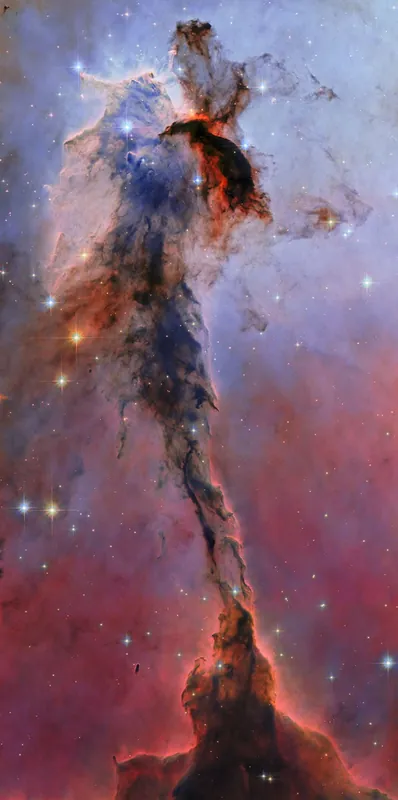
ESA/Hubble & NASA, K. Noll
As part of ESA/Hubble’s 35th anniversary celebrations, the European Space Agency (ESA) is sharing a new image series revisiting stunning, previously released Hubble targets with the addition of the latest Hubble data and new processing techniques.
New images of NGC 346 and the Sombrero Galaxy have already been published. Now, ESA/Hubble is revisiting the Eagle Nebula (originally published in 2005 as part of Hubble’s 15th anniversary celebrations) with new image processing techniques.
Unfurling along the length of the image is a pillar of cold gas and dust that is 9.5 light-years tall. As enormous as this dusty pillar is, it’s just one small piece of the greater Eagle Nebula, also called Messier 16. The name Messier 16 comes from the French astronomer Charles Messier, a comet hunter who compiled a catalog of deep-sky objects that could be mistaken for comets.
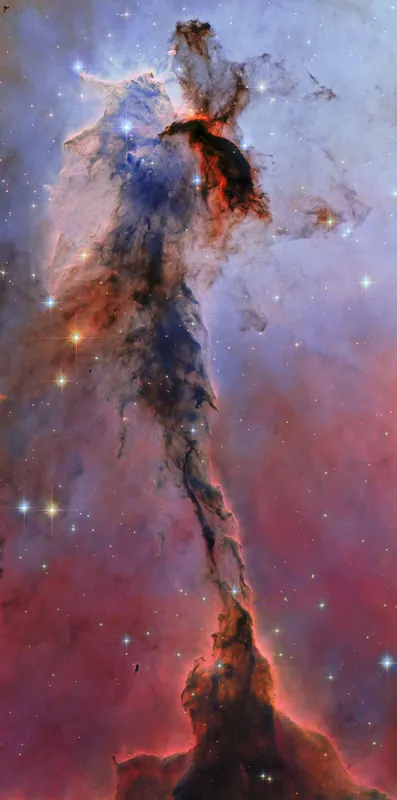
The name Eagle Nebula was inspired by the nebula’s appearance. The edge of this shining nebula is shaped by dark clouds like this one, giving it the appearance of an eagle spreading its wings.Not too far from the region pictured here are the famous Pillars of Creation, which Hubble photographed multiple times, with images released in 1995 and 2015.
The heart of the nebula, which is located beyond the edge of this image, is home to a cluster of young stars. These stars have excavated an immense cavity in the center of the nebula, shaping otherworldly pillars and globules of dusty gas. This particular feature extends like a pointing finger toward the center of the nebula and the rich young star cluster embedded there.
The Eagle Nebula is one of many nebulae in the Milky Way that are known for their sculpted, dusty clouds. Nebulae take on these fantastic shapes when exposed to powerful radiation and winds from infant stars. Regions with denser gas are more able to withstand the onslaught of radiation and stellar winds from young stars, and these dense areas remain as dusty sculptures like the starry pillar shown here.
The Hubble Space Telescope has been operating for over three decades and continues to make ground-breaking discoveries that shape our fundamental understanding of the universe. Hubble is a project of international cooperation between NASA and ESA (European Space Agency). NASA’s Goddard Space Flight Center in Greenbelt, Maryland, manages the telescope and mission operations. Lockheed Martin Space, based in Denver, also supports mission operations at Goddard. The Space Telescope Science Institute in Baltimore, which is operated by the Association of Universities for Research in Astronomy, conducts Hubble science operations for NASA.
@NASAHubble
@NASAHubble
@NASAHubble
Explore Hubble Eagle Nebula Images and Science
Eagle Nebula Pillar
Learn more about and download the image above.
Hubble’s Messier Catalog: Messier 16 (Eagle Nebula)
Messier 16, better known as the Eagle Nebula, has provided Hubble with some of its most iconic images.
Embryonic Stars Emerge from Interstellar “Eggs”
Eerie, dramatic Hubble pictures show newborn stars emerging from “eggs” – not the barnyard variety – but rather dense, compact pockets of interstellar gas called evaporating gaseous globules (EGGs).
The Pillars of Creation: A 3D Multiwavelength Exploration
This scientific visualization explores the iconic Pillars of Creation in the Eagle Nebula (Messier 16 or M16) using data from NASA’s Hubble and Webb space telescopes.
Hubble Goes High Def to Revisit the Iconic ‘Pillars of Creation’
Explore hands-on activities, interactive, lesson plans, educator guides, and other downloadable content about this topic.
Location of Hubble images in the Eagle Nebula
This wide-field image of the Eagle Nebula shows the areas Hubble viewed in greater detail with Hubble’s Wide-Field Planetary Camera 2 (WFPC2) in 1995 and Advanced Camera for Surveys (ACS) in 2005.
The Eagle Has Risen: Stellar Spire in the Eagle Nebula
Released in 2005, this Hubble image of a stellar spire was part of Hubble’s 15th anniversary.
Eagle Nebula (M16) Pillar Detail: Portion of Top
Released in 2005, this Hubble image of a stellar spire was part of Hubble’s 15th anniversary.
Share
Details
Last Updated
Apr 18, 2025
EditorAndrea GianopoulosLocationNASA Goddard Space Flight Center
Contact
Media
Claire Andreoli
NASA’s Goddard Space Flight Center
Greenbelt, Maryland
claire.andreoli@nasa.gov
Bethany Downer
ESA/Hubble
bethany.downer@esahubble.org
Garching, Germany
Related Terms
- Hubble Space Telescope
- Astrophysics
- Astrophysics Division
- Goddard Space Flight Center
- Nebulae
- The Universe
Related Links and Documents
- Hubble’s 35th Anniversary celebrations
- ESA/Hubble’s 35th Anniversary celebrations
- Release on ESA’s website
Keep Exploring
Discover More Topics From Hubble
Hubble Space Telescope
Since its 1990 launch, the Hubble Space Telescope has changed our fundamental understanding of the universe.
Exploring the Birth of Stars
Seeing ultraviolet, visible, and near-infrared light helps Hubble uncover the mysteries of star formation.
Reshaping Our Cosmic View: Hubble Science Highlights
Hubble’s 35th Anniversary
Source: NASA Science