2 min read
Hubble Spies Swirling Spiral
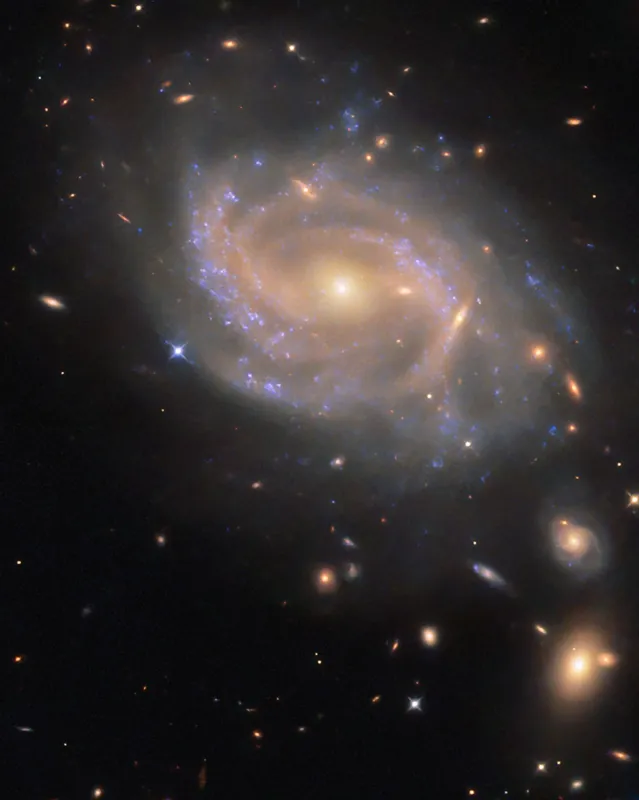
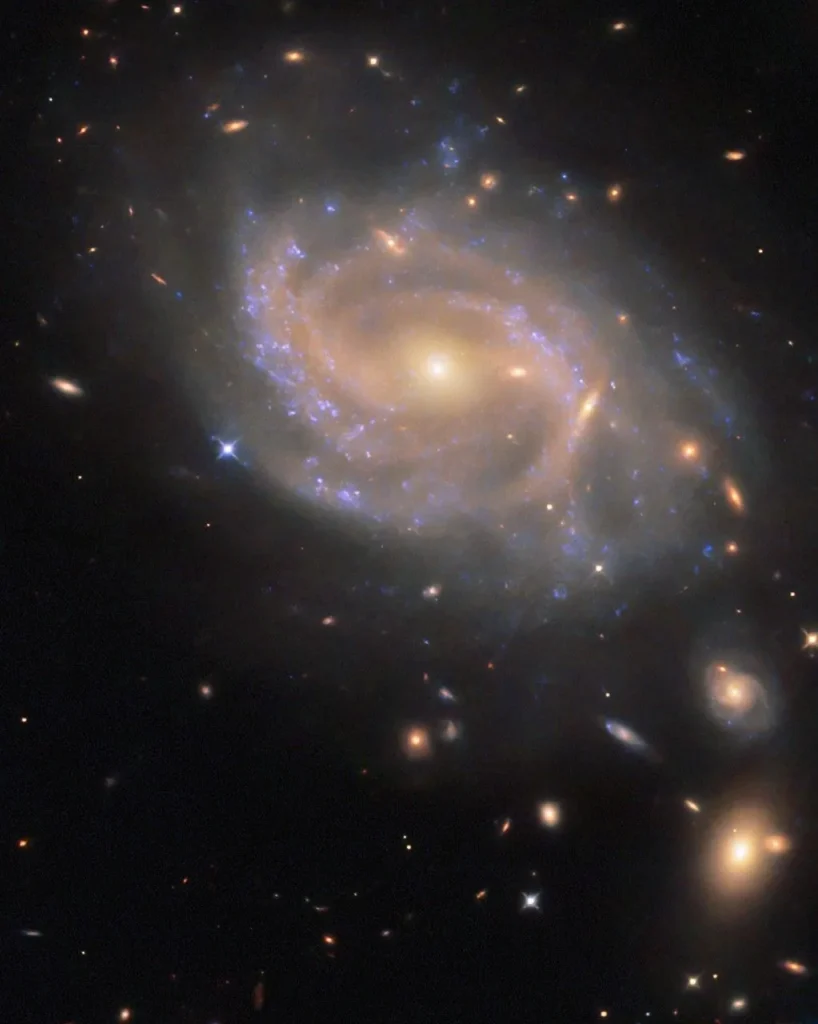
The swirling spiral galaxy in this NASA/ESA Hubble Space Telescope image is NGC 3285B, which resides 137 million light-years away in the constellation Hydra (the Water Snake). Hydra has the largest area of the 88 constellations that cover the entire sky in a celestial patchwork. It’s also the longest constellation, stretching 100 degrees across the sky. It would take nearly 200 full Moons, placed side by side, to reach from one side of the constellation to the other.
NGC 3285B is a member of the Hydra I cluster, one of the largest galaxy clusters in the nearby universe. Galaxy clusters are collections of hundreds to thousands of galaxies bound to one another by gravity. The Hydra I cluster is anchored by two giant elliptical galaxies at its center. Each of these galaxies is about 150,000 light-years across, making them about 50% larger than our home galaxy, the Milky Way.
NGC 3285B sits on the outskirts of its home cluster, far from the massive galaxies at the center. This galaxy drew Hubble’s attention because it hosted a Type Ia supernovain 2023. Type Ia supernovae happen when a type of condensed stellar core called a white dwarf detonates, igniting a sudden burst of nuclear fusion that briefly shines about 5 billion times brighter than the Sun. The supernova, named SN 2023xqm, is visible here as a blueish dot on the left edge of the galaxy’s disk.
Hubble observed NGC 3285B as part of an observing program that targeted 100 Type Ia supernovae. By viewing each of these supernovae in ultraviolet, optical, and near-infrared light, researchers aim to disentangle the effects of distance and dust, both of which can make a supernova appear redder than it actually is. This program will help refine cosmic distance measurements that rely on observations of Type Ia supernovae.
Text Credit: ESA/Hubble
@NASAHubble
@NASAHubble
@NASAHubble
Media Contact:
Claire Andreoli (claire.andreoli@nasa.gov)NASA’s Goddard Space Flight Center, Greenbelt, MD
Share
Details
Last Updated
Jul 31, 2025
EditorAndrea GianopoulosLocationNASA Goddard Space Flight Center
Related Terms
- Hubble Space Telescope
- Astrophysics
- Astrophysics Division
- Galaxies
- Goddard Space Flight Center
- Spiral Galaxies
- The Universe
Keep Exploring
Discover More Topics From Hubble
Hubble Space Telescope
Since its 1990 launch, the Hubble Space Telescope has changed our fundamental understanding of the universe.
Hubble’s Night Sky Challenge
Hubble’s Galaxies
Explore an assortment of galaxies with Hubble.
Reshaping Our Cosmic View: Hubble Science Highlights
Source: NASA Science