2 min read
Hubble Studies the Tarantula Nebula’s Outskirts
Download this image
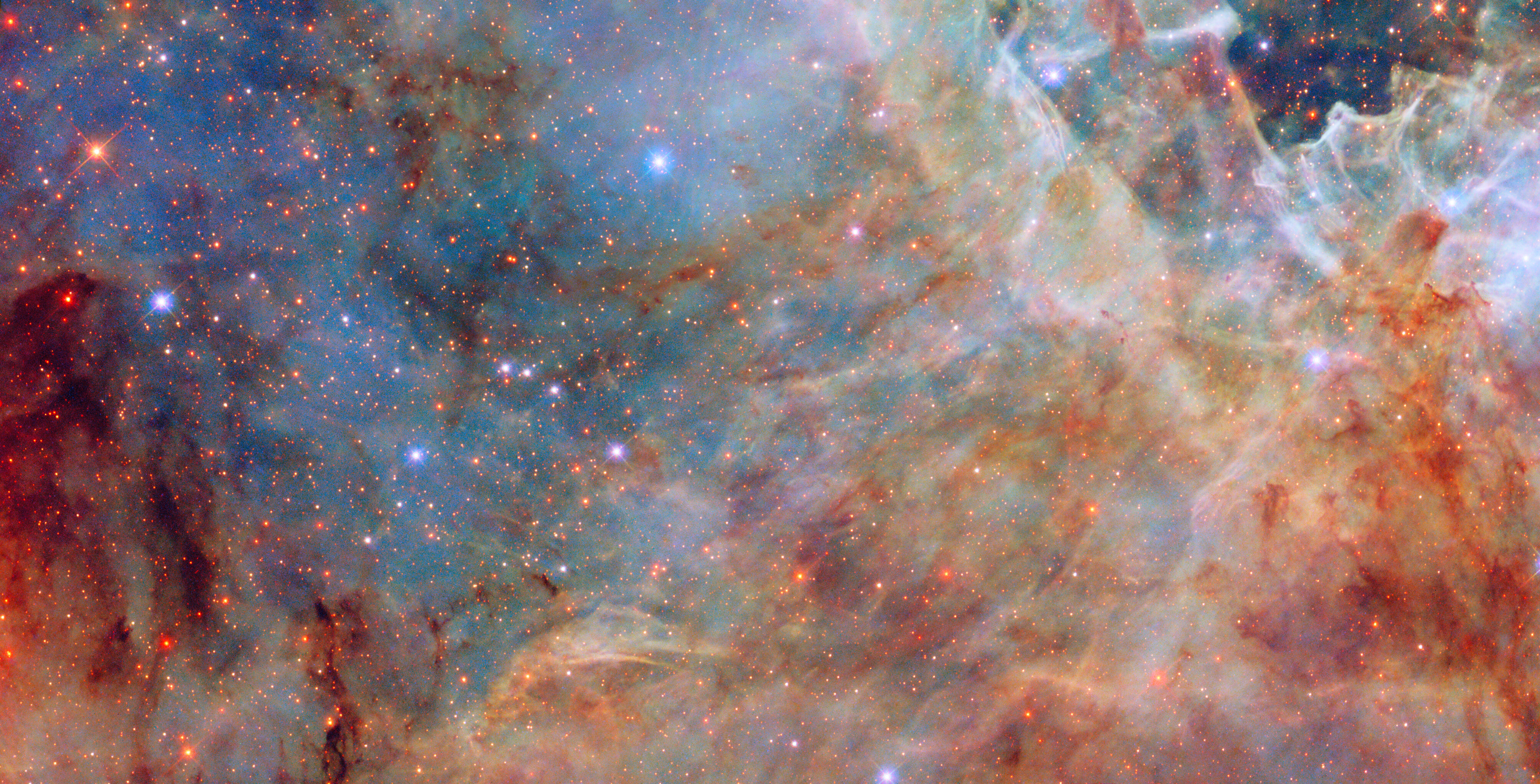
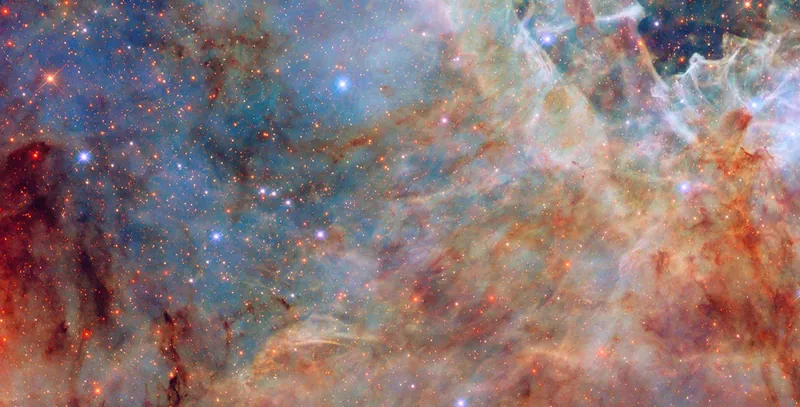
This NASA/ESA Hubble Space Telescope image features a dusty yet sparkling scene from one of the Milky Way’s satellite galaxies, the Large Magellanic Cloud. The Large Magellanic Cloud is a dwarf galaxy situated about 160,000 light-years away in the constellations Dorado and Mensa.
Despite being only 10–20% as massive as the Milky Way galaxy, the Large Magellanic Cloud contains some of the most impressive nearby star-forming regions. The scene pictured here is on the outskirts of the Tarantula Nebula, the largest and most productive star-forming region in the local universe. At its center, the Tarantula Nebula hosts the most massive stars known, weighing roughly 200 times the mass of the Sun.
The section of the nebula shown here features serene blue gas, brownish-orange dust patches, and a sprinkling of multicolored stars. The stars within and behind the dust clouds appear redder than those that are unobscured by dust. Dust absorbs and scatters blue light more than red light, allowing more of the red light to reach our telescopes, which makes the stars appear redder than they are. This image incorporates ultraviolet and infrared light as well as visible light. Using Hubble observations of dusty nebulae in the Large Magellanic Cloud and other galaxies, researchers can study these distant dust grains, helping them better understand the role that cosmic dust plays in the formation of new stars and planets.
@NASAHubble
@NASAHubble
@NASAHubble
Explore More
Caldwell 103 / Tarantula Nebula / 30 Doradus
Hubble’s New View of the Tarantula Nebula
Hubble’s Bubbles in the Tarantula Nebula
Hubble Probes Interior of Tarantula Nebula
Media Contact:
Claire Andreoli (claire.andreoli@nasa.gov)NASA’s Goddard Space Flight Center, Greenbelt, MD
Share
Details
Last Updated
Mar 28, 2025
EditorAndrea GianopoulosLocationNASA Goddard Space Flight Center
Related Terms
- Hubble Space Telescope
- Astrophysics
- Astrophysics Division
- Goddard Space Flight Center
- Magellanic Clouds
- Star-forming Nebulae
- Stars
- The Universe
Keep Exploring
Discover More Topics From Hubble
Hubble Space Telescope
Since its 1990 launch, the Hubble Space Telescope has changed our fundamental understanding of the universe.
Exploring the Birth of Stars
Seeing ultraviolet, visible, and near-infrared light helps Hubble uncover the mysteries of star formation.
Hubble’s Night Sky Challenge
Hubble Focus: The Lives of Stars
This e-book highlights the mission’s recent discoveries and observations related to the birth, evolution, and death of stars.
Source: NASA Science