3 min read
NASA’s Curiosity Captures Martian Morning, Afternoon in New ‘Postcard’
Lighting from two times of day was combined for a stunning view of terrain that the rover is leaving behind.
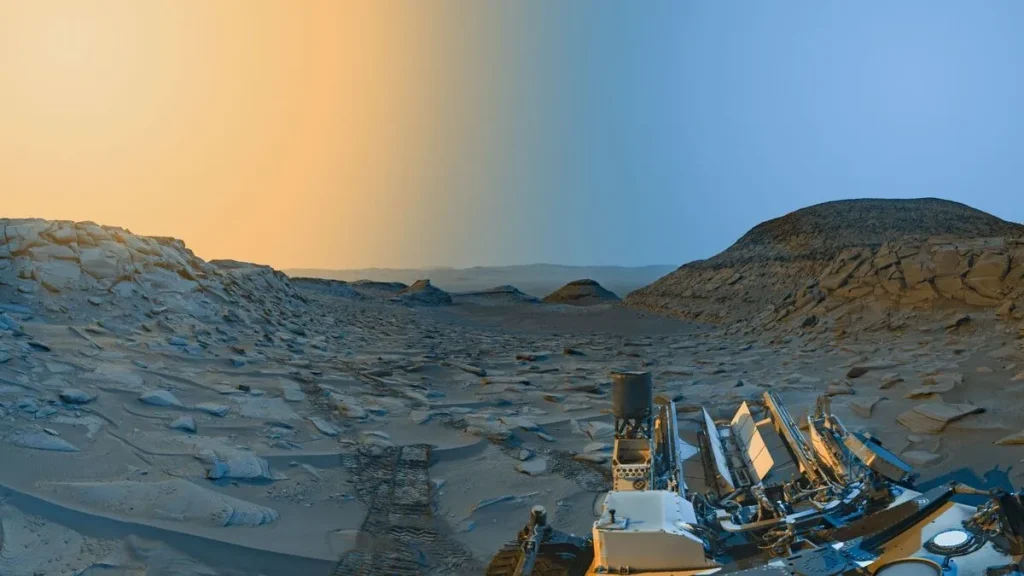
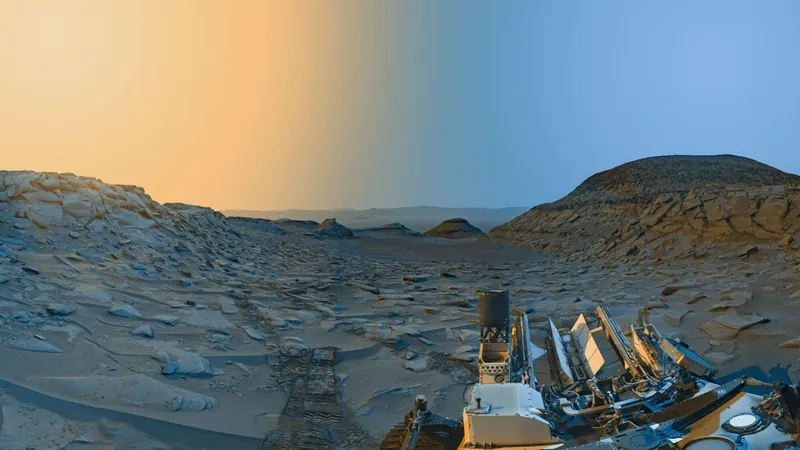
After completing a major software update in April, NASA’s Curiosity Mars rover took a last look at “Marker Band Valley” before leaving it behind, capturing a “postcard” of the scene.
The postcard is an artistic interpretation of the landscape, with color added over two black-and-white panoramas captured by Curiosity’s navigation cameras. The views were taken on April 8 at 9:20 a.m. and 3:40 p.m. local Mars time, providing dramatically different lighting that, when combined, makes details in the scene stand out. Blue was added to parts of the postcard captured in the morning and yellow to parts taken in the afternoon, just as with a similar postcard taken by Curiosity in November 2021.
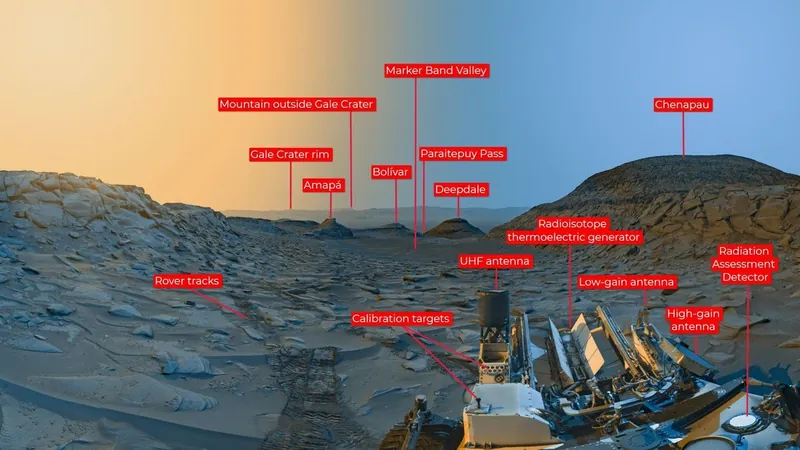
The resulting image is striking. Curiosity is in the foothills of Mount Sharp, which stands 3 miles (5 kilometers) high within Gale Crater, where the rover has been exploring since landing in 2012. In the distance beyond its tracks is Marker Band Valley, a winding area in the “sulfate-bearing region” within which the rover discovered unexpected signs of an ancient lake. Farther below (at center and just to the right) are two hills – “Bolívar” and “Deepdale” – that Curiosity drove between while exploring “Paraitepuy Pass.”
“Anyone who’s been to a national park knows the scene looks different in the morning than it does in the afternoon,” said Curiosity engineer Doug Ellison of NASA’s Jet Propulsion Laboratory in Southern California, who planned and processed the images. “Capturing two times of day provides dark shadows because the lighting is coming in from the left and the right, like you might have on a stage – but instead of stage lights, we’re relying on the Sun.”
Adding to the depth of the shadows is the fact that it was winter – a period of lower airborne dust – at Curiosity’s location when the images were taken. “Mars’ shadows get sharper and deeper when there’s low dust and softer when there’s lots of dust,” Ellison added.
The image peers past the rear of the rover, providing a glimpse of its three antennas and nuclear power source. The Radiation Assessment Detector, or RAD, instrument, which appears as a white circle in the lower right of the image, has been helping scientists learn how to protect the first astronauts sent to Mars from radiation on the planet’s surface.
More About the Mission
Curiosity was built by NASA’s Jet Propulsion Laboratory, which is managed by Caltech in Pasadena, California. JPL leads the mission on behalf of NASA’s Science Mission Directorate in Washington.
For more about Curiosity, visit:https://mars.nasa.gov/msl
News Media Contacts
Andrew GoodJet Propulsion Laboratory, Pasadena, Calif.818-393-2433andrew.c.good@jpl.nasa.gov
Karen Fox / Alana JohnsonNASA Headquarters, Washington301-286-6284 / 202-358-1501karen.c.fox@nasa.gov / alana.r.johnson@nasa.gov
Share
Details
Last Updated
Nov 10, 2024
Related Terms
Explore More
5 min read
NASA Discovery Reveals Complex Water Systems on Early Mars
When NASA’s Perseverance rover reached the inner edge of Mars’ Jezero Crater in September 2023,…
Article
2 weeks ago
2 min read
Curiosity Postcard Celebrates Rover’s 5,000th Day on Mars
Article
2 weeks ago
2 min read
NASA’s Integrated Medical Model (IMM)
Planning crewed missions to the Moon and Mars involves preparing for the medical realities of…
Article
2 weeks ago
Keep Exploring
Discover More Topics From NASA
Mars
Mars is the fourth planet from the Sun, and the seventh largest. It’s the only planet we know of inhabited…
All Mars Resources
Explore this collection of Mars images, videos, resources, PDFs, and toolkits. Discover valuable content designed to inform, educate, and inspire,…
Rover Basics
Each robotic explorer sent to the Red Planet has its own unique capabilities driven by science. Many attributes of a…
Mars Exploration: Science Goals
The key to understanding the past, present or future potential for life on Mars can be found in NASA’s four…
Source: NASA Science