4 Min Read
NASA’s Webb Rings in Holidays with Ringed Planet Uranus
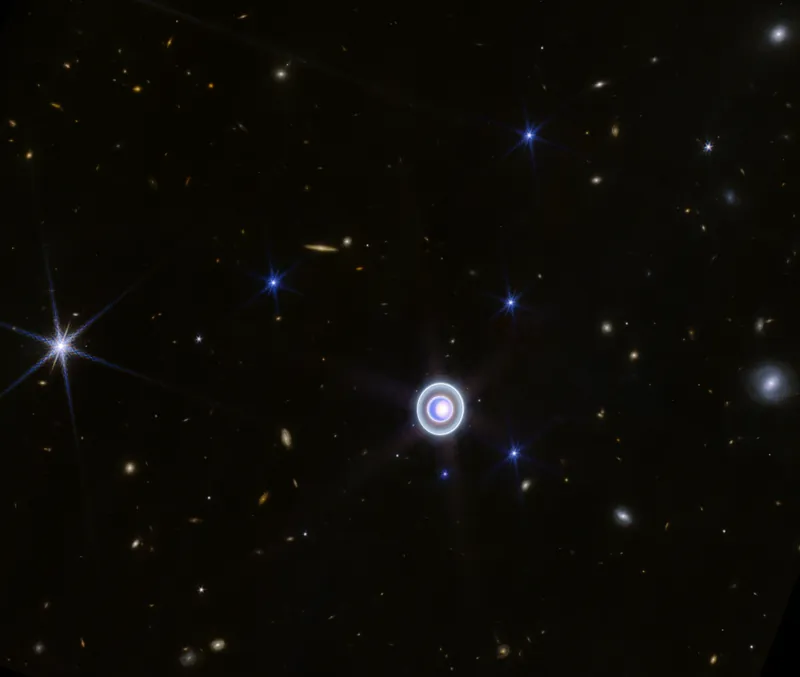
Image: NASA, ESA, CSA, STScI
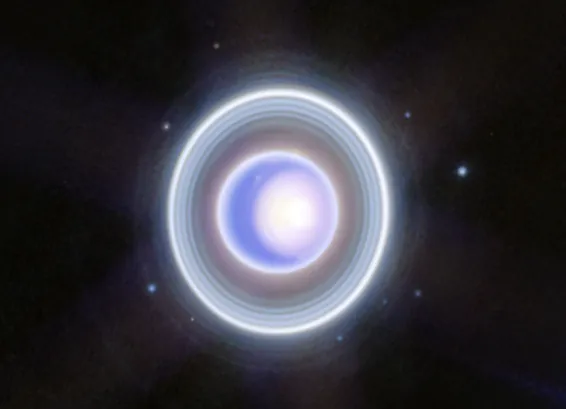
NASA’s James Webb Space Telescope recently trained its sights on unusual and enigmatic Uranus, an ice giant that spins on its side. Webb captured this dynamic world with rings, moons, storms, and other atmospheric features – including a seasonal polar cap. The image expands upon a two-color version released earlier this year, adding additional wavelength coverage for a more detailed look.
With its exquisite sensitivity, Webb captured Uranus’ dim inner and outer rings, including the elusive Zeta ring – the extremely faint and diffuse ring closest to the planet. It also imaged many of the planet’s 27 known moons, even seeing some small moons within the rings.
Image: Uranus and its rings
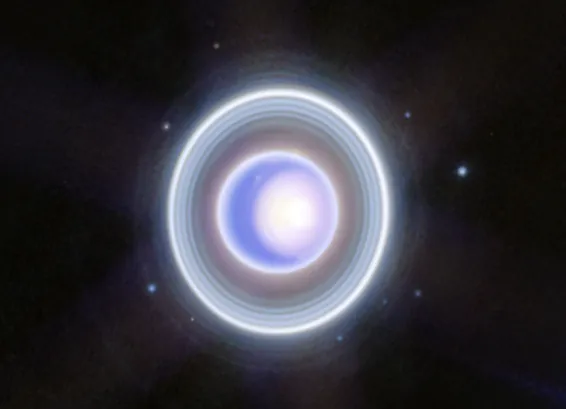
In visible wavelengths as seen by Voyager 2 in the 1980s, Uranus appeared as a placid, solid blue ball. In infrared wavelengths, Webb is revealing a strange and dynamic ice world filled with exciting atmospheric features.
One of the most striking of these is the planet’s seasonal north polar cloud cap. Compared to the Webb image from earlier this year, some details of the cap are easier to see in these newer images. These include the bright, white, inner cap and the dark lane in the bottom of the polar cap, toward the lower latitudes.
Several bright storms can also be seen near and below the southern border of the polar cap. The number of these storms, and how frequently and where they appear in Uranus’s atmosphere, might be due to a combination of seasonal and meteorological effects.
The polar cap appears to become more prominent when the planet’s pole begins to point toward the Sun, as it approaches solstice and receives more sunlight. Uranus reaches its next solstice in 2028, and astronomers are eager to watch any possible changes in the structure of these features. Webb will help disentangle the seasonal and meteorological effects that influence Uranus’s storms, which is critical to help astronomers understand the planet’s complex atmosphere.
Image: Uranus Wide-Field
Because Uranus spins on its side at a tilt of about 98 degrees, it has the most extreme seasons in the solar system. For nearly a quarter of each Uranian year, the Sun shines over one pole, plunging the other half of the planet into a dark, 21-year-long winter.
With Webb’s unparalleled infrared resolution and sensitivity, astronomers now see Uranus and its unique features with groundbreaking new clarity. These details, especially of the close-in Zeta ring, will be invaluable to planning any future missions to Uranus.
Uranus can also serve as a proxy for studying the nearly 2,000 similarly sized exoplanets that have been discovered in the last few decades. This “exoplanet in our backyard” can help astronomers understand how planets of this size work, what their meteorology is like, and how they formed. This can in turn help us understand our own solar system as a whole by placing it in a larger context.
Image: Uranus’ Moons Labelled
The James Webb Space Telescope is the world’s premier space science observatory. Webb is solving mysteries in our solar system, looking beyond to distant worlds around other stars, and probing the mysterious structures and origins of our universe and our place in it. Webb is an international program led by NASA with its partners, ESA (European Space Agency) and the Canadian Space Agency.
Downloads & Related Information
The following sections contain links to download this article’s images and videos in all available resolutions followed by related information links, media contacts, and if available, research paper and Spanish translation links.
Related Images & Videos
Uranus Close-up (NIRCam Image)
This image of Uranus from NIRCam (Near-Infrared Camera) on NASA’s James Webb Space Telescope shows the planet and its rings in new clarity. The Webb image exquisitely captures Uranus’s seasonal north polar cap, including the bright, white, inner cap and the dark lane in the…
Uranus Wide (NIRCam Image)
This image of Uranus from NIRCam (Near-Infrared Camera) on NASA’s James Webb Space Telescope shows the planet and its rings in new clarity. The planet’s seasonal north polar cap gleams in a bright white, and Webb’s exquisite sensitivity resolves Uranus’ dim inner and outer…
Uranus Wide (NIRCam Compass Image)
This image of Uranus, captured by Webb’s Near-Infrared Camera (NIRCam), shows compass arrows, scale bar, and color key for reference. The north and east compass arrows show the orientation of the image on the sky. Note that the relationship between north and east on the sky (as…
Related Links
Share
Details
Last Updated
Sep 21, 2026
LocationNASA Goddard Space Flight Center
Contact
Media
Laura Betz
NASA’s Goddard Space Flight Center
Greenbelt, Maryland
laura.e.betz@nasa.gov
Ann Jenkins
Space Telescope Science Institute
Baltimore, Maryland
Christine Pulliam
Space Telescope Science Institute
Baltimore, Maryland
Science Advisor Credit
Klaus Pontoppidan (NASA-JPL), Emma Dahl (NASA-JPL)
Related Terms
- James Webb Space Telescope (JWST)
- Astrophysics
- Goddard Space Flight Center
- Planets
- Science & Research
- The Solar System
- Uranus
Related Links and Documents
Keep Exploring
Discover More Topics From Webb
James Webb Space Telescope
Webb is the premier observatory of the next decade, serving thousands of astronomers worldwide. It studies every phase in the…
Science Overview
Webb Observatory
Webb Image Galleries
Source: NASA Science