5 Min Read
New Visualization From NASA’s Webb Telescope Explores Cosmic Cliffs
NASA, ESA, CSA, STScI.
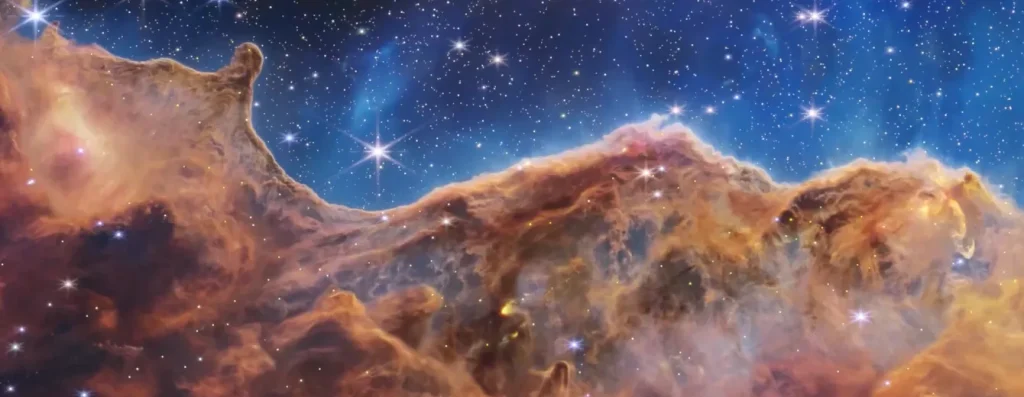
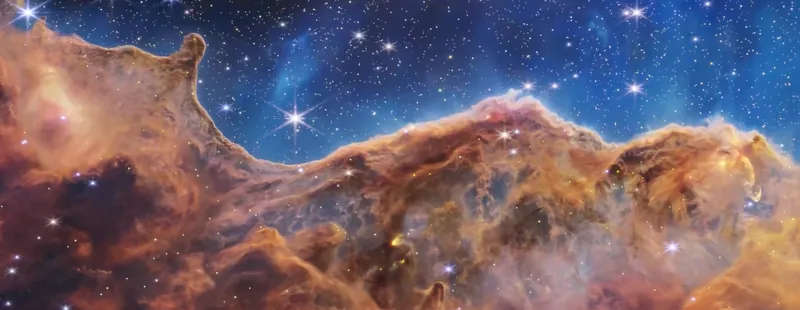
In July 2022, NASA’s James Webb Space Telescope made its public debut with a series of breathtaking images. Among them was an ethereal landscape nicknamed the Cosmic Cliffs. This glittering realm of star birth is the subject of a new 3D visualization derived from the Webb data. The visualization, created by NASA’s Universe of Learning and titled “Exploring the Cosmic Cliffs in 3D,” breathes new life into an iconic Webb image.
It is being presented today at a special event hosted by the International Planetarium Society to commemorate the 100th anniversary of the first public planetarium in Munich, Germany.
The landscape of “mountains” and “valleys” known as the Cosmic Cliffs is actually a portion of the nebula Gum 31, which contains a young star cluster called NGC 3324. Both Gum 31 and NGC 3324 are part of a vast star-forming region known as the Carina Nebula Complex.
Ultraviolet light and stellar winds from the stars of NGC 3324 have carved a cavernous area within Gum 31. A portion of this giant bubble is seen above the Cosmic Cliffs. (The star cluster itself is outside this field of view.)
The Cliffs display a misty appearance, with “steam” that seems to rise from the celestial mountains. In actuality, the wisps are hot, ionized gas and dust streaming away from the nebula under an onslaught of relentless ultraviolet radiation.
Eagle-eyed viewers may also spot particularly bright, yellow streaks and arcs that represent outflows from young, still-forming stars embedded within the Cosmic Cliffs. The latter part of the visualization sequence swoops past a prominent protostellar jet in the upper right of the image.
Video: Exploring the Cosmic Cliffs in 3D
Produced for NASA by the Space Telescope Science Institute (STScI) with partners at Caltech/IPAC, and developed by the AstroViz Project of NASA’s Universe of Learning, this visualization is part of a longer, narrated video that provides broad audiences, including youth, families, and lifelong learners, with a direct connection to the science and scientists of NASA’s Astrophysics missions. That video enables viewers to explore fundamental questions in science, experience how science is done, and discover the universe for themselves.
“Bringing this amazing Webb image to life helps the public to comprehend the three-dimensional structure inherent in the 2D image, and to develop a better mental model of the universe,” said STScI’s Frank Summers, principal visualization scientist and leader of the AstroViz Project.
More visualizations and connections between the science of nebulas and learners can be explored through other products produced by NASA’s Universe of Learning including a Carina Nebula Complex resource page and ViewSpace, a video exhibit that is currently running at almost 200 museums and planetariums across the United States. Visitors can go beyond video to explore the images produced by space telescopes with interactive tools now available for museums and planetariums.
NASA’s Universe of Learning materials are based upon work supported by NASA under award number NNX16AC65A to the Space Telescope Science Institute, working in partnership with Caltech/IPAC, Center for Astrophysics | Harvard & Smithsonian, and NASA’s Jet Propulsion Laboratory.
The James Webb Space Telescope is the world’s premier space science observatory. Webb is solving mysteries in our solar system, looking beyond to distant worlds around other stars, and probing the mysterious structures and origins of our universe and our place in it. Webb is an international program led by NASA with its partners, ESA (European Space Agency) and CSA (Canadian Space Agency).
NASA’s Universe of Learning is part of the NASA Science Activation program, from the Science Mission Directorate at NASA Headquarters. The Science Activation program connects NASA science experts, real content and experiences, and community leaders in a way that activates minds and promotes deeper understanding of our world and beyond. Using its direct connection to the science and the experts behind the science, NASA’s Universe of Learning provides resources and experiences that enable youth, families, and lifelong learners to explore fundamental questions in science, experience how science is done, and discover the universe for themselves.
Downloads & Related Information
The following sections contain links to download this article’s images and videos in all available resolutions followed by related information links, media contacts, and if available, research paper and Spanish translation links.
Related Images & Videos
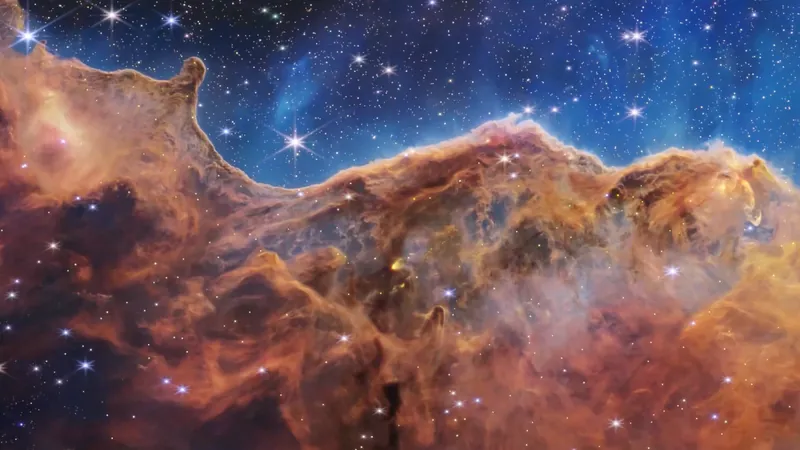
Exploring the Cosmic Cliffs in 3D
This visualization presents a flight through the ethereal landscape of NASA’s James Webb Space Telescope’s famous image nicknamed “ Cosmic Cliffs .” These cliffs are a spectacular ridge of dust clouds, sparkling with a myriad of stars, along the edge of the nebula Gum 31. In a…
Star Formation from the Carina Nebula to the Cosmic Cliffs
This scientific visualization traverses the vast star-forming region of the Carina Nebula Complex using multiwavelength data from NASA space telescopes. The narrated journey explores clusters of massive young stars, the mottled structure of dust clouds, and high-energy X-ray…
Flight to the Carina Nebula Complex
This visualization travels across interstellar space to the vast star-forming region of the Carina Nebula Complex. Starting with the 2D sky as seen from Earth, the sequence traces out the nearby constellations and identifies some prominent star clusters in the widefield view….
Related Links
Explore more: Carina Nebula Complex from NASA’s Universe of Learning
Read more: Webb’s view of the Cosmic Cliffs
Listen: Carina Nebula sonification
Read more: Webb’s star formation discoveries
Share
Details
Last Updated
Sep 21, 2026
LocationNASA Goddard Space Flight Center
Contact
Media
Laura Betz
NASA’s Goddard Space Flight Center
Greenbelt, Maryland
laura.e.betz@nasa.gov
Christine Pulliam
Space Telescope Science Institute
Baltimore, Maryland
Related Terms
- James Webb Space Telescope (JWST)
- Astrophysics
- Goddard Space Flight Center
- Nebulae
- Science & Research
- Star-forming Nebulae
- Stars
- The Universe
Related Links and Documents
Keep Exploring
Discover More Topics From Webb
James Webb Space Telescope
Webb is the premier observatory of the next decade, serving thousands of astronomers worldwide. It studies every phase in the…
Science Overview
Webb Observatory
Webb Image Galleries
Source: NASA Science