Tag: Exoplanets
-
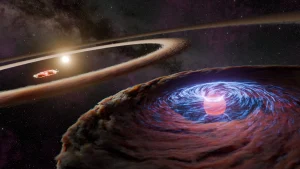
Discovery Alert: ‘Baby’ Planet Photographed in a Ring around a Star for the First Time!
The (Proto) Planet: WISPIT 2b The Discovery: Researchers have discovered a young protoplanet called WISPIT 2b embedded in a ring-shaped gap in a disk encircling a young star. While theorists have thought that planets likely exist in these gaps (and…
-
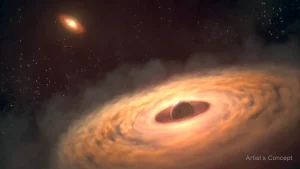
NASA’s Webb Telescope Studies Moon-Forming Disk Around Massive Planet
NASA’s James Webb Space Telescope has provided the first direct measurements of the chemical and physical properties of a potential moon-forming disk encircling a large exoplanet. The carbon-rich disk surrounding the world called CT Cha b, which is located 625…
-
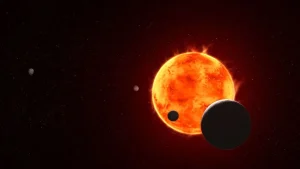
NASA Webb Looks at Earth-Sized, Habitable-Zone Exoplanet TRAPPIST-1 e
Scientists are in the midst of observing the exoplanet TRAPPIST-1 e with NASA’s James Webb Space Telescope. Careful analysis of the results so far presents several potential scenarios for what the planet’s atmosphere and surface may be like, as NASA…
-
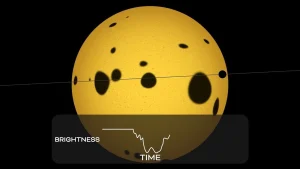
Astronomers Map Stellar ‘Polka Dots’ Using NASA’s TESS, Kepler
Scientists have devised a new method for mapping the spottiness of distant stars by using observations from NASA missions of orbiting planets crossing their stars’ faces. The model builds on a technique researchers have used for decades to study star…
-
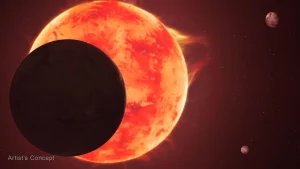
Webb Narrows Atmospheric Possibilities for Earth-sized Exoplanet TRAPPIST-1 d
The exoplanet TRAPPIST-1 d intrigues astronomers looking for possibly habitable worlds beyond our solar system because it is similar in size to Earth, rocky, and resides in an area around its star where liquid water on its surface is theoretically…
-
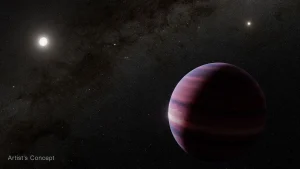
NASA’s Webb Finds New Evidence for Planet Around Closest Solar Twin
Astronomers using NASA’s James Webb Space Telescope have found strong evidence of a giant planet orbiting a star in the stellar system closest to our own Sun. At just 4 light-years away from Earth, the Alpha Centauri triple star system…
-
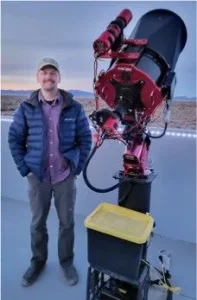
NASA Citizen Science and Your Career: Stories of Exoplanet Watch Volunteers
Doing NASA Science brings many rewards. But can taking part in NASA citizen science help your career? To find out, we asked participants in NASA’s Exoplanet Watch project about their experiences. In this project, amateur astronomers work together with professionals…
-
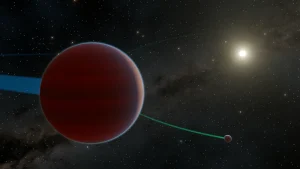
Discovery Alert: Scientists Spot a Planetary Carousel
The Planets KOI-134 b and KOI-134 c The Discovery A new investigation into old Kepler data has revealed that a planetary system once thought to house zero planets actually has two planets which orbit their star in a unique style,…
-
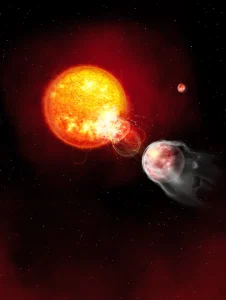
Discovery Alert: Flaring Star, Toasted Planet
The Discovery A giant planet some 400 light-years away, HIP 67522 b, orbits its parent star so tightly that it appears to cause frequent flares from the star’s surface, heating and inflating the planet’s atmosphere. Key Facts On planet Earth,…
-
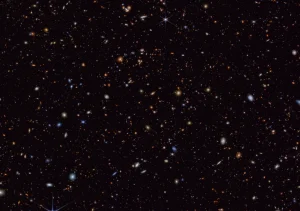
3 Years of Science: 10 Cosmic Surprises from NASA’s Webb Telescope
Since July 2022, NASA’s James Webb Space Telescope has been unwaveringly focused on our universe. With its unprecedented power to detect and analyze otherwise invisible infrared light, Webb is making observations that were once impossible, changing our view of the…