Tag: Goddard Space Flight Center
-
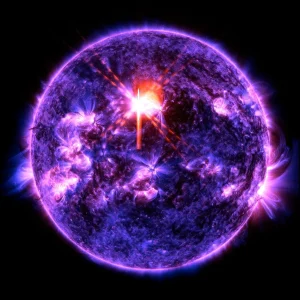
To Protect Artemis II Astronauts, NASA Experts Keep Eyes on Sun
As four astronauts travel around the Moon on NASA’s Artemis II mission, they will venture beyond Earth’s protective magnetic field. The crew’s spacecraft, Orion, will carry and protect them as they journey into deep space and serves as the main…
-
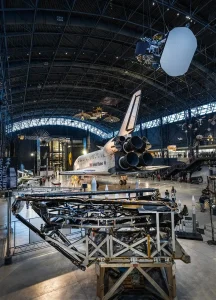
Artifacts From NASA’s Webb, Parker Solar Probe on View at Smithsonian
A testing replica of the “backbone” of NASA’s James Webb Space Telescope and a full-scale model of the agency’s Parker Solar Probe are now on permanent display at the Smithsonian’s National Air and Space Museum, Steven F. Udvar-Hazy Center in…
-
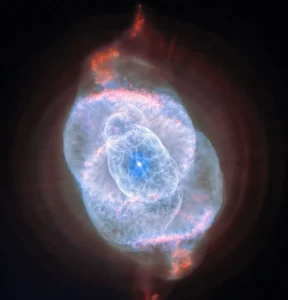
Two Observatories, One Cosmic Eye: Hubble and Euclid View Cat’s Eye Nebula
This new NASA/ESA Hubble Space Telescope image features one of the most visually intricate remnants of a dying star: the Cat’s Eye Nebula, also known as NGC 6543. This extraordinary planetary nebula lies in the constellation Draco and has captivated…
-
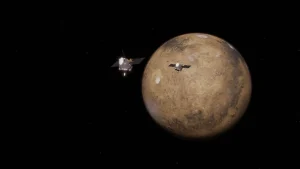
NASA’s ESCAPADE Ready to Study Space Weather from Earth to Mars
Mars is not what it used to be. Once warm, watery, and blanketed by a thick atmosphere, today the Red Planet is cold, dry, and draped by a thin atmospheric veil. The main culprit is a relentless stream of particles…
-
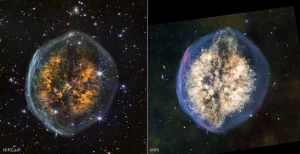
NASA’s Webb Examines Cranium Nebula
Two heads are better than one in the latest images from NASA’s James Webb Space Telescope, which reveal new detail in a mysterious, little-studied nebula surrounding a dying star. Nebula PMR 1 is a cloud of gas and dust that…
-
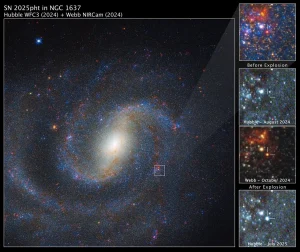
NASA’s Webb Telescope Locates Former Star That Exploded as Supernova
Forty million years ago, a star in a nearby galaxy exploded, spewing material across space and generating a brilliant beacon of light. That light traveled across the cosmos, reaching Earth June 29, 2025, where it was detected by the All-Sky…
-
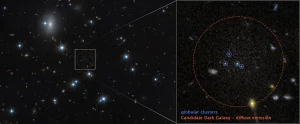
NASA’s Hubble Identifies One of Darkest Known Galaxies
In the vast tapestry of the universe, most galaxies shine brightly across cosmic time and space. Yet a rare class of galaxies remains nearly invisible — low-surface-brightness galaxies dominated by dark matter and containing only a sparse scattering of faint…
-
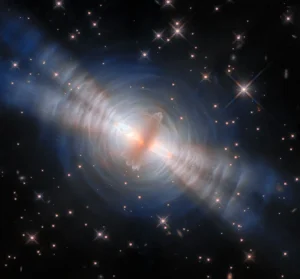
NASA’s Hubble Captures Light Show Around Rapidly Dying Star
This stunning image from NASA’s Hubble Space Telescope reveals a dramatic interplay of light and shadow in the Egg Nebula, sculpted by freshly ejected stardust. Located approximately 1,000 light-years away in the constellation Cygnus, the Egg Nebula features a central…
-
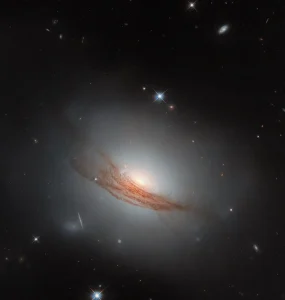
Hubble Sees Galaxy with Dark Rings in New Light
This NASA/ESA Hubble Space Telescope image features an uncommon galaxy with a striking appearance. NGC 7722 is a lenticular galaxy located about 187 million light-years away in the constellation Pegasus. A lenticular, meaning “lens-shaped,” galaxy is a type whose classification…
-
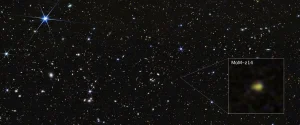
NASA Webb Pushes Boundaries of Observable Universe Closer to Big Bang
NASA’s James Webb Space Telescope has topped itself once again, delivering on its promise to push the boundaries of the observable universe closer to cosmic dawn with the confirmation of a bright galaxy that existed 280 million years after the…