Tag: Heliophysics
-
New NASA Mission to Reveal Earth’s Invisible ‘Halo’
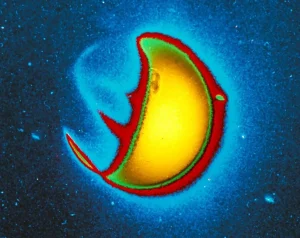
This story is also available in Spanish. A new NASA mission will capture images of Earth’s invisible “halo,” the faint light given off by our planet’s outermost atmospheric layer, the exosphere, as it morphs and changes in response to the…
-
NASA’s IMAP Mission to Study Boundaries of Our Home in Space
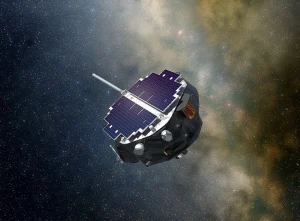
Summary Space is a dangerous place — one that NASA continues to explore for the benefit of all. It’s filled with radiation and high-energy particles that can damage DNA and circuit boards alike. Yet life endures in our solar system…
-
NASA Launching Rockets Into Radio-Disrupting Clouds
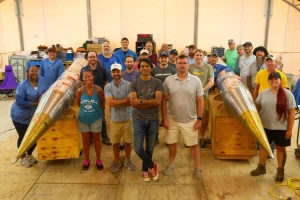
UPDATE June 30, 2025: The second rocket of the SEED mission launched on Saturday, June 28, at 8:11 p.m. Marshall Islands Time (MHT). Principal investigator Aroh Barjatya reports that the rocket launched into active science conditions in the ionosphere and…
-
NASA Observes First Visible-light Auroras at Mars
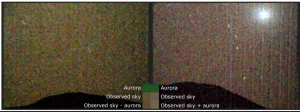
On March 15, 2024, near the peak of the current solar cycle, the Sun produced a solar flare and an accompanying coronal mass ejection (CME), a massive explosion of gas and magnetic energy that carries with it large amounts of…
-
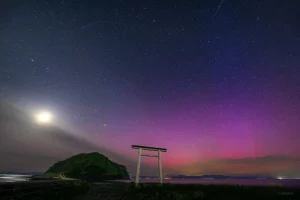
What NASA Is Learning from the Biggest Geomagnetic Storm in 20 Years
One year on, NASA scientists are still making huge discoveries about the largest geomagnetic storm to hit Earth in two decades, the Gannon storm. The findings are helping us better understand and prepare for the ways in which the Sun’s…
-
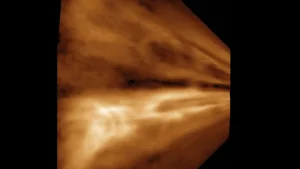
Can Solar Wind Make Water on Moon? NASA Experiment Shows Maybe
Scientists have hypothesized since the 1960s that the Sun is a source of ingredients that form water on the Moon. When a stream of charged particles known as the solar wind smashes into the lunar surface, the idea goes, it…
-
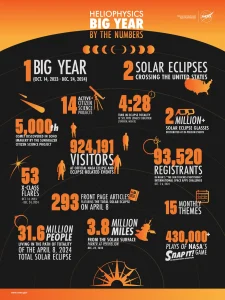
Eclipses, Science, NASA Firsts: Heliophysics Big Year Highlights
One year ago today, a total solar eclipse swept across the United States. The event was a cornerstone moment in the Heliophysics Big Year, a global celebration of the Sun’s influence on Earth and the entire solar system. From October…
-
The Autonomous Ion Mass Spectrometer Sentry: Observing Ionospheric Plasma and Monitoring Contamination for the International Space Station
A team at Los Alamos National Laboratory is leveraging SMD-funded technology developments to design a novel sensor that examines the interactions between space plasma and the plumes generated by the thrusters of spacecraft delivering supplies and crew members to the…
-
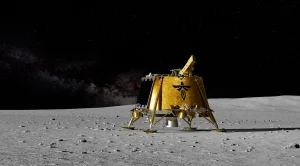
NASA’s LEXI Will Provide X-Ray Vision of Earth’s Magnetosphere
Editor’s Note, Feb. 25, 2025: The LEXI telescope was turned on successfully shortly after launch on Jan. 16. The instrument has operated for several hours every day conducting checkouts and initial commissioning, operating for a total of more than 50…
-
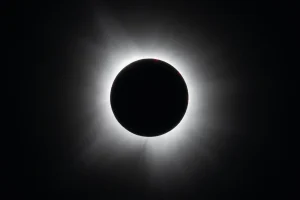
Scientists Share Early Results from NASA’s Solar Eclipse Experiments
On April 8, 2024, a total solar eclipse swept across North America, from the western shores of Mexico, through the United States, and into northeastern Canada. For the eclipse, NASA helped fund numerous research projects and called upon citizen scientists…