Tag: Origin & Evolution of the Universe
-
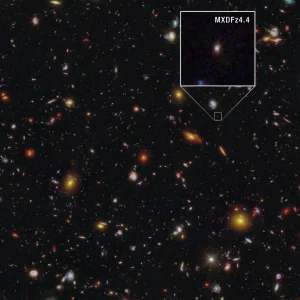
Hubble Details Early Galaxy Transforming Neighborhood
Astronomers using NASA’s Hubble Space Telescope have found something they never expected — ultraviolet light from a galaxy that existed just 1.4 billion years after the big bang.
-
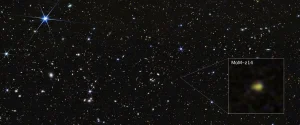
NASA Webb Pushes Boundaries of Observable Universe Closer to Big Bang
NASA’s James Webb Space Telescope has topped itself once again, delivering on its promise to push the boundaries of the observable universe closer to cosmic dawn with the confirmation of a bright galaxy that existed 280 million years after the…
-
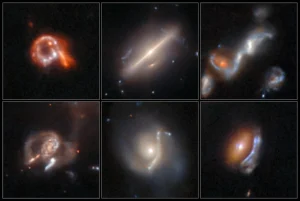
AI Unlocks Hundreds of Cosmic Anomalies in Hubble Archive
A team of astronomers has employed a cutting-edge, artificial intelligence-assisted technique to uncover rare astronomical phenomena within archived data from NASA’s Hubble Space Telescope. The team analyzed nearly 100 million image cutouts from the Hubble Legacy Archive, each measuring just…
-
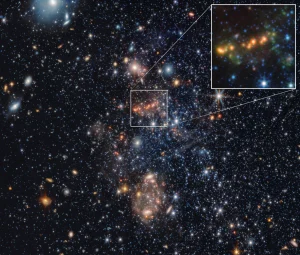
NASA Webb Finds Early-Universe Analog’s Unexpected Talent for Making Dust
Using NASA’s James Webb Space Telescope, astronomers have spotted two rare kinds of dust in the dwarf galaxy Sextans A, one of the most chemically primitive galaxies near the Milky Way.
-
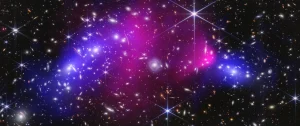
NASA Webb ‘Pierces’ Bullet Cluster, Refines Its Mass
NASA’s James Webb Space Telescope recently zeroed in on the Bullet Cluster — delivering highly detailed images that show a greater abundance of extremely faint and distant galaxies than ever before. Using Webb’s crisp near-infrared observations of this region, researchers…
-
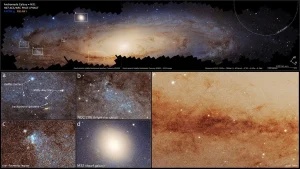
NASA’s Hubble Traces Hidden History of Andromeda Galaxy
In the years following the launch of NASA’s Hubble Space Telescope, astronomers have tallied over 1 trillion galaxies in the universe. But only one galaxy stands out as the most important nearby stellar island to our Milky Way — the…
-
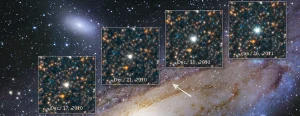
NASA Celebrates Edwin Hubble’s Discovery of a New Universe
For humans, the most important star in the universe is our Sun. The second-most important star is nestled inside the Andromeda galaxy. Don’t go looking for it — the flickering star is 2.2 million light-years away, and is 1/100,000th the…
-
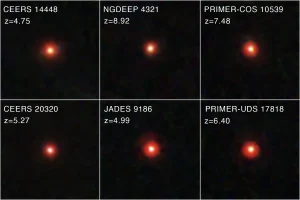
Newfound Galaxy Class May Indicate Early Black Hole Growth, Webb Finds
In December 2022, less than six months after commencing science operations, NASA’s James Webb Space Telescope revealed something never seen before: numerous red objects that appear small on the sky, which scientists soon called “little red dots” (LRDs). Though these…
-

NASA’s GUSTO Prepares to Map Space Between the Stars
Editor’s Note: The GUSTO mission successfully launched on a scientific balloon from Antarctica Dec. 31, 7:30 p.m. local time (Dec. 31, 1:30 a.m EST). The balloon is floating 128,000 feet above Earth’s surface and can be tracked in real-time on…