Tag: The Kuiper Belt
-

NASA’s New Horizons Spacecraft Wakes from Hibernation in Good Health
Following its longest hibernation period ever of nearly a year, NASA’s New Horizons spacecraft has emerged in good health and is ready to begin transmitting science data gathered in the distant Kuiper Belt far beyond Pluto. On June 23, flight…
-
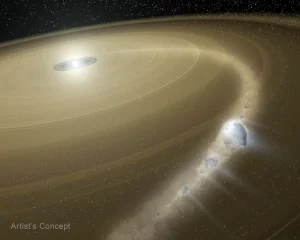
NASA’s Hubble Sees White Dwarf Eating Piece of Pluto-Like Object
In our nearby stellar neighborhood, a burned-out star is snacking on a fragment of a Pluto-like object. With its unique ultraviolet capability, only NASA’s Hubble Space Telescope could identify that this meal is taking place. The stellar remnant is a…
-
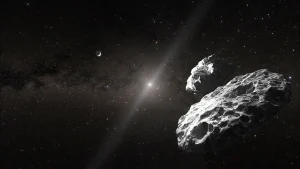
NASA’s Hubble Finds Kuiper Belt Duo May Be Trio
The puzzle of predicting how three gravitationally bound bodies move in space has challenged mathematicians for centuries, and has most recently been popularized in the novel and television show “3 Body Problem.” There’s no problem, however, with what a team…
-

10 Things: What’s That Space Rock?
The path through the solar system is a rocky road. Asteroids, comets, Kuiper Belt Objects—all kinds of small bodies of rock, metal and ice are in constant motion as they orbit the Sun. But what’s the difference between them? Why…
-
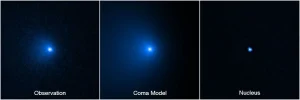
Hubble Confirms Largest Comet Nucleus Ever Seen
NASA’s Hubble Space Telescope has determined the size of the largest icy comet nucleus ever seen by astronomers. The estimated diameter is approximately 80 miles across, making it larger than the state of Rhode Island. The nucleus is about 50…
-
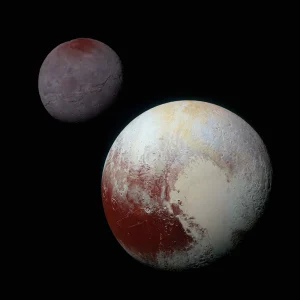
NASA’s Webb To Examine Objects in the Graveyard of the Solar System
Beyond the orbit of Neptune, a diverse collection of thousands of dwarf planets and other relatively small objects dwells in a region called the Kuiper Belt. These often-pristine leftovers from our solar system’s days of planet formation are called Kuiper…