6 Min Read
NASA’s Webb Reveals Intricate Layers of Interstellar Dust, Gas
NASA, ESA, CSA, STScI, J. Jencson (Caltech/IPAC)
Once upon a time, the core of a massive star collapsed, creating a shockwave that blasted outward, ripping the star apart as it went. When the shockwave reached the star’s surface, it punched through, generating a brief, intense pulse of X-rays and ultraviolet light that traveled outward into the surrounding space. About 350 years later, that pulse of light has reached interstellar material, illuminating it, warming it, and causing it to glow in infrared light.
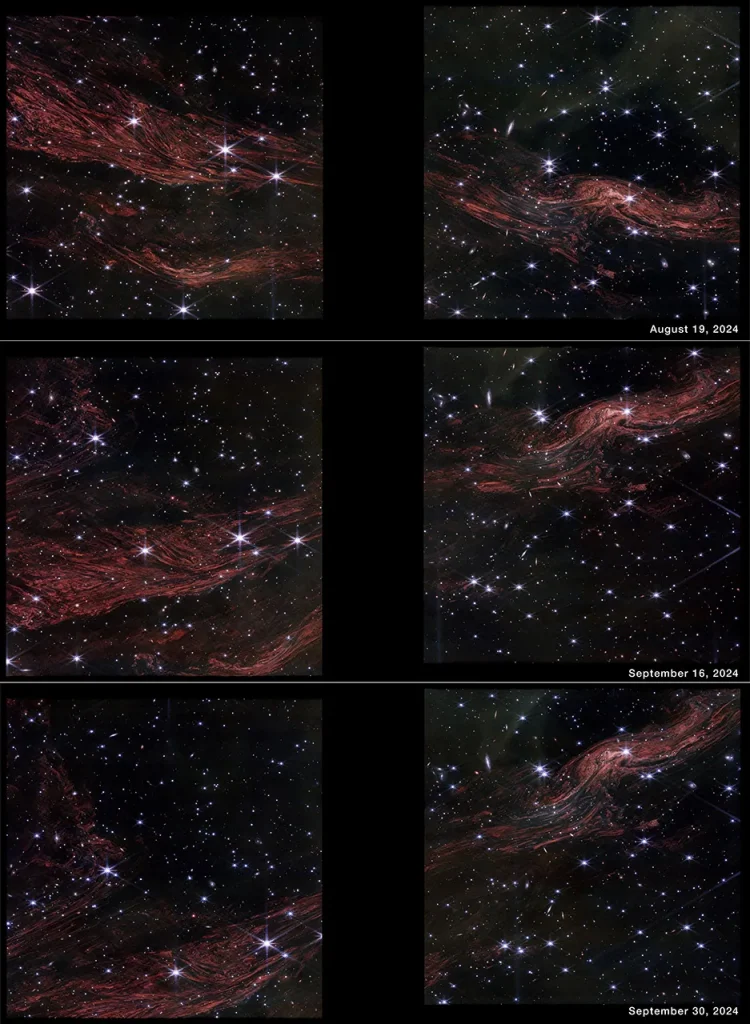
NASA’s James Webb Space Telescope has observed that infrared glow, revealing fine details resembling the knots and whorls of wood grain. These observations are allowing astronomers to map the true 3D structure of this interstellar dust and gas (known as the interstellar medium) for the first time.
“We were pretty shocked to see this level of detail,” said Jacob Jencson of Caltech/IPAC in Pasadena, principal investigator of the science program.
“We see layers like an onion,” added Josh Peek of the Space Telescope Science Institute in Baltimore, a member of the science team. “We think every dense, dusty region that we see, and most of the ones we don’t see, look like this on the inside. We just have never been able to look inside them before.”
The team is presenting their findings in a press conference at the 245th meeting of the American Astronomical Society in Washington.
“Even as a star dies, its light endures—echoing across the cosmos. It’s been an extraordinary three years since we launched NASA’s James Webb Space Telescope. Every image, every discovery, shows a portrait not only of the majesty of the universe but the power of the NASA team and the promise of international partnerships. This groundbreaking mission, NASA’s largest international space science collaboration, is a true testament to NASA’s ingenuity, teamwork, and pursuit of excellence,” said NASA Administrator Bill Nelson. “What a privilege it has been to oversee this monumental effort, shaped by the tireless dedication of thousands of scientists and engineers around the globe. This latest image beautifully captures the lasting legacy of Webb—a keyhole into the past and a mission that will inspire generations to come.”
Image: Light Echoes Near Cassiopeia A (NIRCam)
Video: Light Echoes Near Cassiopeia A (NIRCam)
Taking a CT Scan
The images from Webb’s NIRCam (Near-Infrared Camera) highlight a phenomenon known as a light echo. A light echo is created when a star explodes or erupts, flashing light into surrounding clumps of dust and causing them to shine in an ever-expanding pattern. Light echoes at visible wavelengths (such as those seen around the star V838 Monocerotis) are due to light reflecting off of interstellar material. In contrast, light echoes at infrared wavelengths are caused when the dust is warmed by energetic radiation and then glows.
The researchers targeted a light echo that had previously been observed by NASA’s retired Spitzer Space Telescope. It is one of dozens of light echoes seen near the Cassiopeia A supernova remnant – the remains of the star that exploded. The light echo is coming from unrelated material that is behind Cassiopeia A, not material that was ejected when the star exploded.
The most obvious features in the Webb images are tightly packed sheets. These filaments show structures on remarkably small scales of about 400 astronomical units, or less than one-hundredth of a light-year. (An astronomical unit, or AU, is the average Earth-Sun distance. Neptune’s orbit is 60 AU in diameter.)
“We did not know that the interstellar medium had structures on that small of a scale, let alone that it was sheet-like,” said Peek.
These sheet-like structures may be influenced by interstellar magnetic fields. The images also show dense, tightly wound regions that resemble knots in wood grain. These may represent magnetic “islands” embedded within the more streamlined magnetic fields that suffuse the interstellar medium.
“This is the astronomical equivalent of a medical CT scan,” explained Armin Rest of the Space Telescope Science Institute, a member of the science team. “We have three slices taken at three different times, which will allow us to study the true 3D structure. It will completely change the way we study the interstellar medium.”
Image: Cassiopeia A (Spitzer with Webb Insets)
Future Work
The team’s science program also includes spectroscopic observations using Webb’s MIRI (Mid-Infrared Instrument). They plan to target the light echo multiple times, weeks or months apart, to observe how it evolves as the light echo passes by.
“We can observe the same patch of dust before, during, and after it’s illuminated by the echo and try to look for any changes in the compositions or states of the molecules, including whether some molecules or even the smallest dust grains are destroyed,” said Jencson.
Infrared light echoes are also extremely rare, since they require a specific type of supernova explosion with a short pulse of energetic radiation. NASA’s upcoming Nancy Grace Roman Space Telescope will conduct a survey of the galactic plane that may find evidence of additional infrared light echoes for Webb to study in detail.
The James Webb Space Telescope is the world’s premier space science observatory. Webb is solving mysteries in our solar system, looking beyond to distant worlds around other stars, and probing the mysterious structures and origins of our universe and our place in it. Webb is an international program led by NASA with its partners, ESA (European Space Agency) and CSA (Canadian Space Agency).
Downloads & Related Information
The following sections contain links to download this article’s images and videos in all available resolutions followed by related information links, media contacts, and if available, research paper and Spanish translation links.
Related Images & Videos
Cassiopeia A Light Echoes (NIRCam Images)
These shimmering cosmic curtains show interstellar gas and dust that has been heated by the flashbulb explosion of a long-ago supernova. The gas then glows infrared light in what is known as a thermal light echo. As the supernova illumination travels through space at the speed…
Cassiopeia A Light Echoes (Spitzer Context)
This background image of the region around supernova remnant Cassiopeia A was released by NASA’s Spitzer Space Telescope in 2008 . By taking multiple images of this region over three years with Spitzer, researchers were able to examine a number of light echoes. Now, NASA’s James…
Cassiopeia A Light Echoes (Compass Image)
Image of light echoes near Cassiopeia A captured by Webb’s NIRCam instrument, with compass arrows, scale bar, and color key for reference. The north and east compass arrows show the orientation of the image on the sky. Note that the relationship between north and east on the sky…
Cassiopeia A Light Echoes Time-lapse
This time-lapse video using data from NASA’s James Webb Space Telescope highlights the evolution of one light echo in the vicinity of the supernova remnant Cassiopeia A. A light echo is created when a star explodes or erupts, flashing light into surrounding clumps of…
Related Links
Articles: Past Webb news releases on Cassiopeia A
Interactive: Explore light echoes in V838 Monocerotis
Videos: Learn more about supernovas.
Share
Details
Last Updated
Sep 21, 2026
LocationNASA Goddard Space Flight Center
Contact
Media
Laura Betz
NASA’s Goddard Space Flight Center
Greenbelt, Maryland
laura.e.betz@nasa.gov
Christine Pulliam
Space Telescope Science Institute
Baltimore, Maryland
Science
Jacob Jencson (Caltech/IPAC)
Related Terms
- James Webb Space Telescope (JWST)
- Astrophysics
- Goddard Space Flight Center
- Nebulae
- Science & Research
- Supernova Remnants
- Supernovae
- The Universe
Related Links and Documents
Keep Exploring
Related Topics
James Webb Space Telescope
Webb is the premier observatory of the next decade, serving thousands of astronomers worldwide. It studies every phase in the…
Stars Stories
Universe
Spitzer Space Telescope
Spitzer uses an ultra-sensitive infrared telescope to study asteroids, comets, planets and distant galaxies.
Source: NASA Science