5 min read
Hubble Finds First Evidence of Water Vapor at Jupiter’s Moon Ganymede
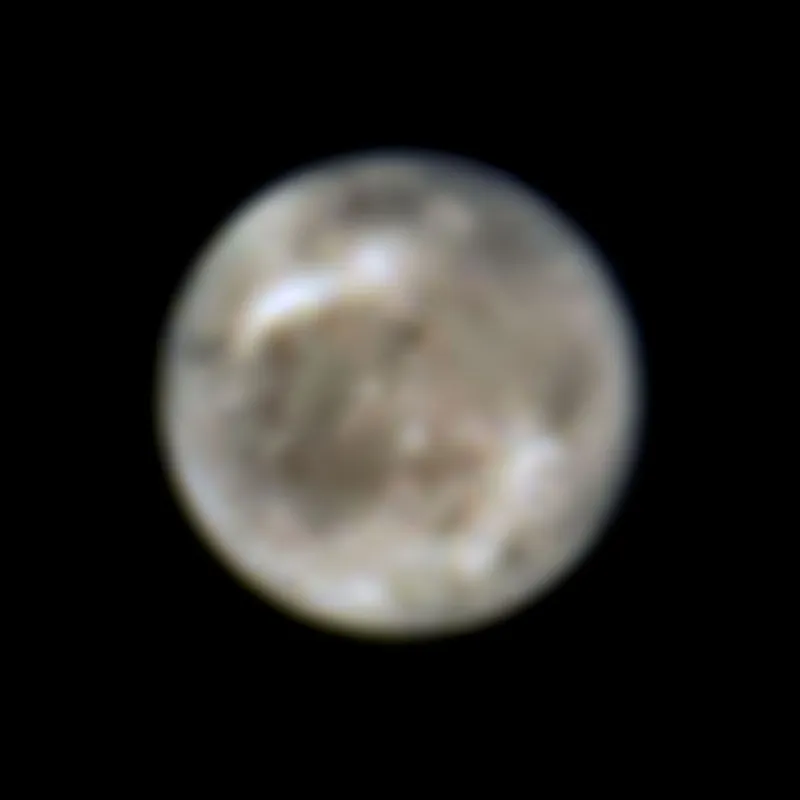
For the first time, astronomers have uncovered evidence of water vapor in the atmosphere of Jupiter’s moon Ganymede. This water vapor forms when ice from the moon’s surface sublimates — that is, turns from solid to gas.
Scientists used new and archival datasets from NASA’s Hubble Space Telescope to make the discovery, published in the journal Nature Astronomy.
Previous research has offered circumstantial evidence that Ganymede, the largest moon in the solar system, contains more water than all of Earth’s oceans. However, temperatures there are so cold that water on the surface is frozen solid. Ganymede’s ocean would reside roughly 100 miles below the crust; therefore, the water vapor would not represent the evaporation of this ocean.
Astronomers re-examined Hubble observations from the last two decades to find this evidence of water vapor.
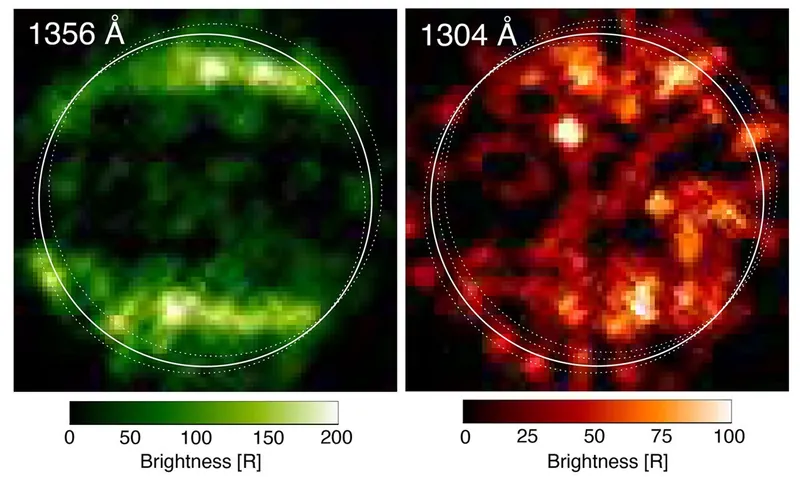
In 1998, Hubble’s Space Telescope Imaging Spectrograph took the first ultraviolet (UV) images of Ganymede, which revealed colorful ribbons of electrified gas called auroral bands, and provided further evidence that Ganymede has a weak magnetic field.
The similarities in these UV observations were explained by the presence of molecular oxygen (O2). But some observed features did not match the expected emissions from a pure O2 atmosphere. At the same time, scientists concluded this discrepancy was likely related to higher concentrations of atomic oxygen (O).
As part of a large observing program to support NASA’s Juno mission in 2018, Lorenz Roth of the KTH Royal Institute of Technology in Stockholm, Sweden led the team that set out to measure the amount of atomic oxygen with Hubble. The team’s analysis combined the data from two instruments: Hubble’s Cosmic Origins Spectrograph in 2018 and archival images from the Space Telescope Imaging Spectrograph (STIS) from 1998 to 2010.
To their surprise, and contrary to the original interpretations of the data from 1998, they discovered there was hardly any atomic oxygen in Ganymede’s atmosphere. This means there must be another explanation for the apparent differences in these UV aurora images.
Roth and his team then took a closer look at the relative distribution of the aurora in the UV images. Ganymede’s surface temperature varies strongly throughout the day, and around noon near the equator it may become sufficiently warm that the ice surface releases (or sublimates) some small amounts of water molecules. In fact, the perceived differences in the UV images are directly correlated with where water would be expected in the moon’s atmosphere.
“So far only the molecular oxygen had been observed,” explained Roth. “This is produced when charged particles erode the ice surface. The water vapor that we measured now originates from ice sublimation caused by the thermal escape of water vapor from warm icy regions.”
This finding adds anticipation to ESA (European Space Agency)’s upcoming mission, JUICE, which stands for JUpiter ICy moons Explorer. JUICE is the first large-class mission in ESA’s Cosmic Vision 2015-2025 program. Planned for launch in 2022 and arrival at Jupiter in 2029, it will spend at least three years making detailed observations of Jupiter and three of its largest moons, with particular emphasis on Ganymede as a planetary body and potential habitat.
Ganymede was identified for detailed investigation because it provides a natural laboratory for analysis of the nature, evolution and potential habitability of icy worlds in general, the role it plays within the system of Galilean satellites, and its unique magnetic and plasma interactions with Jupiter and its environment.
“Our results can provide the JUICE instrument teams with valuable information that may be used to refine their observation plans to optimize the use of the spacecraft,” added Roth.
Right now, NASA’s Juno mission is taking a close look at Ganymede and recently released new imagery of the icy moon. Juno has been studying Jupiter and its environment, also known as the Jovian system, since 2016.
Understanding the Jovian system and unravelling its history, from its origin to the possible emergence of habitable environments, will provide us with a better understanding of how gas giant planets and their satellites form and evolve. In addition, new insights will hopefully be found on the habitability of Jupiter-like exoplanetary systems.
The Hubble Space Telescope is a project of international cooperation between NASA and ESA (European Space Agency). NASA’s Goddard Space Flight Center in Greenbelt, Maryland, manages the telescope. The Space Telescope Science Institute (STScI) in Baltimore, Maryland, conducts Hubble science operations. STScI is operated for NASA by the Association of Universities for Research in Astronomy in Washington, D.C.
Related Images & Videos
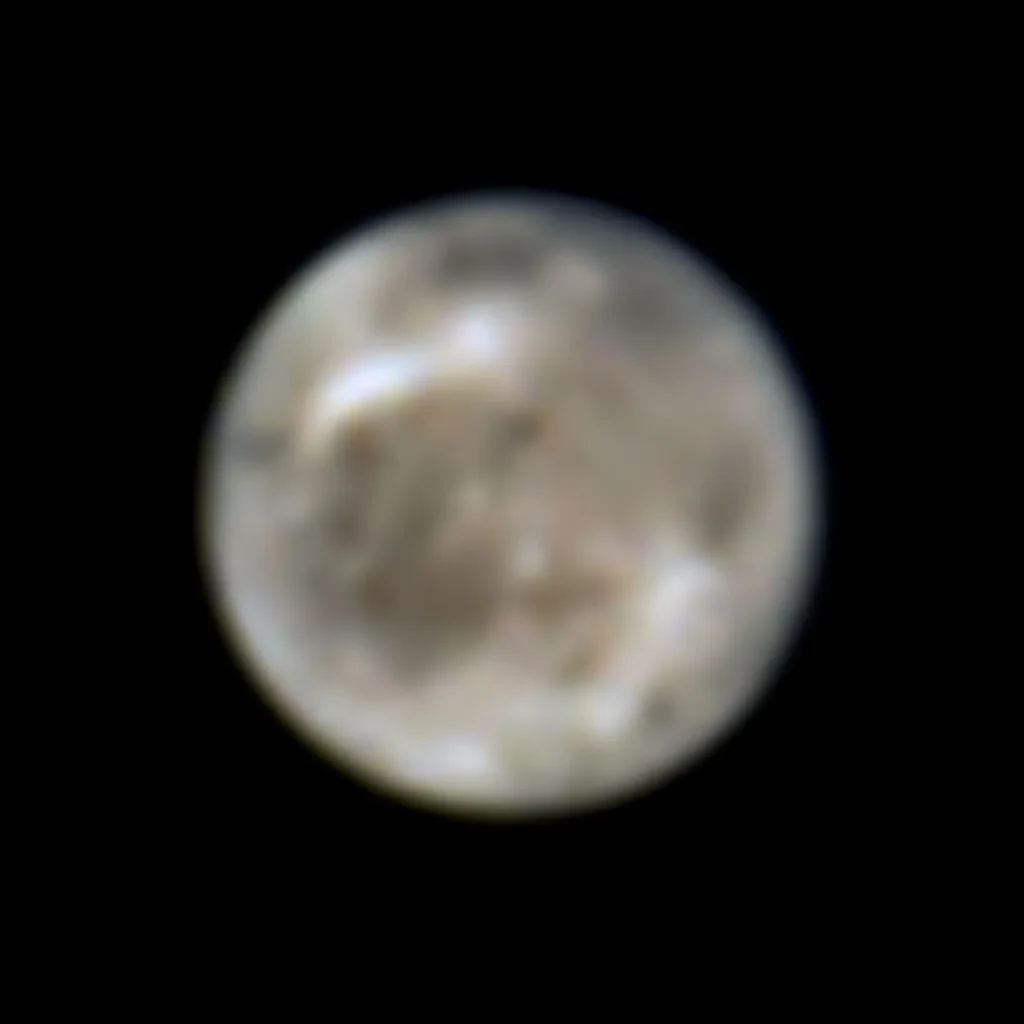
Hubble’s View of Ganymede in 1996
This image presents Jupiter’s moon Ganymede as seen by NASA’s Hubble Space Telescope in 1996. Located 1/2- billion miles (over 600 million kilometers) away, Hubble can follow changes on the moon and reveal other characteristics at ultraviolet and near-infrared wavelengths….
Hubble’s Ultraviolet Observations of Ganymede in 1998
In 1998, Hubble’s Space Telescope Imaging Spectrograph (STIS) took these first ultraviolet (UV) images of Ganymede, which revealed a particular pattern in the observed emissions from the moon’s atmosphere. The moon displays auroral bands that are somewhat similar to aurora…
Share
Details
Last Updated
Mar 31, 2025
LocationNASA Goddard Space Flight Center
Contact
Media
Claire Andreoli
NASA’s Goddard Space Flight Center
Greenbelt, Maryland
claire.andreoli@nasa.gov
Ray Villard
Space Telescope Science Institute
Baltimore, Maryland
Bethany Downer
ESA/Hubble.org
Science
Lorenz Roth
KTH Royal Institute of Technology
Stockholm, Sweden
Related Terms
- Exoplanet Atmosphere
- Hubble Space Telescope
- Jupiter
- Moons
- Planetary Environments & Atmospheres
- Planets
- The Solar System
Related Links and Documents
- NASA’s Hubble Portal
- ESA/Hubble.org’s Release
- Goddard’s Hubble Water Vapor on Ganymede Video (YouTube)
- Southwest Research Institute’s Press Release
- Science Paper: The science paper by L. Roth et al., PDF (1.00 MB)
- Noticias en español: El telescopio espacial Hubble encuentra la primera evidencia de vapor de agua en Ganimedes, luna de Júpiter, PDF (189.15 KB)
Keep Exploring
Discover More Topics From Hubble
Hubble Space Telescope
Since its 1990 launch, the Hubble Space Telescope has changed our fundamental understanding of the universe.
Hubble Science Highlights
Hubble’s most notable scientific discoveries reflect the broad range of research and the breakthroughs it has achieved.
Hubble Images
Explore Hubble’s iconic images of the universe, and view photos of mission operations and astronauts servicing Hubble in space.
Hubble News
Source: NASA Science