5 Min Read
NASA’s Webb Discovers New Feature in Jupiter’s Atmosphere
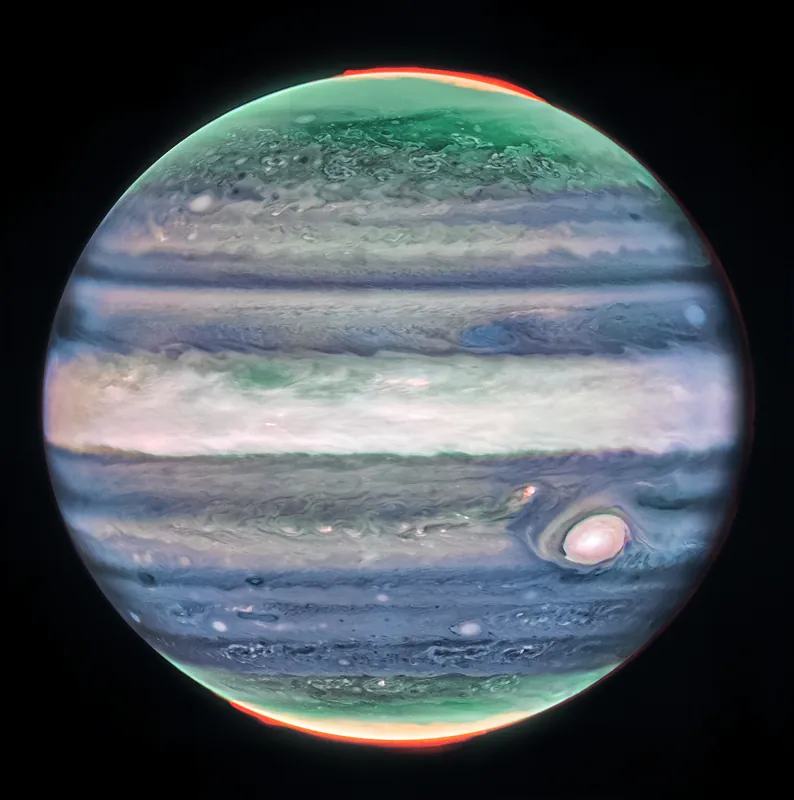
Image: NASA, ESA, CSA, STScI, Ricardo Hueso (UPV), Imke de Pater (UC Berkeley), Thierry Fouchet (Observatory of Paris), Leigh Fletcher (University of Leicester), Michael Wong (UC Berkeley), Joseph DePasquale (STScI)
NASA’s James Webb Space Telescope has discovered a new, never-before-seen feature in Jupiter’s atmosphere. The high-speed jet stream, which spans more than 3,000 miles (4,800 kilometers) wide, sits over Jupiter’s equator above the main cloud decks. The discovery of this jet is giving insights into how the layers of Jupiter’s famously turbulent atmosphere interact with each other, and how Webb is uniquely capable of tracking those features.
Image: Webb’s View of Jupiter
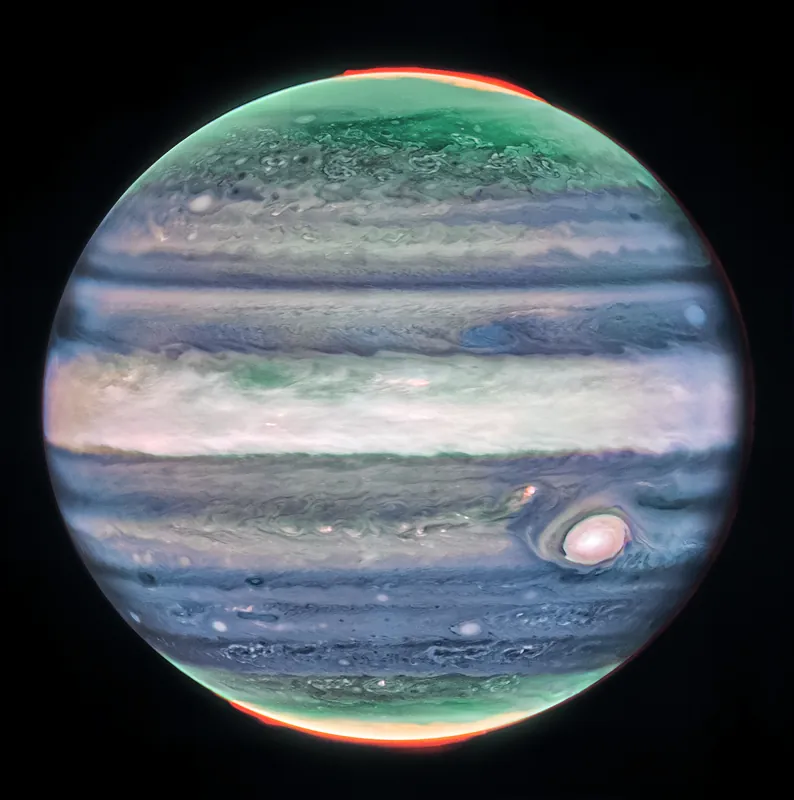
“This is something that totally surprised us,” said Ricardo Hueso of the University of the Basque Country in Bilbao, Spain, lead author on the paper describing the findings. “What we have always seen as blurred hazes in Jupiter’s atmosphere now appear as crisp features that we can track along with the planet’s fast rotation.”
The research team analyzed data from Webb’s NIRCam (Near-Infrared Camera) captured in July 2022. The Early Release Science program – jointly led by Imke de Pater from the University of California, Berkeley and Thierry Fouchet from the Observatory of Paris – was designed to take images of Jupiter 10 hours apart, or one Jupiter day, in four different filters, each uniquely able to detect changes in small features at different altitudes of Jupiter’s atmosphere.
“Even though various ground-based telescopes, spacecraft like NASA’s Juno and Cassini, and NASA’s Hubble Space Telescope have observed the Jovian system’s changing weather patterns, Webb has already provided new findings on Jupiter’s rings, satellites, and its atmosphere,” de Pater noted.
While Jupiter is different from Earth in many ways – Jupiter is a gas giant, Earth is a rocky, temperate world – both planets have layered atmospheres. Infrared, visible, radio, and ultraviolet light wavelengths observed by these other missions detect the lower, deeper layers of the planet’s atmosphere – where gigantic storms and ammonia ice clouds reside.
Image: Jupiter’s Equatorial Jet Stream
On the other hand, Webb’s look farther into the near-infrared than before is sensitive to the higher-altitude layers of the atmosphere, around 15-30 miles (25-50 kilometers) above Jupiter’s cloud tops. In near-infrared imaging, high-altitude hazes typically appear blurry, with enhanced brightness over the equatorial region. With Webb, finer details are resolved within the bright hazy band.
The newly discovered jet stream travels at about 320 miles per hour (515 kilometers per hour), twice the sustained winds of a Category 5 hurricane here on Earth. It is located around 25 miles (40 kilometers) above the clouds, in Jupiter’s lower stratosphere.
By comparing the winds observed by Webb at high altitudes, to the winds observed at deeper layers from Hubble, the team could measure how fast the winds change with altitude and generate wind shears.
Image: Jupiter’s Winds
While Webb’s exquisite resolution and wavelength coverage allowed for the detection of small cloud features used to track the jet, the complementary observations from Hubble taken one day after the Webb observations were also crucial to determine the base state of Jupiter’s equatorial atmosphere and observe the development of convective storms in Jupiter’s equator not connected to the jet.
“We knew the different wavelengths of Webb and Hubble would reveal the three-dimensional structure of storm clouds, but we were also able to use the timing of the data to see how rapidly storms develop,” added team member Michael Wong of the University of California, Berkeley, who led the associated Hubble observations.
The researchers are looking forward to additional observations of Jupiter with Webb to determine if the jet’s speed and altitude change over time.
“Jupiter has a complicated but repeatable pattern of winds and temperatures in its equatorial stratosphere, high above the winds in the clouds and hazes measured at these wavelengths,” explained team member Leigh Fletcher of the University of Leicester in the United Kingdom. “If the strength of this new jet is connected to this oscillating stratospheric pattern, we might expect the jet to vary considerably over the next 2 to 4 years – it’ll be really exciting to test this theory in the years to come.”
“It’s amazing to me that, after years of tracking Jupiter’s clouds and winds from numerous observatories, we still have more to learn about Jupiter, and features like this jet can remain hidden from view until these new NIRCam images were taken in 2022,” continued Fletcher.
The researchers’ results were recently published in Nature Astronomy.
The James Webb Space Telescope is the world’s premier space science observatory. Webb is solving mysteries in our solar system, looking beyond to distant worlds around other stars, and probing the mysterious structures and origins of our universe and our place in it. Webb is an international program led by NASA with its partners, ESA (European Space Agency) and the Canadian Space Agency.
Downloads & Related Information
The following sections contain links to download this article’s images and videos in all available resolutions followed by related information links, media contacts, and if available, research paper and Spanish translation links.
Related Images & Videos
Jupiter (NIRCam Image)
This image of Jupiter from NASA’s James Webb Space Telescope’s NIRCam (Near-Infrared Camera) shows stunning details of the majestic planet in infrared light. In this image, brightness indicates high altitude. The numerous bright white “spots” and “streaks” are likely very…
Jupiter Jet Pullouts (NIRCam Image)
Researchers using NASA’s James Webb Space Telescope’s NIRCam (Near-Infrared Camera) have discovered a high-speed jet stream sitting over Jupiter’s equator, above the main cloud decks. At a wavelength of 2.12 microns, which observes between altitudes of about 12-21 miles (20-35…
Jupiter’s Atmosphere (Illustration)
Astronomers using NASA’s James Webb Space Telescope have discovered a high-speed jet stream traveling over Jupiter’s equator above the main cloud decks. The jet is traveling 320 miles per hour (515 kilometers per hour). It is located around 25 miles (40 kilometers) in altitude,…
Related Links
Share
Details
Last Updated
Sep 21, 2026
LocationNASA Goddard Space Flight Center
Contact
Media
Laura Betz
NASA’s Goddard Space Flight Center
Greenbelt, Maryland
laura.e.betz@nasa.gov
Hannah Braun
Space Telescope Science Institute
Baltimore, Maryland
Christine Pulliam
Space Telescope Science Institute
Baltimore, Maryland
Science Credit
Ricardo Hueso (UPV), Imke de Pater (UC Berkeley), Thierry Fouchet (Observatory of Paris), Leigh Fletcher (University of Leicester), Michael Wong (UC Berkeley)
Related Terms
- James Webb Space Telescope (JWST)
- Astrophysics
- Goddard Space Flight Center
- Jupiter
- Planetary Environments & Atmospheres
- Planets
- Science & Research
- The Solar System
Related Links and Documents
- Noticias en español: Webb descubre una nueva característica de la atmósfera de Júpiter, PDF (595.49 KB)
- The researchers’ results published in Nature Astronomy.
Keep Exploring
Discover More Topics From Webb
James Webb Space Telescope
Webb is the premier observatory of the next decade, serving thousands of astronomers worldwide. It studies every phase in the…
Science Overview
Webb Observatory
Webb Image Galleries
Source: NASA Science