4 Min Read
New Webb Image Captures Clearest View of Neptune’s Rings in Decades
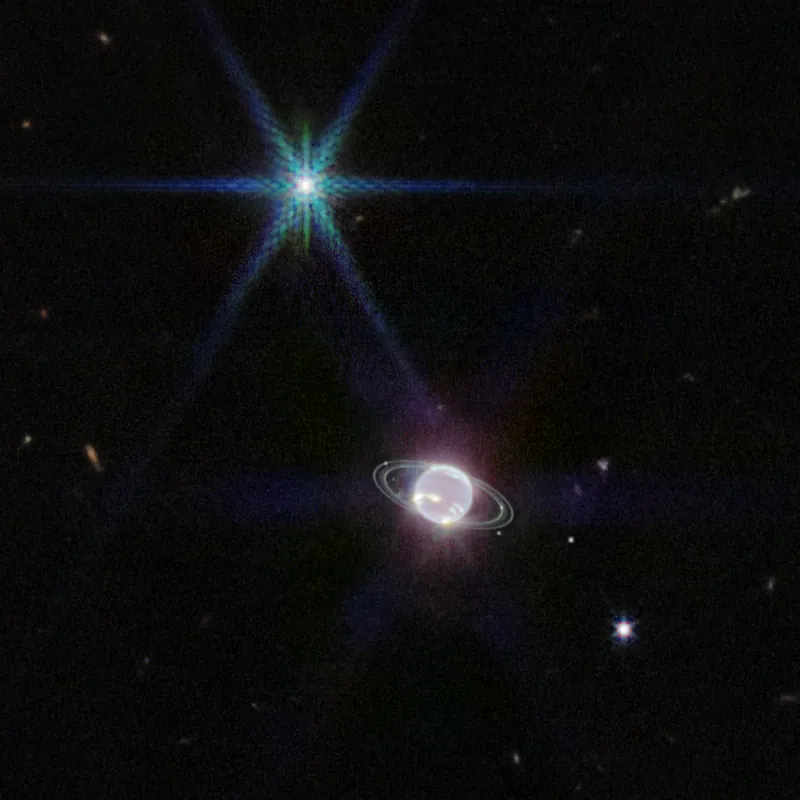
Image: NASA, ESA, CSA, STScI; Image Processing: Joseph DePasquale (STScI), Naomi Rowe-Gurney (NASA-GSFC)
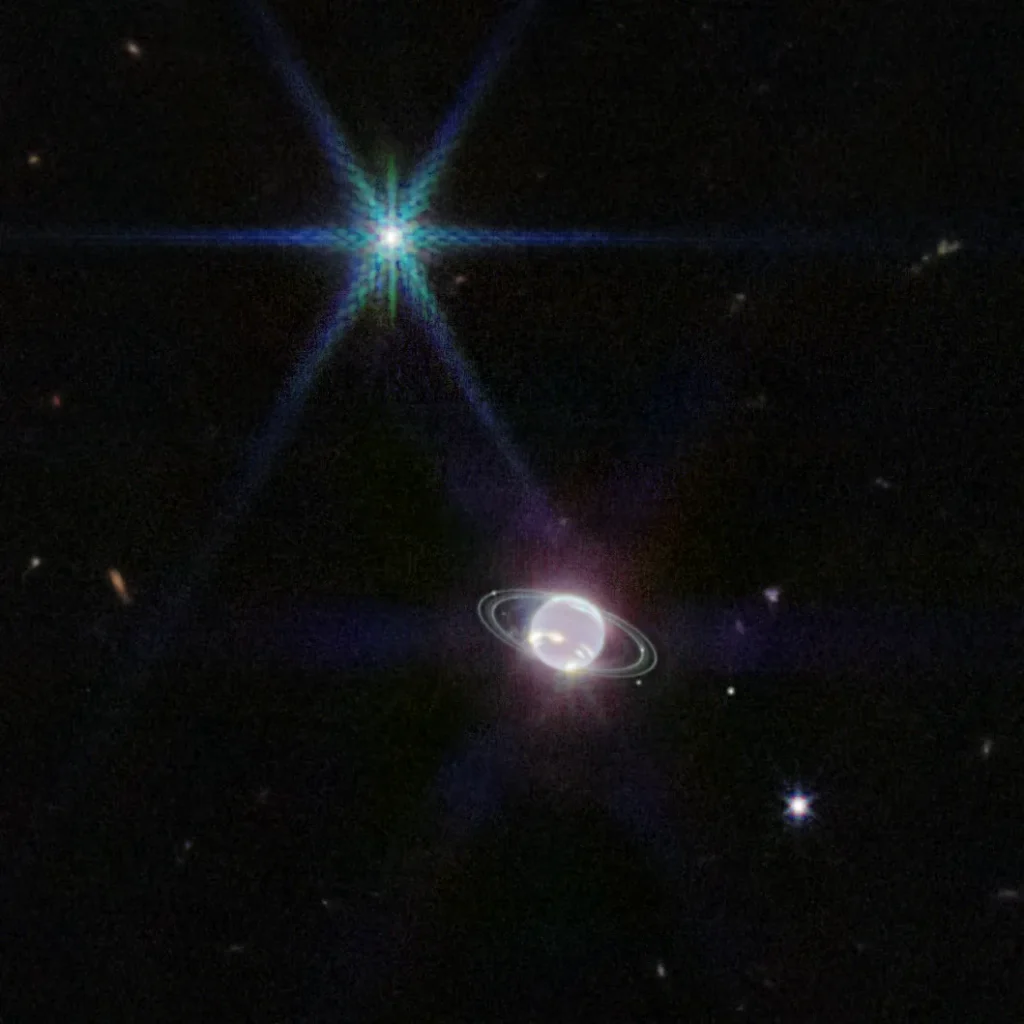
NASA’s James Webb Space Telescope shows off its capabilities closer to home with its first image of Neptune. Not only has Webb captured the clearest view of this distant planet’s rings in more than 30 years, but its cameras reveal the ice giant in a whole new light.
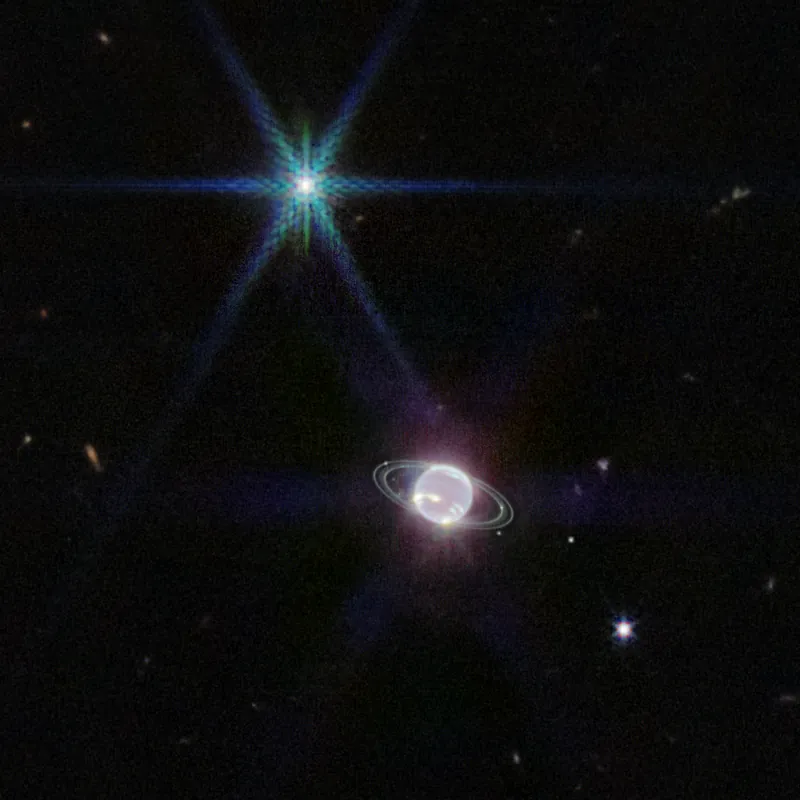
Most striking in Webb’s new image is the crisp view of the planet’s rings – some of which have not been detected since NASA’s Voyager 2 became the first spacecraft to observe Neptune during its flyby in 1989. In addition to several bright, narrow rings, the Webb image clearly shows Neptune’s fainter dust bands.
“It has been three decades since we last saw these faint, dusty rings, and this is the first time we’ve seen them in the infrared,” notes Heidi Hammel, a Neptune system expert and interdisciplinary scientist for Webb. Webb’s extremely stable and precise image quality permits these very faint rings to be detected so close to Neptune.
Neptune has fascinated researchers since its discovery in 1846. Located 30 times farther from the Sun than Earth, Neptune orbits in the remote, dark region of the outer solar system. At that extreme distance, the Sun is so small and faint that high noon on Neptune is similar to a dim twilight on Earth.
This planet is characterized as an ice giant due to the chemical make-up of its interior. Compared to the gas giants, Jupiter and Saturn, Neptune is much richer in elements heavier than hydrogen and helium. This is readily apparent in Neptune’s signature blue appearance in Hubble Space Telescope images at visible wavelengths, caused by small amounts of gaseous methane.
Webb’s Near-Infrared Camera (NIRCam) images objects in the near-infrared range from 0.6 to 5 microns, so Neptune does not appear blue to Webb. In fact, the methane gas so strongly absorbs red and infrared light that the planet is quite dark at these near-infrared wavelengths, except where high-altitude clouds are present. Such methane-ice clouds are prominent as bright streaks and spots, which reflect sunlight before it is absorbed by methane gas. Images from other observatories, including the Hubble Space Telescope and the W.M. Keck Observatory, have recorded these rapidly evolving cloud features over the years.
More subtly, a thin line of brightness circling the planet’s equator could be a visual signature of global atmospheric circulation that powers Neptune’s winds and storms. The atmosphere descends and warms at the equator, and thus glows at infrared wavelengths more than the surrounding, cooler gases.
Neptune’s 164-year orbit means its northern pole, at the top of this image, is just out of view for astronomers, but the Webb images hint at an intriguing brightness in that area. A previously-known vortex at the southern pole is evident in Webb’s view, but for the first time Webb has revealed a continuous band of high-latitude clouds surrounding it.
Webb also captured seven of Neptune’s 14 known moons. Dominating this Webb portrait of Neptune is a very bright point of light sporting the signature diffraction spikes seen in many of Webb’s images, but this is not a star. Rather, this is Neptune’s large and unusual moon, Triton.
Covered in a frozen sheen of condensed nitrogen, Triton reflects an average of 70 percent of the sunlight that hits it. It far outshines Neptune in this image because the planet’s atmosphere is darkened by methane absorption at these near-infrared wavelengths. Triton orbits Neptune in an unusual backward (retrograde) orbit, leading astronomers to speculate that this moon was originally a Kuiper belt object that was gravitationally captured by Neptune. Additional Webb studies of both Triton and Neptune are planned in the coming year.
The James Webb Space Telescope is the world’s premier space science observatory. Webb will solve mysteries in our solar system, look beyond to distant worlds around other stars, and probe the mysterious structures and origins of our universe and our place in it. Webb is an international program led by NASA with its partners, ESA (European Space Agency) and the Canadian Space Agency.
Related Images & Videos
Neptune (NIRCam)
This image of the Neptune system, captured by Webb’s Near-Infrared Camera (NIRCam), reveals stunning views of the planet’s rings, which have not been seen with this clarity in more than three decades. Webb’s new image of Neptune also captures details of the planet’s turbulent,…
Neptune (NIRCam) Labeled
In this version of Webb’s Near-Infrared Camera (NIRCam) image of Neptune, the planet’s visible moons are labeled. Neptune has 14 known satellites, and seven of them are visible in this image. Triton, the bright spot of light in the upper left of this image, far outshines Neptune…
Neptune Close Up (NIRCam)
Webb’s Near-Infrared Camera (NIRCam) image of Neptune, taken on July 12, 2022, brings the planet’s rings into full focus for the first time in more than three decades. The most prominent features of Neptune’s atmosphere in this image are a series of bright patches in the…
Neptune Wide Field (NIRCam)
In this image by Webb’s Near-Infrared Camera (NIRCam), a smattering of hundreds of background galaxies, varying in size and shape, appear alongside the Neptune system. Neptune, when compared to Earth, is a big planet. If Earth were the size of a nickel, Neptune would be as big…
Neptune Wide Field (NIRCam Compass Image)
This image of Neptune and its rings and moons, captured by Webb’s Near-Infrared Camera (NIRCam), shows compass arrows and a color key for reference. The north and east compass arrows show the orientation of the image on the sky. Note that the relationship between north and east…
Share
Details
Last Updated
Sep 21, 2026
LocationNASA Goddard Space Flight Center
Contact
Media
Laura Betz
NASA’s Goddard Space Flight Center
Greenbelt, Maryland
laura.e.betz@nasa.gov
Hannah Braun
Space Telescope Science Institute
Baltimore, Maryland
Christine Pulliam
Space Telescope Science Institute
Baltimore, Maryland
Release Credit
NASA, ESA, CSA, STScI
Related Terms
- James Webb Space Telescope (JWST)
- Astrophysics
- Exoplanet Atmosphere
- Goddard Space Flight Center
- Neptune
- Planetary Environments & Atmospheres
- Planets
- Science & Research
- The Solar System
Related Links and Documents
Keep Exploring
Discover More Topics From Webb
James Webb Space Telescope
Webb is the premier observatory of the next decade, serving thousands of astronomers worldwide. It studies every phase in the…
Science Overview
Webb Observatory
Webb Image Galleries
Source: NASA Science