2 min read
NASA Citizen Scientists Discover “Peter Pan Disks”
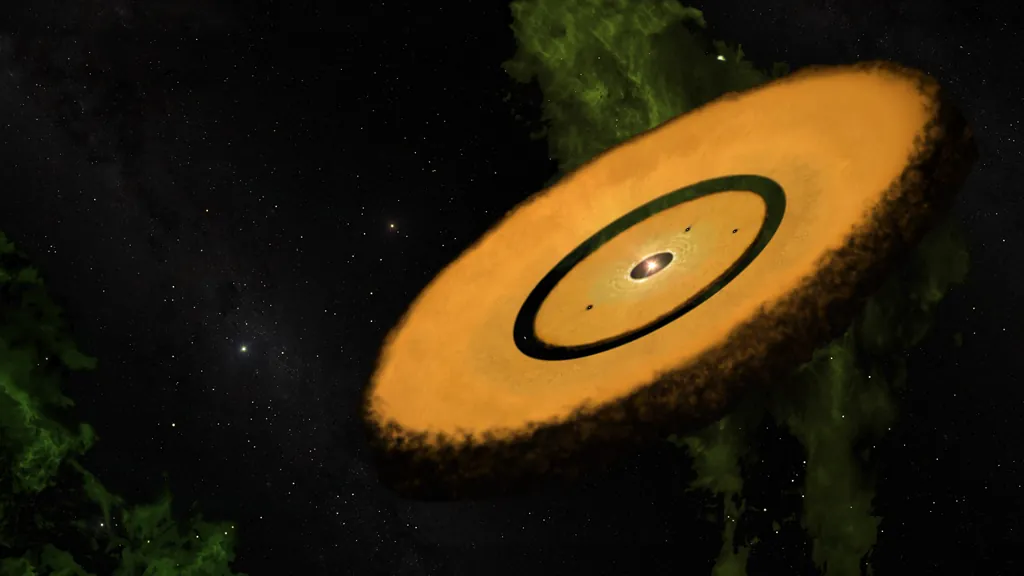
Scientists think planets, including the Earth, form inside giant disks of gas and dust that circle young stars. Observing these disks, called protoplanetary disks, teaches us how long it takes planets to form. Until recently astronomers thought that protoplanetary disks all faded away after just a few million years, telling us that gas giant planets, like Jupiter and Saturn, form quickly.
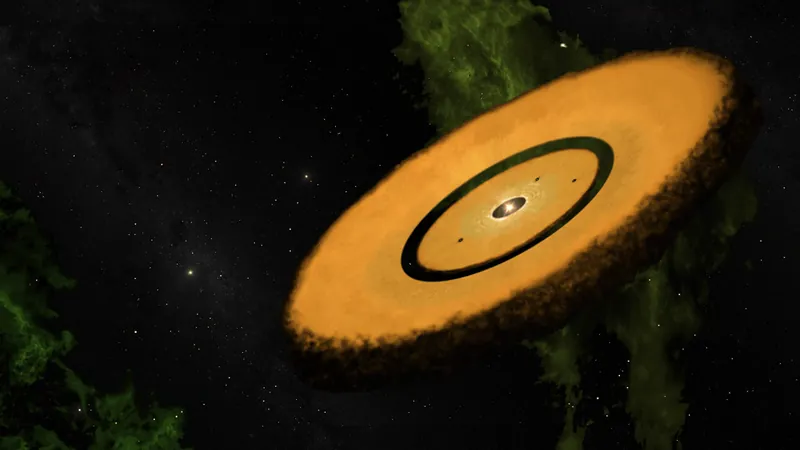
Citizen scientists at NASA’s Disk Detective project discovered the oldest protoplanetary disk back in 2016, raising the possibility that planet formation might take ten times as long around some stars! Now, a new paper from the project announces the discovery of four more such long-lived disks found by citizen scientists orbiting nearby stars. It’s a new class of disks, which the Disk Detective team is calling “Peter Pan” disks, since they won’t grow up. Seeing all these new examples of old disks shows us that it’s not a fluke; planet formation often seems to last much longer than we thought, at least around stars with lower masses. Each of these disks has retained the gas needed to form a Jupiter-like planet for 5-10 times as long as disks like this were thought to last. The paper, to appear in the Astrophysical Journal, includes citizen scientists Joseph R. Biggs, Milton K.D. Bosch, Katharina Doll, Hugo A. Durantini Luca, Alexandru Enachioaie, Joshua Hamilton, Jonathan Holden, and Michiharu Hyogo as co-authors.
The Disk Detective project will be re-launching later this year at https://www.diskdetective.org with new data from NASA’s WISE mission. To join the email list and participate in the relaunch, send an email to diskdetectives@gmail.com.
For a list of current NASA citizen science projects, visit citizenscience.
References and Resources:
The paper can be found online at https://arxiv.org/abs/2001.05030.
A blog post about the discovery can be found at https://blog.diskdetective.org/2020/01/17/our-new-paper-peter-pan-disks.
Share
Details
Last Updated
Jul 23, 2023
Related Terms
Explore More
3 min read
What’s Up: October 2026 Skywatching Tips from NASA
Article
22 hours ago
2 min read
Help Overlap Zoo Reveal Cosmic Dust
Article
2 days ago
2 min read
October’s Night Sky Notes: Spooky Stargazing
Article
4 days ago
Keep Exploring
Discover More Topics From NASA
James Webb Space Telescope
Webb is the premier observatory of the next decade, serving thousands of astronomers worldwide. It studies every phase in the…
Perseverance Rover
This rover and its aerial sidekick were assigned to study the geology of Mars and seek signs of ancient microbial…
Parker Solar Probe
On a mission to “touch the Sun,” NASA’s Parker Solar Probe became the first spacecraft to fly through the corona…
Juno
NASA’s Juno spacecraft entered orbit around Jupiter in 2016, the first explorer to peer below the planet’s dense clouds to…
Source: NASA Science