Tag: Stars
-
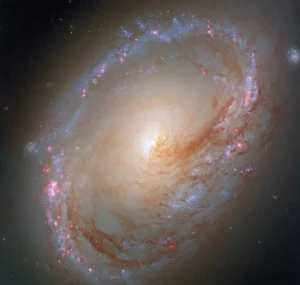
Hubble Homes in on Galaxy’s Star Formation
This NASA/ESA Hubble Space Telescope image features a galaxy whose asymmetric appearance may be the result of a galactic tug of war. Located 35 million light-years away in the constellation Leo, the spiral galaxy Messier 96 is the brightest of…
-
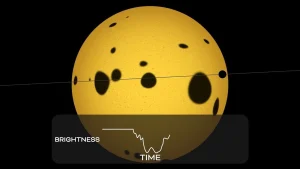
Astronomers Map Stellar ‘Polka Dots’ Using NASA’s TESS, Kepler
Scientists have devised a new method for mapping the spottiness of distant stars by using observations from NASA missions of orbiting planets crossing their stars’ faces. The model builds on a technique researchers have used for decades to study star…
-
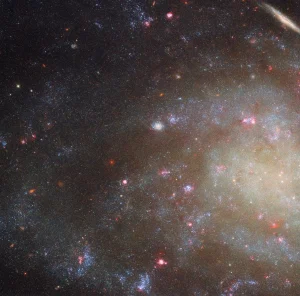
Hubble Examines Low Brightness, High Interest Galaxy
This NASA/ESA Hubble Space Telescope image zooms in on the feathery spiral arms of the galaxy NGC 45, which lies just 22 million light-years away in the constellation Cetus (the Whale). The portrait uses data drawn from two complementary observing…
-
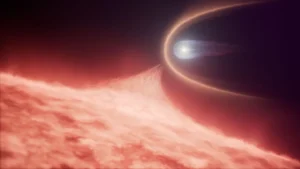
NASA’s Hubble Uncovers Rare White Dwarf Merger Remnant
An international team of astronomers has discovered a cosmic rarity: an ultra-massive white dwarf star resulting from a white dwarf merging with another star, rather than through the evolution of a single star. This discovery, made by NASA’s Hubble Space…
-
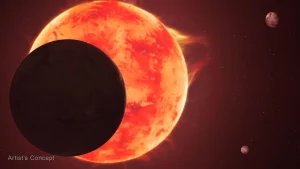
Webb Narrows Atmospheric Possibilities for Earth-sized Exoplanet TRAPPIST-1 d
The exoplanet TRAPPIST-1 d intrigues astronomers looking for possibly habitable worlds beyond our solar system because it is similar in size to Earth, rocky, and resides in an area around its star where liquid water on its surface is theoretically…
-
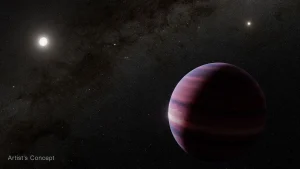
NASA’s Webb Finds New Evidence for Planet Around Closest Solar Twin
Astronomers using NASA’s James Webb Space Telescope have found strong evidence of a giant planet orbiting a star in the stellar system closest to our own Sun. At just 4 light-years away from Earth, the Alpha Centauri triple star system…
-
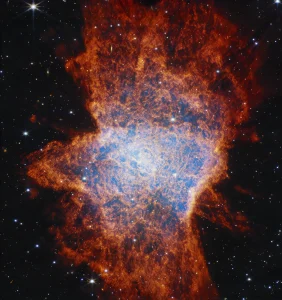
NASA’s Webb Traces Details of Complex Planetary Nebula
Since their discovery in the late 1700s, astronomers have learned that planetary nebulae, or the expanding shell of glowing gas expelled by a low-intermediate mass star late in its life, can come in all shapes and sizes. Most planetary nebula…
-
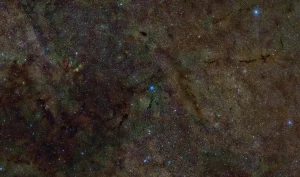
NASA, JAXA XRISM Satellite X-rays Milky Way’s Sulfur
An international team of scientists have provided an unprecedented tally of elemental sulfur spread between the stars using data from the Japan-led XRISM (X-ray Imaging and Spectroscopy Mission) spacecraft. Astronomers used X-rays from two binary star systems to detect sulfur…
-
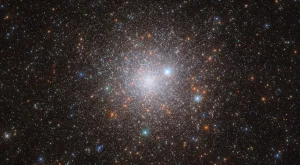
Hubble Digs Up Galactic Time Capsule
This NASA/ESA Hubble Space Telescope image features the field of stars that is NGC 1786. The globular cluster is located in the Large Magellanic Cloud (LMC), a small satellite galaxy of the Milky Way Galaxy that is approximately 160,000 light-years…
-
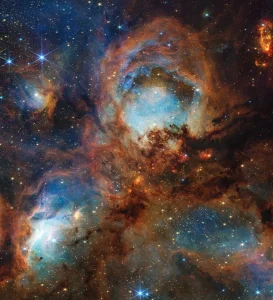
NASA’s Webb Scratches Beyond Surface of Cat’s Paw for 3rd Anniversary
It’s the cat’s meow! To celebrate its third year of revealing stunning scenes of the cosmos in infrared light, NASA’s James Webb Space Telescope has “clawed” back the thick, dusty layers of a section within the Cat’s Paw Nebula (NGC…