Tag: Stars
-
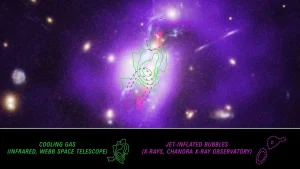
Webb Maps Full Picture of How Phoenix Galaxy Cluster Forms Stars
Discovery proves decades-old theory of galaxy feeding cycle. Researchers using NASA’s James Webb Space Telescope have finally solved the mystery of how a massive galaxy cluster is forming stars at such a high rate. The confirmation from Webb builds on…
-
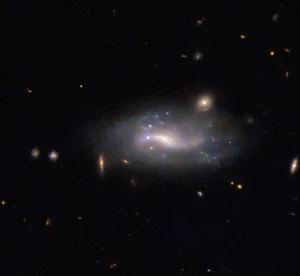
Hubble Goes Supernova Hunting
A supernova and its host galaxy are the subject of this NASA/ESA Hubble Space Telescope image. The galaxy in question is LEDA 132905 in the constellation Sculptor. Even at more than 400 million light-years away, LEDA 132905’s spiral structure is…
-
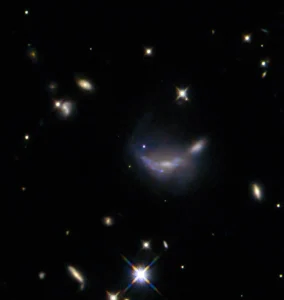
Hubble Spots a Supernova
The subject of this NASA/ESA Hubble Space Telescope image is a supernova-hosting galaxy located about 600 million light-years away in the constellation Gemini. Hubble captured this image roughly two months after a supernova named SN 2022aajn was discovered. The supernova…
-
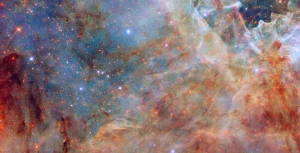
Hubble Studies the Tarantula Nebula’s Outskirts
This NASA/ESA Hubble Space Telescope image features a dusty yet sparkling scene from one of the Milky Way’s satellite galaxies, the Large Magellanic Cloud. The Large Magellanic Cloud is a dwarf galaxy situated about 160,000 light-years away in the constellations…
-
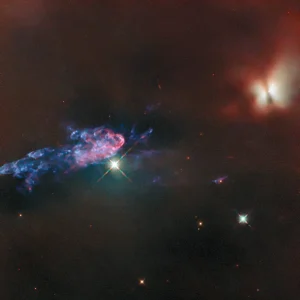
Hubble Captures Young Stars Changing Their Environments
This NASA/ESA Hubble Space Telescope image peers into the dusty recesses of the nearest massive star-forming region to Earth, the Orion Nebula (Messier 42, M42). Just 1,500 light-years away, the Orion Nebula is visible to the unaided eye below the…
-
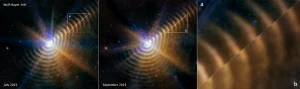
Webb Watches Carbon-Rich Dust Shells Form, Expand in Star System
Astronomers have long tried to track down how elements like carbon, which is essential for life, become widely distributed across the universe. Now, NASA’s James Webb Space Telescope has examined one ongoing source of carbon-rich dust in our own Milky…
-
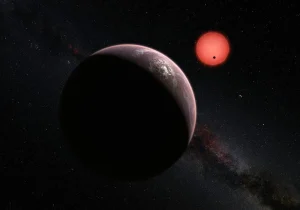
Promising Worlds Found Around Nearby Ultra-cool Dwarf Star
Astronomers using the TRAPPIST telescope at ESO’s La Silla Observatory have discovered three planets with sizes and temperatures similar to those of Venus and Earth, orbiting an ultra-cool dwarf star just 40 light-years from Earth.