Author: Andrea Gianopoulos
-
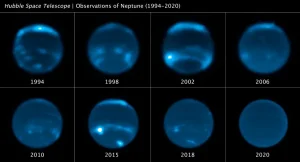
Neptune’s Disappearing Clouds Linked to the Solar Cycle
Astronomers have uncovered a link between Neptune’s shifting cloud abundance and the 11-year solar cycle, in which the waxing and waning of the Sun’s entangled magnetic fields drives solar activity. This discovery is based on three decades of Neptune observations…
-
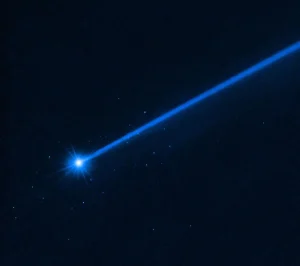
Hubble Sees Boulders Escaping from Asteroid Dimorphos
The popular 1954 rock song “Shake, Rattle and Roll,” could be the theme music for the Hubble Space Telescope‘s latest discovery about what is happening to the asteroid Dimorphos in the aftermath of NASA’s DART (Double Asteroid Redirection Test) experiment.…
-
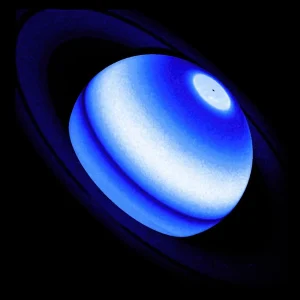
Hubble Finds Saturn’s Rings Heating Its Atmosphere
The secret has been hiding in plain view for 40 years. But it took the insight of a veteran astronomer to pull it all together within a year, using observations of Saturn from NASA’s Hubble Space Telescope and retired Cassini…
-
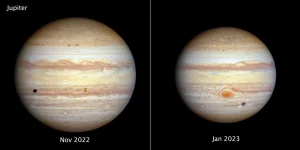
Hubble Monitors Changing Weather and Seasons at Jupiter and Uranus
Ever since its launch in 1990, NASA’s Hubble Space Telescope has been an interplanetary weather observer, keeping an eye on the largely gaseous outer planets and their ever-changing atmospheres. NASA spacecraft missions to the outer planets have given us a…
-
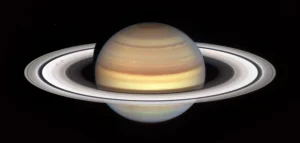
Hubble Captures the Start of a New Spoke Season at Saturn
New images of Saturn from NASA’s Hubble Space Telescope herald the start of the planet’s “spoke season” surrounding its equinox, when enigmatic features appear across its rings. The cause of the spokes, as well as their seasonal variability, has yet…
-
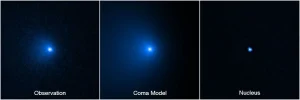
Hubble Confirms Largest Comet Nucleus Ever Seen
NASA’s Hubble Space Telescope has determined the size of the largest icy comet nucleus ever seen by astronomers. The estimated diameter is approximately 80 miles across, making it larger than the state of Rhode Island. The nucleus is about 50…
-
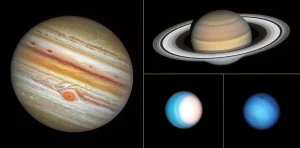
Hubble’s Grand Tour of the Outer Solar System
From its vantage point high above Earth’s atmosphere, NASA’s Hubble Space Telescope has completed this year’s grand tour of the outer solar system – returning crisp images that complement current and past observations from interplanetary spacecraft. This is the realm…
-
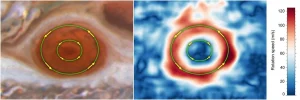
Hubble Shows Winds in Jupiter’s Great Red Spot Are Speeding Up
Like the speed of an advancing race car driver, the winds in the outermost “lane” of Jupiter’s Great Red Spot are accelerating – a discovery only made possible by NASA’s Hubble Space Telescope, which has monitored the planet for more…
-
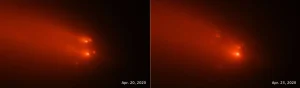
Comet ATLAS May Have Been a Blast from the Past
It’s suspected that about 5,000 years ago a comet swept within 23 million miles of the Sun, closer than the innermost planet Mercury. The comet might have been a spectacular sight to civilizations across Eurasia and North Africa at the…
-
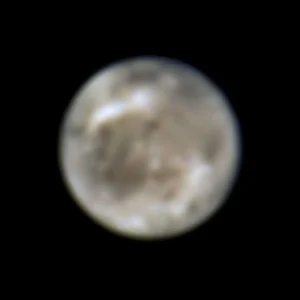
Hubble Finds First Evidence of Water Vapor at Jupiter’s Moon Ganymede
For the first time, astronomers have uncovered evidence of water vapor in the atmosphere of Jupiter’s moon Ganymede. This water vapor forms when ice from the moon’s surface sublimates — that is, turns from solid to gas. Scientists used new…