Tag: The Universe
-
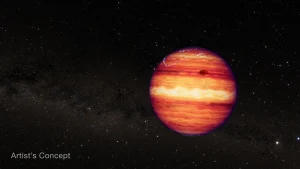
NASA’s Webb Exposes Complex Atmosphere of Starless Super-Jupiter
An international team of researchers has discovered that previously observed variations in brightness of a free-floating planetary-mass object known as SIMP 0136 must be the result of a complex combination of atmospheric factors, and cannot be explained by clouds alone.…
-
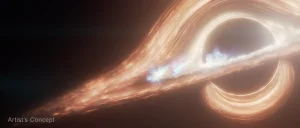
Webb Reveals Rapid-Fire Light Show From Milky Way’s Central Black Hole
The supermassive black hole at the center of the Milky Way appears to be having a party, complete with a disco ball-style light show. Using NASA’s James Webb Space Telescope, a team of astrophysicists has gained the longest, most detailed…
-
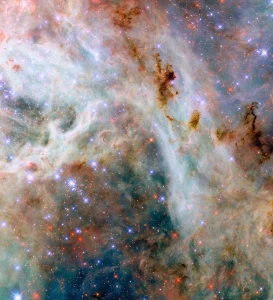
Hubble Captures a Cosmic Cloudscape
The universe is a dusty place, as this NASA/ESA Hubble Space Telescope image featuring swirling clouds of gas and dust near the Tarantula Nebula reveals. Located in the Large Magellanic Cloud about 160,000 light-years away in the constellations Dorado and…
-
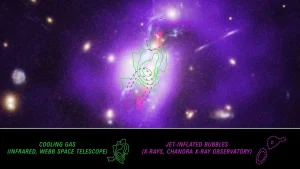
Webb Maps Full Picture of How Phoenix Galaxy Cluster Forms Stars
Discovery proves decades-old theory of galaxy feeding cycle. Researchers using NASA’s James Webb Space Telescope have finally solved the mystery of how a massive galaxy cluster is forming stars at such a high rate. The confirmation from Webb builds on…
-
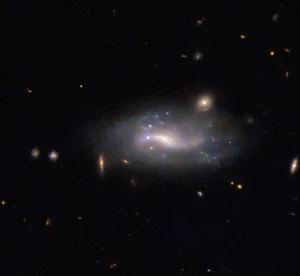
Hubble Goes Supernova Hunting
A supernova and its host galaxy are the subject of this NASA/ESA Hubble Space Telescope image. The galaxy in question is LEDA 132905 in the constellation Sculptor. Even at more than 400 million light-years away, LEDA 132905’s spiral structure is…
-
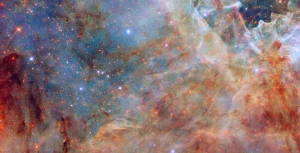
Hubble Studies the Tarantula Nebula’s Outskirts
This NASA/ESA Hubble Space Telescope image features a dusty yet sparkling scene from one of the Milky Way’s satellite galaxies, the Large Magellanic Cloud. The Large Magellanic Cloud is a dwarf galaxy situated about 160,000 light-years away in the constellations…
-
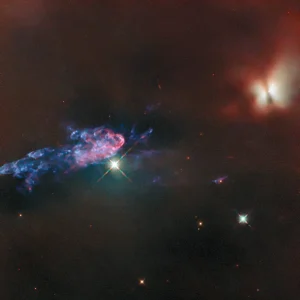
Hubble Captures Young Stars Changing Their Environments
This NASA/ESA Hubble Space Telescope image peers into the dusty recesses of the nearest massive star-forming region to Earth, the Orion Nebula (Messier 42, M42). Just 1,500 light-years away, the Orion Nebula is visible to the unaided eye below the…
-
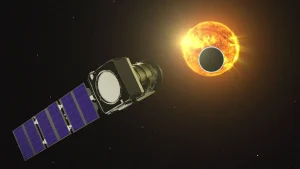
NASA’s Pandora Mission One Step Closer To Probing Alien Atmospheres
Pandora is a small satellite designed to characterize exoplanet atmospheres and their host stars.
-
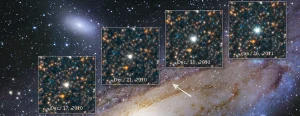
NASA Celebrates Edwin Hubble’s Discovery of a New Universe
For humans, the most important star in the universe is our Sun. The second-most important star is nestled inside the Andromeda galaxy. Don’t go looking for it — the flickering star is 2.2 million light-years away, and is 1/100,000th the…
-
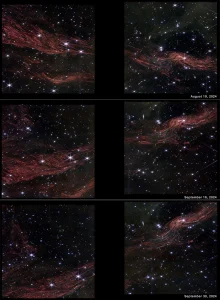
NASA’s Webb Reveals Intricate Layers of Interstellar Dust, Gas
Once upon a time, the core of a massive star collapsed, creating a shockwave that blasted outward, ripping the star apart as it went. When the shockwave reached the star’s surface, it punched through, generating a brief, intense pulse of…